For developers and engineers, the release of the Grok Build Plugin Marketplace marks a significant shift from manually stitching together disparate tools to deploying cohesive, pre-verified bundles directly from the terminal. xAI has launched this integrated catalog today, allowing makers to extend their coding agent’s capabilities without leaving the command line. Instead of wiring up individual integrations one by one, a single command now pulls a complete package of skills, agents, and hooks into the workflow.
What Is Inside a Plugin?
Grok Build serves as the terminal interface for xAI’s software engineering agent. The new marketplace adds a discovery layer to this environment. A plugin is essentially a directory that aggregates six distinct component types, each mapped to a specific file or folder. This structure allows one installation to extend the agent across multiple dimensions simultaneously.
| Component | Location | Purpose |
|---|---|---|
| Skills | skills/ | SKILL.md capabilities |
| Commands | commands/ | Slash commands |
| Agents | agents/ | Subagent definitions |
| Hooks | hooks/hooks.json | Lifecycle hooks |
| MCP servers | .mcp.json | MCP server configs |
| LSP servers | .lsp.json | Language server configs |
An optional plugin.json manifest can add metadata or override component paths. The entire catalog is hosted in the open repository xai-org/plugin-marketplace on GitHub, acting as an index that points to external sources for fetching.
Installation and Usage
Within Grok Build, users type /marketplace to browse the available catalog. Pressing i installs a selected plugin. Alternatively, developers can run commands directly from the shell using the following syntax:
grok plugin marketplace list
grok plugin install <name> --trust
The installation command includes a --trust flag, which is critical because plugins can execute code and access local data. This flag signifies that the user accepts the risk associated with the plugin’s permissions.
Launch Plugins and Use Cases
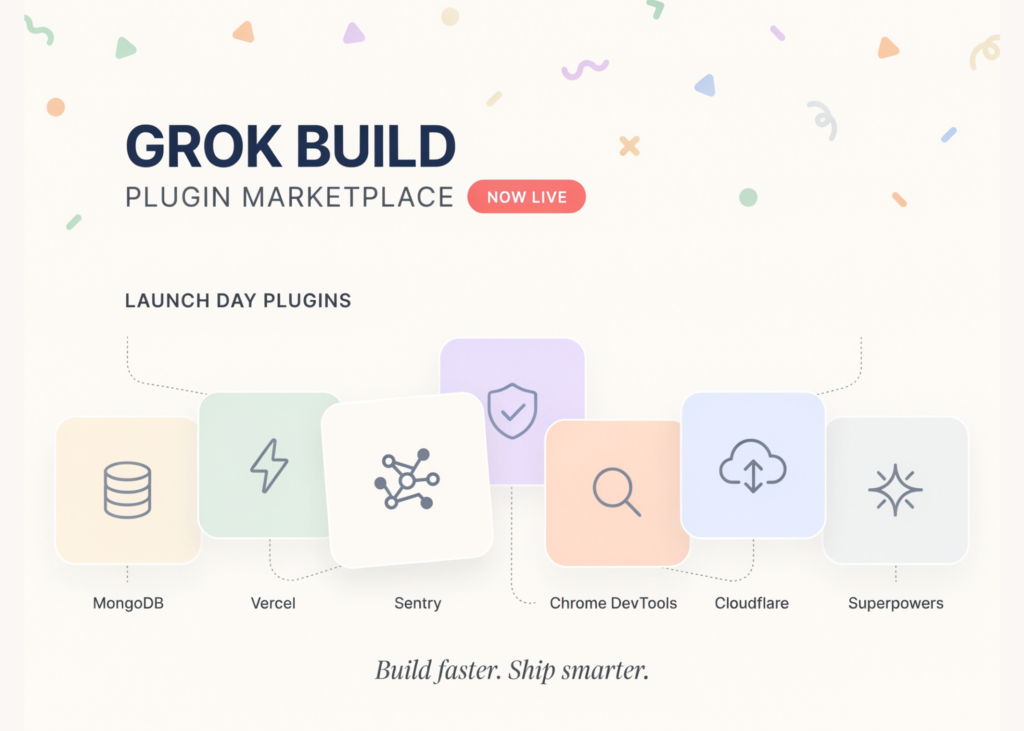
The marketplace launches with six plugins from partners across the tech stack, each targeting a specific workflow:
- MongoDB, explore data, manage collections, and optimize queries.
- Vercel, manage deployments, check build status, and configure domains.
- Sentry, analyze stack traces and debug production errors.
- Chrome DevTools, control a live browser, record performance traces, and inspect network requests.
- Cloudflare, skills for Workers, Durable Objects, and more.
- Superpowers, popular agent-driven workflows.
Consider a data scientist struggling with a sluggish MongoDB query; installing the MongoDB plugin allows them to ask the agent to optimise it instantly. Similarly, a frontend engineer can install Chrome DevTools to inspect network requests during a failing render, while an on-call engineer can deploy Sentry to triage a production stack trace.
The Security Model: SHA Pinning
Security is enforced through SHA pinning. Every remote plugin requires a full 40-character lowercase commit SHA. Grok Build re-verifies git rev-parse HEAD == sha immediately after cloning. Without this pin, a force-push or repository compromise could silently ship new code. The pin closes this vulnerability at install time. Additionally, the repo separates first-party plugins, maintained by xAI, from third-party ones. xAI states it does not author, control, or verify third-party plugins. They ship AS-IS, and you install at your own risk.
Publishing Your Own Plugin
The catalog is open to contributions. To add a plugin, edit .grok-plugin/marketplace.json and open a pull request. A remote entry looks like this:
{
  "name": "my-plugin",
  "description": "What the plugin does.",
  "category": "development",
  "source": {
    "source": "url",
    "url": "https://github.com/my-org/my-plugin.git",
    "sha": "0000000000000000000000000000000000000000"
  },
  "homepage": "https://github.com/my-org/my-plugin",
  "keywords": ["my-plugin"]
}
A generated plugin-index.json records each plugin’s components. You never hand-edit that file. Regenerate it with python3 scripts/generate-plugin-index.py. CI runs the same script with --check and fails on stale files.
How It Compares
The bundling concept echoes other agent tooling, such as Claude Code. The table below maps the marketplace against a raw MCP setup.
| Capability | Grok Build Marketplace | Raw MCP integration |
|---|---|---|
| Bundles skills, commands, agents, hooks, MCP, LSP | Yes | No, MCP servers only |
| In-terminal browse and install | Yes, via /marketplace | Manual config edits |
| Commit-SHA pin verification | Yes, enforced at install | Not built in |
| Open PR-based public catalog | Yes | Not applicable |
| Update mechanism | grok plugin update flow | Manual |
Note: the table reflects documented design, not a hands-on benchmark.
Strengths and Trade-offs
Strengths
- One install adds skills, commands, agents, hooks, MCP, and LSP support.
- SHA pinning gives a concrete supply-chain guard for executable code.
- The open catalog lowers the bar to contribute a plugin.
Trade-offs
- Grok Build access still sits behind paid SuperGrok and X Premium Plus tiers.
- The catalog is small at launch, with six plugins.
- xAI verifies the pin, not plugin behavior, so trust still falls on you.
Related articles