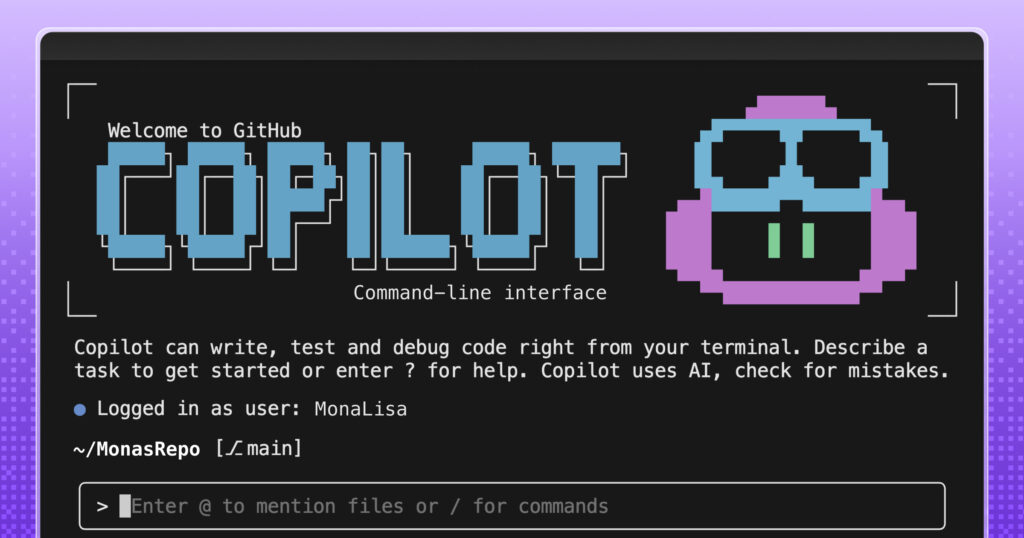
When an AI coding agent tries to understand your code, it often resorts to brute force: extracting JAR files to temporary folders, grepping through raw bytecode, and stitching together API signatures from text patterns. While resourceful, this approach is fundamentally limited and prone to error. To give GitHub Copilot CLI genuine code intelligence, you need to connect it to a language server.
The Language Server Protocol (LSP) is the standard that enables features like ‘go to definition’ and type resolution in editors like VS Code. It works just as effectively in the terminal. The new LSP Setup skill automates the installation and configuration of these servers for Copilot CLI, ensuring the agent receives precise, structured data about your codebase rather than relying on unreliable text search heuristics.
In this piece, we explain the mechanics behind the skill, detail the configuration format it generates, and show you how to enable support for any of the 14 languages currently available.
The problem: heuristic code understanding
Without an LSP server, the agent in GitHub Copilot CLI reverse-engineers API information through text search and binary extraction. For a Java project, that process looks messy and inefficient:
# Find the dependency JAR
find ~/.m2/repository -name "*httpclient*.jar"

# Extract it to a temp directory
mkdir /tmp/httpclient && cd /tmp/httpclient
jar xf ~/.m2/repository/org/apache/httpcomponents/httpclient/4.5.14/httpclient-4.5.14.jar

# Search extracted class files for a method
grep -r "execute" --include="*.class" .
For Python, the agent might cat files inside site-packages. For TypeScript, it walks node_modules. These text-based approaches work for simple cases, but they are performing pattern-matching over raw text rather than true semantic analysis. Consequently, they miss generics, function overloads, and transitive types, and they cannot interpret compiled bytecode at all. That is precisely the gap a language server closes.
An LSP server solves this structurally. When the agent sends a textDocument/definition request for a symbol, the language server returns the exact source location, fully resolved type, and signature instantly.
What is an agent skill?
An agent skill is a reusable instruction set that extends the capabilities of an AI coding agent. Skills are defined in Markdown files with YAML frontmatter and follow a standard structure: trigger descriptions, step-by-step workflows, reference data, and behavioral constraints.The LSP Setup skill uses this structure to guide the agent through a multi-step installation process, detecting the operating system, choosing the right package manager, writing valid configuration, and verifying the result.
How the LSP Setup skill works
When triggered, the skill executes a seven-step workflow:
1. Language selection
The agent uses ask_user with a set of choices to determine which language the user needs LSP support for. This drives all subsequent steps.
2. Operating system detection
The agent runs uname -s (or checks $env:OS / %OS% on Windows) to determine the target platform. Install commands vary by operating system. For example, brew install jdtls on macOS versus downloading from eclipse.org on Linux.
3. LSP server lookup
The skill includes a reference file (references/lsp-servers.md) with curated data for 14 languages: install commands per operating system, binary names, and ready-to-use config snippets. The agent reads this file and selects the matching entry.
4. Configuration scope
The agent asks whether the config should be:
- User-level:
~/.copilot/lsp-config.json-applies to all repositories - Repository-level:
lsp.jsonat the repository root or.github/lsp.json-scoped to a single project
Repository-level configuration takes precedence when both exist.
5. Installation
The agent runs the appropriate install command. For example:
# TypeScript on any OS
npm install -g typescript typescript-language-server

# Java on macOS
brew install jdtls

# Rust on any OS
rustup component add rust-analyzer
6. Configuration
The agent writes or merges an entry into the chosen config file. The format uses a lspServers object where each key is a server identifier:
{
  "lspServers": {
    "java": {
      "command": "jdtls",
      "args": [],
      "fileExtensions": {
        ".java": "java"
      }
    }
  }
}
Key rules the skill enforces:
commandmust be on$PATHor an absolute pathargstypically includes"--stdio"for standard I/O transport (some servers likejdtlshandle this internally)fileExtensionsmaps each extension (with leading dot) to a language identifier- Existing entries in the config file are preserved, the agent merges, never overwrites
7. Verification
The agent runs which <binary> (or where.exe on Windows) to confirm the server is accessible, then validates the config file is well-formed JSON.
Supported languages
The skill comes with a set of predefined language servers for several programming languages. If the coding agent faces one that is not mapped out already, it will search for an appropriate server and walk you through manual configuration.
What changes after setup
Once an LSP server is configured, the CLI agent can:
- Resolve types across dependencies, no more grepping through JAR files or
node_modules - Jump to definitions in third-party libraries, even when source isn’t checked into the repository
- Find all references to a symbol across the project
- Read hover documentation for any function, class, or type
This means the agent spends less time on tool calls and produces more accurate code on the first pass. For you, that’s less time waiting while the agent decompiles a JAR file or greps through node_modules to answer a question your IDE already knows, and fewer wrong turns built on a misread signature. The agent reasons about your code with the same structured understanding you get from go-to-definition in your editor, so you can hand it bigger, gnarlier tasks and trust the result.
Get started
- Download the skill: visit the Awesome Copilot LSP Setup skill page and click the Download button to get a ZIP file.
- Extract the ZIP to
~/.copilot/skills/by running:
unzip lsp-setup.zip -d ~/.copilot/skills/Key takeaways
- Move beyond heuristics: Without LSP, agents guess code structure by grepping raw text; with LSP, they receive precise, structured definitions.
- Automated setup: The LSP Setup skill handles OS detection, package manager selection, and config merging for 14 supported languages.
- Immediate accuracy: Connecting to language servers allows agents to resolve types across dependencies and jump to definitions in third-party libraries instantly.