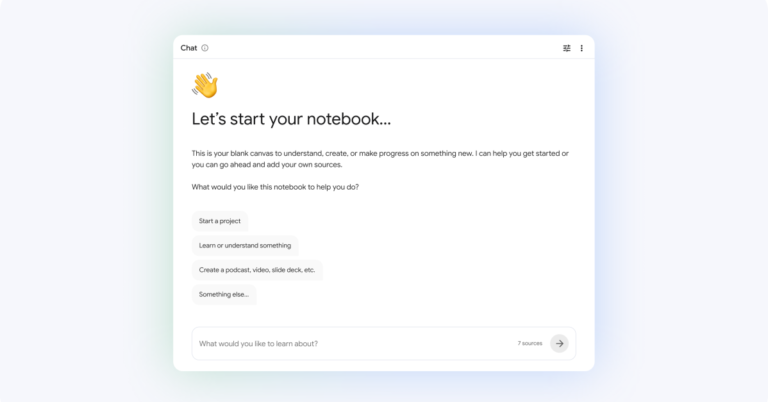
Google has significantly upgraded NotebookLM, transforming it from a simple research assistant into an autonomous system capable of executing code and managing complex workflows. The tool now operates on Gemini 3.5 Flash and integrates Google’s Antigravity coding engine, allocating a dedicated cloud computer to each notebook. This architecture enables the system to write, run, and debug code independently while employing agent-based features to handle multi-step research tasks. Internal testing indicates that this new configuration outperformed the previous version in approximately sixty-five percent of scenarios, marking a substantial shift in how the platform processes information.
This development matters because it fundamentally changes the relationship between human analysts and generative AI, moving the tool from a passive summariser to an active collaborator. By allowing notebooks to function as independent computational units, Google reduces the latency associated with external API calls and provides a more self-contained environment for data analysis. The ability to export findings directly into standard formats like PDF, Excel, and PowerPoint streamlines the workflow for professionals who require immediate, actionable insights without manual formatting. Furthermore, the zero-source feature expands the tool’s utility by automatically sourcing relevant material via Google Search, ensuring that research remains current and comprehensive without requiring manual input.
- NotebookLM now executes code and research autonomously using a dedicated cloud computer per notebook.
- Internal benchmarks show the updated system beats the previous version in about sixty-five percent of cases.
- Export options include PDF, Excel, PowerPoint, and images, with automatic source gathering via Google Search.