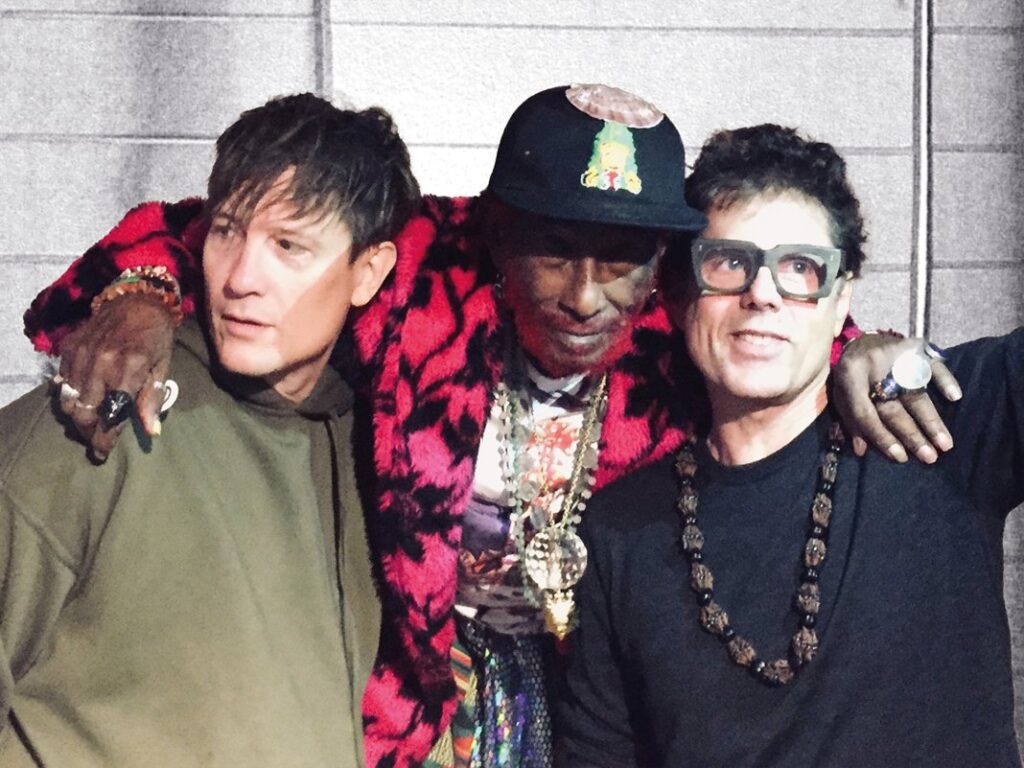
Lee “Scratch” Perry died in 2021 at the age of 85. His final album, Spatial, No Problem, was recorded in Berlin by Mouse on Mars.
The project brings together two very different worlds. Perry produced Bob Marley and The Clash. Mouse on Mars made electronic music with Iaora Tahiti in 1995. The contrast seems stark. Jan Werner, one half of the duo, admits the collaboration still does not make sense to them.
“I don’t know if he had ever heard of Mouse on Mars,” Werner says. He credits a mutual friend for the connection but remains unsure why Perry came to Germany.
Perry arrived from the US. Andi Toma, the other member of Mouse on Mars, picked him up. Perry ignored the agreed limit of three hours of work per day. He worked until the early hours of the morning. Perry said he would be ready again by 10 am the next day.
Werner notes Perry’s stamina. “He was basically more durable than us,” Werner says. “We were more 80 years old than Lee.”
The artist also broke his own rules. He started making music outside the reggae spectrum. Werner views Perry less as a genre icon and more as a conceptual artist.
“The guy was just a catalyst for everything that human beings can produce that isn’t shitty,” Werner says.
Spatial, No Problem is neither a reggae album nor an electronic album. Perry’s voice is the only constant. It delivers clear messages or floats around the edges. Song structure is not a concern. There are no verses, choruses, or much repetition. Some tracks sound like jams.
“Everything is a first take,” Werner says. The process was not about counting beats. It involved listening to existing recordings until a new idea emerged.
Horn choirs raise the temperature of Fire Dali as Perry shouts: “More fire! More fire!” Spatialee uses synth drips and drops to expand into ambient metallics. Economic Train mixes these qualities over loose, flailing drums.
Perry led a relaxed, explorative approach. He rarely gave specific directions. He encouraged everyone to listen instead of play.
“It was much more about stepping back and trying to understand what happened. Contributing something whenever it seemed appropriate,” Werner says.
Werner and Toma usually manipulate knobs to find a sound they deem worthy. Perry alleviated this pressure by reminding them to trust themselves.
“Control versus trust,” is how Werner describes it. He links trust to self-confidence. “You cannot trust when you’re unsure, unstable, or in panic mode. If you’re really rooted in yourself, you can let things happen. You’re open to the unexpected, and that is what Lee brought.”
Trust played out literally at times. When the studio was packed, Werner and Toma were handed cables without knowing the source. Tracing them back would disrupt the creativity in the moment.
“We had to listen to a lot of those recordings, figuring out what is actually on those tracks,” Werner says. One time, he followed a cable to a cigar box with rubber bands. It sounded like a bass instrument. He did not know what it was.
With this philosophy, Werner and Toma used many room mics to capture everything. Perry floated through the space. They needed to capture him wherever he went.
“Let’s have as many microphones as possible, because you don’t know if Lee will move around, or what’s going to happen. Let’s just see that we can record as much as possible,” Werner explains.
When Werner talks about Perry moving, he means more than staying in one room. Perry went to different rooms with different mics set up. Some had six. Others had one. The album is a stereo production, but it transcends the idea that controlling sound always goes wrong.
The only option to relinquish as much control as possible was to present the album in spatial audio. Ironically, many spatial productions incur a significant element of control. Mics are often placed in specific parts of the room to have an individual channel for the complete 9.1.4 configuration, which is a very common setup for Dolby Atmos spatial recordings.
However, in the case of this album, the title says it all: Spatial, No Problem. Perry said those exact words to Werner and Toma during the session. The spirit of his workflow allowed them immense freedom when they were processing the album into immersive audio.
“The room is basically the mixer. We don’t have to mix to stereo. We can just assign sounds to different locations,” Werner says.
If Lee was moving around the room, they could have his audio encircling the space. If he was lying down, they could accommodate that, too. Not to mention all the unknown sounds they dug up in the recordings. They had no idea what the source was, so they had no idea where it originated in the room. Where it fit in the 3D spatial rendering was completely at their behest. Sometimes they even lost track of the downbeat.
“You just have to jump into this vagueness, somehow. It’s all variables. None of that shit is really controllable,” Werner says. “If you do object-based mixing, you can try to comprehend all these aspects of sound, and do the narration, spatially.”
Lee “Scratch” Perry was the narrator of this album, one last time. But then again, maybe not.
“Sometimes, we wanted to get a clearer voice of Lee, so we sent him through some AI tools,” Werner says. “We asked Mireille if it was okay to do this. Because if you feed an AI the voice of whoever, it’s in the machine. And she was like, ‘Lee would have loved this. He wanted to be a machine.'”
What it means
This album shows how a producer can change a workflow by removing the need for precision. Instead of fixing every knob or placement, the team trusted the room and the unexpected sounds. The result is an immersive experience where the source of a sound matters less than where it sits in the space.