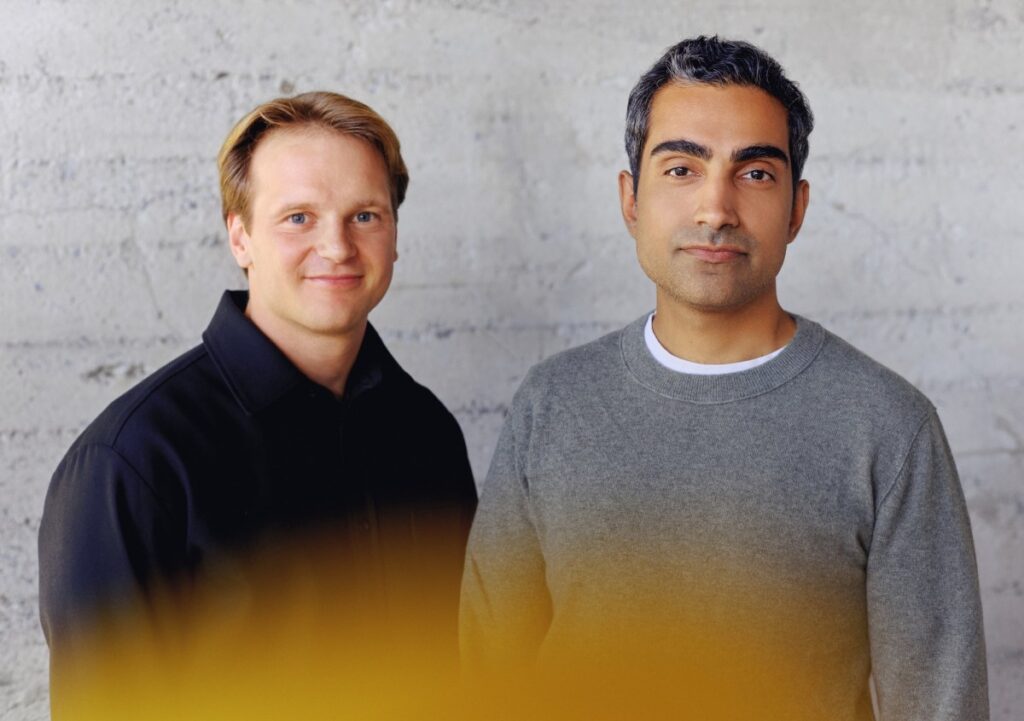
A day after Anthropic researcher Jacob Coxon left his role due to fears that artificial intelligence could end the decade by killing everyone, I met with founders Rune Kvist and Rajiv Dattani. They believe they have a method to stop rogue AI agents within businesses, or at least prevent them from causing harm.
“AI is becoming smarter at an increasingly rapid rate,” Kvist said. “The surprising thing about AI is that it becomes harder to adopt and harder to control as AI gets smarter, not easier.” Kvist was an early employee at Anthropic and is married to Dattani’s sister. Dattani previously served as chief operating officer for the AI safety research group METR.
The pair launched a company called Artificial Intelligence Underwriting Company, or AIUC. It aims to bring safety standards to enterprises and firms building AI models. Existing clients include Cursor, Lovable, Harvey, and ElevenLabs.
On Tuesday, AIUC announced a $40 million Series A round led by Ribbit Capital, with participation from First Harmonic. The company previously raised $15 million in a seed round from Nat Friedman through his fund NFDG, alongside Emergence, Terrain, and Anthropic co-founder Ben Mann. Total funding now stands at $55 million.
Investors were drawn to AIUC’s attempt to apply a familiar cybersecurity model to new AI risks. The firm has built a third-party audit and certification layer for AI agents.
“Banks, hospitals, governments and militaries no longer decline to deploy AI because a model isn’t smart enough,” Kvist said. “They decline because they’ve made commitments to their own customers about what a system will and won’t do, and nobody can currently guarantee that.”
Using the widely adopted cybersecurity standard SOC 2 as a guide, AIUC has developed a standard called AIUC-1 and a testing service to validate agents against it.
To build the standard, AIUC assembled a consortium of about 250 security and risk leaders who buy agents. “These are the people who we meet with on a monthly basis, and the question we ask them is: When you’re buying agents from someone, what would you look for? What are the questions you’d want to ask, and what would you want to see addressed?” Dattani told TechCrunch.
That feedback shapes the tests. The startup then runs an agent through a suite of some 5,000 tests to see how it behaves in scenarios involving jailbreaks, hallucinations, and data leaks. The results produce a roughly 100-page report detailing where an agent performs safely and reliably, and where it does not. AIUC uses AI agents to run the tests and AI to analyze the data. Humans, however, verify the final audit, Kvist said.
If this sounds a bit familiar, it is. Dattani’s former employer METR, where he was COO from 2024 to 2025 and remains a board member, does similar testing for the frontier labs. Its work until recently focused mostly on performance, such as whether agents can reliably complete tasks. METR was one of the independent research organisations OpenAI used to investigate its Hugging Face incident.
Anthropic CEO Dario Amodei has also recently called for the AI industry to pace frontier development, citing a rapid increase in bad-behaviour incidents. In his post, Amodei floated the idea of requiring frontier labs to use embedded third-party evaluators to observe and verify safety, and named METR as one possibility.
While AIUC is not proposing to embed itself at customer sites, the overall idea is similar: give enterprises an independent assessment of how safe their AI agents are. “Here’s where it passes and where you can trust it. And here’s where there’s concerns. You should be aware of those references before you make the decision to buy,” Dattani said.
What it means
For companies buying AI tools, the change is a shift from trusting marketing claims to trusting independent reports. Enterprises will receive a detailed audit showing exactly where a system fails before they deploy it. This moves safety verification from a theoretical promise by the vendor to a concrete document a buyer can review.