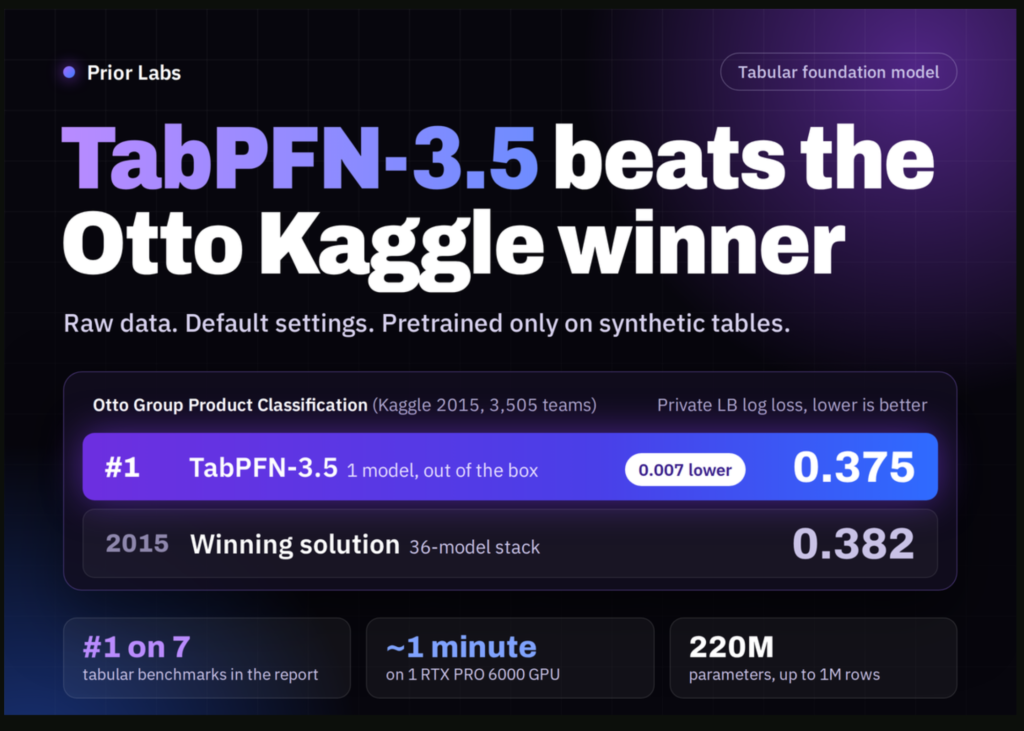
Prior Labs has released TabPFN-3.5, a new tabular foundation model that achieves first place across seven benchmarks and beats the winning solution of the 2015 Otto Group Kaggle competition using default settings.
The model predicts on a table in a single forward pass. It requires no per-dataset training or tuning. Prior Labs reports the system took first place on TabArena, BeyondArena, STRABLE, MulTaBench, RelArena-α, TALENT, and ScoringBench. A separate demonstration shows it beating the winning solution of a famous 2015 Kaggle competition.
Deployable?
Yes, with a license. Open weights run locally for research, evaluation and Kaggle, but production use needs Prior Labs’ API or a commercial license.
The Otto Result
The Otto Group Product Classification Challenge ran on Kaggle in 2015. It drew 3,505 teams competing for $10,000. Entrants sorted products into 9 categories using 93 obfuscated count features. Submissions were scored with multi-class log loss, where lower is better.
The winning solution came from Gilberto Titericz and Stanislav Semenov. Both have held the world #1 Kaggle grandmaster ranking. Their entry was a multi-layer stack of 36 models built on hand-crafted features.
Nick Erickson, co-creator of AutoGluon and an AI researcher at Prior Labs, has chased that score for years. According to Erickson, AutoGluon placed rank 23 in its 2020 paper. AutoGluon 1.0 reached rank 14 in 2023, and AutoGluon 1.6 reached rank 9 in August 2026.
The final stretch was the hardest. Moving from rank 50 to rank 10 cut log loss from 0.41 to 0.40. Reaching the winning 0.382 from rank 10 took a further 0.018, nearly double.
TabPFN-3.5 scores 0.375 on the private leaderboard. Erickson says it ran on raw data with default settings. It took about a minute on an RTX PRO 6000 GPU. The model was pretrained only on synthetic data and never saw Otto or any Kaggle dataset. A reproducible Kaggle notebook is public.
Benchmark Results
The technical report lists first place on TabArena, BeyondArena, STRABLE, MulTaBench, RelArena-α, TALENT and ScoringBench. The top entry is not always the base model. TabPFN-3.5-Thinking holds first on TabArena, BeyondArena, STRABLE and MulTaBench. An internal TabPFN-Rel harness preview takes RelArena-α.
On TabArena, a living benchmark of 51 datasets, Thinking reaches 1910 Elo. The base model scores 1866, ahead of TabFM+ at 1823. Prior Labs says the base model beats AutoGluon 1.6 extreme by 130 Elo in a fifth of the time.
BeyondArena spans 142 datasets with grouped, temporal, wide, text-rich and high-cardinality data. TabPFN-3.5 finishes about 150 Elo points ahead of the previous overall leader. Tuned and ensembled MLPs still lead on its grouped, temporal and large-data slices.
What Changed Under the Hood
- Wider model: The in-context transformer grows from 512 to 1024 dimensions. Parameters rise to 220M, up from 53M for TabPFN-3 classification.
- 1 checkpoint: A single multitask checkpoint now covers classification and regression.
- New cell encodings: Values pass through learned Fourier features and in-context ECDF ranks. The ranks do not change under monotonic transforms such as log scaling.
- Simpler preprocessing: Quantile transforms, robust scaling and SVD features are removed.
- Scale: Up to 1M rows, with 6,000 features recommended and 20,000 supported.
- Tuned prior: Synthetic data now emphasizes high-cardinality, wide and grouped tables.
The KV cache stays roughly the same size as TabPFN-3, despite about 4x more parameters. Cached single-row predictions match TabPFN-3 speed. On large training sets, however, the base model runs up to 2x slower than TabPFN-3.
The Model Family
- TabPFN-3.5: Open weights, 220M parameters, 8 estimators by default.
- TabPFN-3.5-Fast (alpha): Open weights, 84M parameters, up to 6x faster than the base model.
- TabPFN-3.5-Plus: API and enterprise only. Adds native text handling and FP8 attention.
- TabPFN-3.5-Thinking: Spends extra inference compute, with no LLMs, real data or search. Runs up to 12x faster than TabPFN-3-Thinking.
What it means
For data scientists working with tabular data, this update removes the need for manual feature engineering and complex preprocessing pipelines. The model accepts raw data directly. A user can now deploy a system that previously required expert tuning, relying instead on a single, general-purpose model that adapts to the specific dataset at inference time. This lowers the barrier to entry for high-performance tabular prediction while maintaining the ability to handle larger, more complex datasets than previous versions.