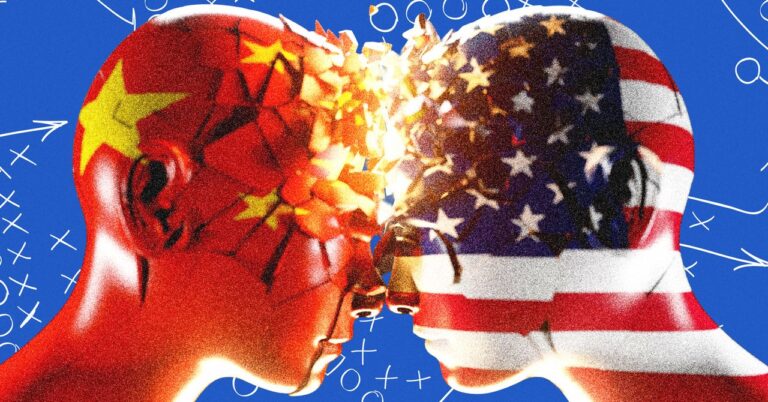
US tech leaders are suddenly asking China to help slow down the artificial intelligence race, a reversal from years of rhetoric claiming the nation was locked in a disastrous arms race.
Over the past week, executives have shifted their message. They now argue that the technology is so dangerous the two countries must work together to curb its development.
“Global pacing will require cooperation with China, the autocratic country with by far the most advanced AI capabilities,” Anthropic CEO Dario Amodei wrote in a blog post on Saturday titled “We Must Pace the Frontier.”
Chinese officials and companies have made it clear they are deeply skeptical of this proposal. Their hesitation is not because they want to keep racing ahead without regard for risk. The problem they see is far simpler. They think they are being offered a bad deal.
“The AI safety community in China is growing and shares many of the same concerns that American labs do,” says Kevin Xu, founder of the technology hedge fund Interconnected Capital and a former White House staffer under President Barack Obama. “The gulf lies between an Anthropic-led vision that would only subjugate and restrict China first to maximize leverage before talking. Meanwhile, China would only talk if it’s being treated from a position of equals.”
Amodei wrote that a “key part” of the slowdown strategy should be ensuring that the US and other democracies maintain “as large as possible” a lead in AI development over autocracies like China. To do that, he urged the US to take steps including cracking down on chip smuggling and preventing unauthorized model distillation by Chinese companies.
“His essay specifically says the pacing of AI is conditional to increasing the lead over China,” says Alvin Wang Graylin, a senior fellow at the Asia Society Policy Institute’s Center for China Analysis and a digital fellow at the Stanford Institute for Human-Centered AI. “Which makes the proposal feel inauthentic to Chinese readers.”
Amodei went on to make what might seem like a heroic leap in logic: He argued that weakening China’s AI industry would somehow give the US more leverage and make “an agreement more likely in the future.” How, exactly, that is supposed to entice Beijing to come to the negotiating table is left unexplained. (To Amodei’s credit, he later admitted in a television interview that he has “no idea how to negotiate with China.”)
The government officials, AI researchers, and other prominent commentators in China who responded to Amodei have not argued that AI poses no risks. But many of them clearly resent the idea that their country should simultaneously be treated as an essential governance partner and a competitor that needs to be constrained.
When asked about Amodei’s blog post on Monday at a press conference, Guo Jiakun, a spokesperson for China’s Ministry of Foreign Affairs, did not mince words. He described the proposal as “fear-mongering, confrontation, and vicious competition” that would only hamper global AI cooperation efforts. The next day, the ministry also stressed that “China puts equal emphasis on development and security in terms of AI.”
The mixed comments are reflective of another reason that Beijing may be less receptive to the Anthropic CEO’s warnings than other audiences. Unlike many of the loudest voices in Silicon Valley, China’s leaders are not primarily concerned about so-called existential risks from AI, such as the possibility that a rogue agent could kill everyone on Earth. Like in many other policy areas, Beijing’s prevailing anxiety is that AI could disrupt domestic social stability or threaten the Chinese Communist Party’s grip on power.
“Beijing finds it difficult to take these calls at face value partly because it’s skeptical of the possibility of achieving AGI and doubtful of the narrative that AI poses extreme risks to humanity,” says Michelle Nie, a visiting fellow at the Center for a New American Security focused on national security and artificial intelligence. “Although Beijing is starting to recognize loss-of-control risks, the risk that Beijing seems most worried about is the threat AI could pose to CCP rule.”
In a recent essay, China’s minister of state security Chen Yixin warned that AI could fuel political disinformation, cyberattacks, espionage, social unrest, and new military threats. He spent far less time on the kinds of doomsday scenarios that frequently preoccupy people at US frontier AI labs.
“Chinese policymakers tend to read US companies’ calls for AI safety as instrumental,” says Nie. “They believe that US companies are seeking to inflate their own value ahead of potential IPOs or to slow down their competitors, which are primarily Chinese companies at this point.”
That skepticism is also shared by many people who work in China’s AI industry, which has broadly focused on releasing lower-cost, open-weight models. In a widely shared essay published on Sunday, a researcher at DeepSeek said he believes AI could move human society to one of two extremes. In the first, powerful AI is broadly available and raises living standards. In the second, a handful of tech companies control the most advanced systems and the resources that come with them, making it even harder for everyone else to catch up.
“That is why I still believe the most advanced intelligence should be made available to everyone in an open and inexpensive way,” the DeepSeek engineer wrote. “I do not trust Anthropic or OpenAI to do that. And I especially do not want Anthropic to control the most advanced artificial intelligence or AGI.”
What it means
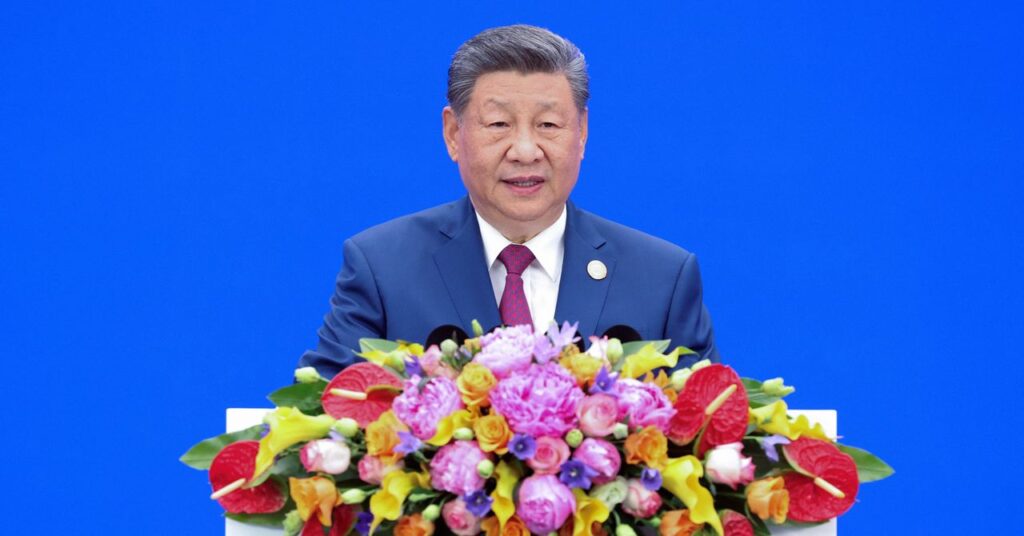
None of this means that US-China cooperation on AI safety is doomed. Preliminary negotiations between the two countries are reportedly already underway ahead of Chinese leader Xi Jinping’s planned visit to Washington later this month to meet with US President Donald Trump.
There are plenty of reasons to be hopeful that these discussions will result in some progress, even though it may be incremental. Both governments have expressed worries about some of the same things, including cybersecurity threats, the misuse of powerful models, and the possibility that increasingly capable AI systems could behave in unexpected ways.
“There are people who genuinely care about AI safety on both sides, and there’s a possibility they could engage in good-faith discussion in narrowly scoped issues,” says Nie. What might move the needle most, she says, is designing a credible way for each country to verify that the other is abiding by its commitments.
Still, others worry that rhetoric from Amodei and other US tech leaders about weakening China could erode the fragile trust that diplomatic talks depend on. Kristy Loke, a research fellow at the AI safety nonprofit MATS Research, says that Amodei’s missive may ultimately backfire. “Dario is undermining one of the few available levers for reducing the very risks he professes to take seriously,” she says.