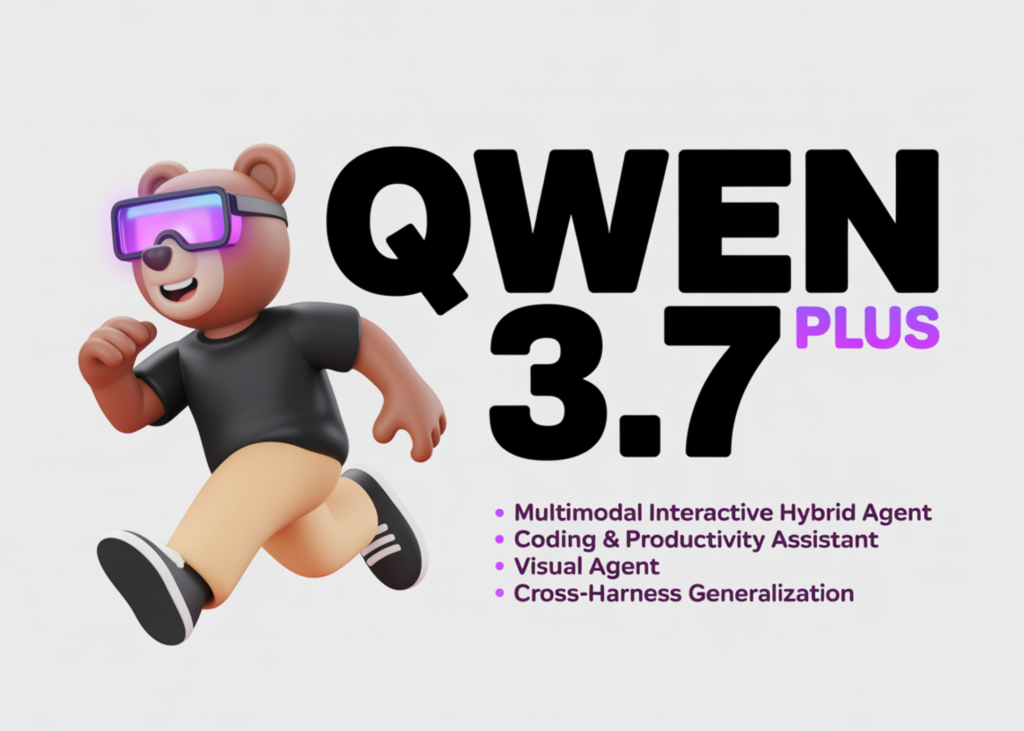
For developers and creative builders, Alibaba’s latest release shifts the focus from simple chatbots to autonomous agents. The new Qwen3.7-Plus model is now live on the Bailian platform (known internationally as Model Studio). It brings multimodal capabilities to the table, allowing systems to interpret images and video alongside text prompts to plan and execute complex tasks.
The Multimodal Shift
Qwen3.7-Plus is designed as a multimodal large language model. It processes visual inputs and written instructions together. It is important to distinguish this from its sibling, Qwen3.7-Max, which remains text-only. Furthermore, this is a model for understanding media, not creating it. Alibaba separates its image and video generation tasks into distinct model families, leaving this release focused on analysis and reasoning.
The team positions this as a step toward multimodal hybrid agent technology. An agent is defined by its ability to plan and act across multiple steps. Building on its visual foundation, Qwen3.7-Plus introduces five core capabilities that move the model from answering questions to performing work:
- Deep reasoning: Breaking down complex problems step by step.
- Self-programming: Writing and revising its own code.
- Tool invocation: Calling external functions or APIs to gather data.
- Verification and testing: Running outputs and checking results for accuracy.
- Autonomous iteration: Looping through tasks until the goal is fully achieved.
Collectively, these features describe a model engineered to act, not just respond.
Performance in the Vision Arena
Qwen3.7-Plus serves as the multimodal counterpart to the 3.7 family. Early benchmarks in the Vision Arena show measurable results. In the overall leaderboard, the preview version ranked #16. This performance placed Alibaba as the #5 laboratory in the field. Note that the model’s rank and the lab’s aggregate rank are separate figures.
The Vision Arena is a neutral leaderboard run by LM Arena, where users vote on image-understanding answers in blind matchups. While the #16 spot trails the top US labs, it signals strong competitiveness for image-heavy workloads. These capabilities are particularly relevant for scaling OCR, reading charts, or analysing video frames.
The text-only Qwen3.7-Max anchors the generation’s reasoning power. It scored 56.6 on the Artificial Analysis Intelligence Index, marking the highest placement for any Chinese model at release.
Building the Agentic Loop
The defining shift in the Qwen3.7 series is its focus on agency. Alibaba is positioning these models for long-running, multi-step tasks. The Bailian platform supports this with two critical additions.
First is an Agentic Reinforcement Learning (RL) mechanism. This uses real-world execution feedback to refine model accuracy over time. Second is a suite of built-in safety guardrails. These ensure autonomous tools operate within preset limits, which is vital when an agent is running commands or editing files.
Key takeaways
- Agentic backend: Qwen3.7-Plus provides a vision-capable agent backend via a single API, suitable for workloads mixing images, video, and tool use.
- Understanding, not generation: The model excels at interpreting media for decision-making; image and video creation remain separate proprietary capabilities.
- Verified performance: The #16 ranking in the Vision Arena and the top Chinese score on the Artificial Analysis Intelligence Index demonstrate competitive promise, though validation on proprietary data is recommended.
- Platform safety: The Bailian host includes specific reinforcement learning and guardrail features to manage the risks associated with autonomous tool execution.