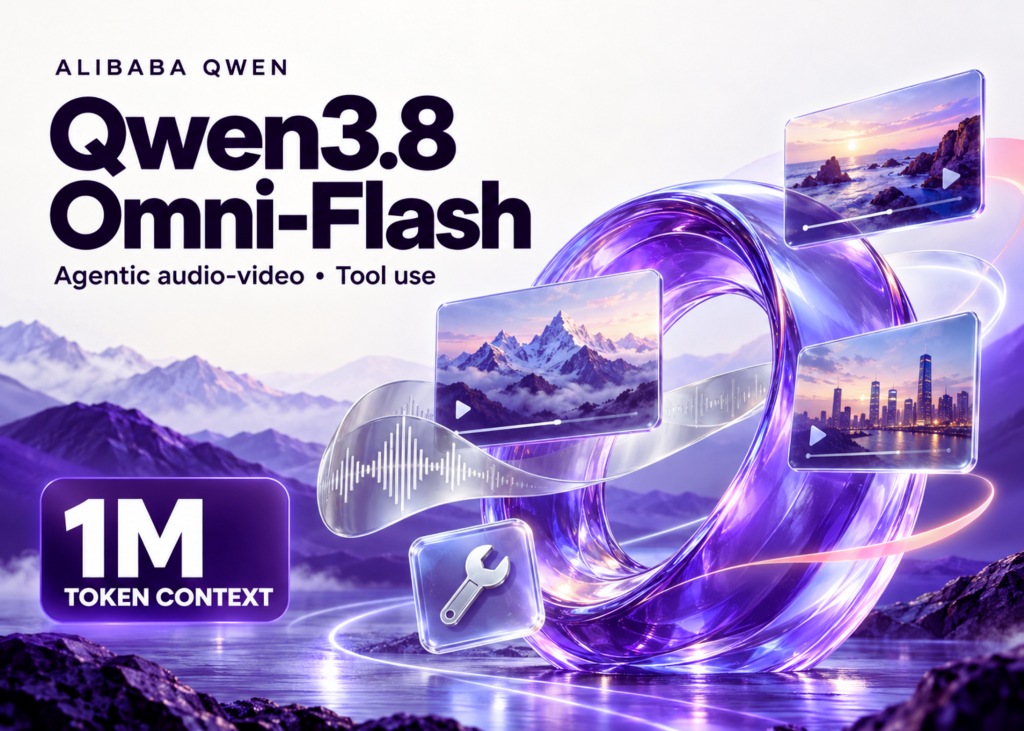
Alibaba’s Qwen team has launched Qwen3.8-Omni-Flash, a new model designed to handle text, images, audio, and video within a single interface. The system processes these inputs and returns text, combining understanding, reasoning, and tool execution into one workflow. It is available immediately via API on QwenCloud, Alibaba Cloud Model Studio, and Qwen Studio. No open weights were released at launch, meaning developers cannot self-host the model.
Architecture and limits
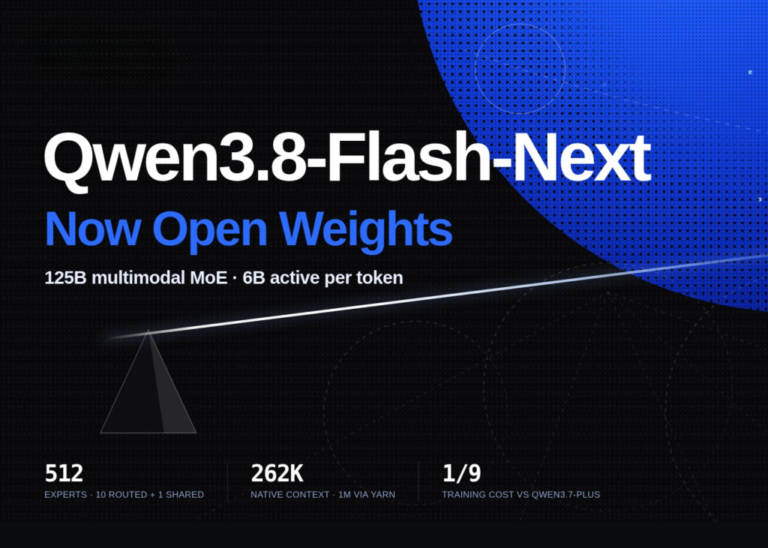
The model builds on the Qwen3.8-Flash-Next architecture, which received open weights in August 2026. The context window accepts 1M tokens, with QwenCloud specifying a maximum input of 991K and a maximum output of 131K. Reasoning capacity extends to 262K tokens.
Output is strictly text. If speech generation is required, documentation directs users to the Qwen3.5-Omni model. Thinking is enabled by default with the reasoning_effort parameter set to xhigh. Setting this value to none turns off the reasoning process.
The API supports both DashScope and OpenAI protocols. It works with Chat Completions and the Responses API. Supported features include function calling, web search, structured outputs, context caching, and batch calls.
Agentic perception for long video
Standard video models typically scan a file from start to finish, even when the answer appears in a specific section. The Qwen research team describes a different approach. The agent starts with the question and decides which parts to watch and hear. It then gathers evidence over several rounds, moving from coarse to fine detail. Compute and tokens are directed only at the segments that matter.
Testing on OmniVideoBench shows accuracy rising from 63.4 to 67.8. Token usage drops from 145,736 to 79,117, a reduction of about 45.7%.
Reported benchmarks
All figures come from Qwen. Independent results were not available at publication.
- Across 29 evaluations, the average score improves by more than 25% over Qwen3.5-Omni-Plus.
- WildClawBench-MM improves by 36.5 points. AgenticVBench improves by 22.3 points.
- UniClawBench reaches 69.6.
- LongAudioSpan gains 8.3 points. OmniVideoBench gains 9.6 points.
- OmniCap-IF CSR and ISR improve by 8.5 and 14.1 points.
The research team states that audio-visual performance is close to Gemini 3.8 Flash. It also claims overall audio performance exceeds Gemini 3.8 Flash. An X post summarises the agent gains as +19.5 points on average across WildClawBench-MM and UniClawBench.
🚀 Meet Qwen3.8-Omni-Flash, Qwen’s first omni-modal model built around agentic capabilities!
Native audio-video understanding, reasoning, and tool use come together in one model: understand the content, plan the task, execute with tools, and deliver the result.
Highlights: 🥳
-… pic.twitter.com/iJypeohw7y— Qwen (@Alibaba_Qwen) September 18, 2026
Pricing and input limits
QwenCloud lists pricing at $0.15 per 1M input tokens and $0.47 per 1M output tokens. Implicit cache hits cost $0.016 per 1M tokens.
Documentation reports large cost cuts against Qwen3.5-Omni-Plus. Audio input costs over 98% less per hour. Audio-visual input costs over 93% less per hour. An X post puts the video input reduction at about 89%.
Key limits from the Model Studio docs:
- Video files up to 2 hours and 2 GB by URL.
- Audio files up to 3 hours.
- Audio input in 113 languages and dialects.
- Stable results with video sampled at up to 15 fps.
- Two-channel stereo and four-channel FOA spatial audio through
use_multichannel. - Availability in 6 regions: Beijing, Singapore, Hong Kong, Tokyo, Frankfurt, and Virginia.
Calling it takes a few lines with the OpenAI SDK:
import os
from openai import OpenAI

client = OpenAI(
    api_key=os.environ["DASHSCOPE_API_KEY"],
    base_url=os.environ["DASHSCOPE_BASE_URL"],
)
completion = client.chat.completions.create(
    model="qwen3.8-omni-flash",
    messages=[{"role": "user", "content": [
        {"type": "video_url", "video_url": {"url": os.environ["VIDEO_URL"]}},
        {"type": "text", "text": "List the key moments with timestamps."},
    ]}],
    modalities=["text"],
    stream=True,
)
for chunk in completion:
    if chunk.choices and chunk.choices[0].delta.content:
        print(chunk.choices[0].delta.content, end="")
Open-source tooling
The model returns text, so tools do the media work. The Qwen team is open-sourcing two projects to support this.
Qwen-MM-Plugins is live under Apache-2.0. Its tagline is ‘Make any agent harness multimodal-native.’ Each capability installs as a Skill plus an optional MCP server. The guided installer supports Claude Code, CodeBuddy, Codex, Qoder, OpenClaw, Qwen Code, and Gemini CLI.
The Omni capabilities map to the launch demos:
omni-memorybuilds an audio-visual memory of a long video.omni-video2noteconverts a tutorial video into an illustrated PDF.omni-chatcutcovers Music-to-MV, movie commentary, and speaker-preserving video translation.
A core plugin lets the main model read local images and video frames natively. The README notes one current gap. Most harnesses cannot feed audio to the main model natively yet. Audio is routed through the API for now.
Interactive explainer
What it means
For the people building applications, the shift is from a single model that tries to do everything to a model that understands context and delegates to tools. Developers can feed long videos or complex audio streams without worrying about token limits or scanning inefficiencies. The code examples show standard integration, but the underlying capability to plan tasks and use external functions changes how complex media workflows are structured.
Related articles