Alibaba launches Qwen3.8-Flash-Next with a focus on reducing training expenses
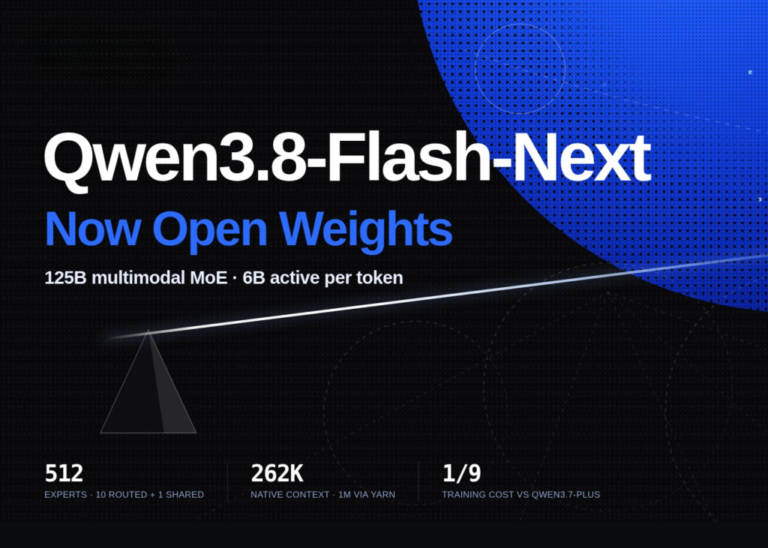
The Qwen team at Alibaba has released Qwen3.8-Flash-Next, a multimodal mixture-of-experts model that acts as an architecture preview for Qwen4. The goal is to match the performance of much larger models while keeping training costs down to a fraction of the usual price.
This version contains 125 billion parameters in total but only activates 6 billion for every token processed. It includes 51 billion parameters within a new N-gram embedding layer. This layer stores common word groups as standalone entries in a phrase dictionary. It can sit in regular system RAM rather than on the GPU at relatively low additional cost.
The model supports a context window of 262,144 tokens and can scale to one million tokens using YaRN. The technical report is available on GitHub, and weights are available on Hugging Face and ModelScope. The production version ships as Qwen3.8-Flash through QwenCloud. Pricing is set at $0.16 per million input tokens and $0.47 per million output tokens. The API should go live shortly.
One-ninth the training cost, better results
Qwen3.8-Flash-Next delivers better results than Qwen3.7-Plus at roughly one-ninth the training cost. The biggest gains appear in coding and office tasks. Qwen3.7-Plus has 397 billion parameters with 17 billion activated per token, nearly three times Flash-Next’s active count.
Alibaba’s published benchmarks pit the model against DeepSeek-V4-Flash, which has 284 billion parameters and 13 billion activated, and Anthropic’s Claude Opus 4.6 (Max). Despite both being much larger or more expensive, Flash-Next leads in the majority of tested tasks.
The model seems optimized for agentic coding benchmarks, which require an AI to independently find and fix bugs in real software projects. Flash-Next scored 58.7 on DeepSWE and 62.5 on SWE-bench Pro, beating both DeepSeek-V4-Flash and Claude Opus 4.6.
The gap on office and productivity tasks is even wider. Flash-Next hit 73.9 on CoWorkBench while DeepSeek-V4-Flash managed just 45.1. On JobBench, a test for professional workflows, Flash-Next scored 55.7, nearly double Qwen3.7-Plus at 27.6. On scientific reasoning (GPQA Diamond: 91.7) and competitive programming (LiveCodeBench v6: 91.9), the models are closely matched.
| Model | Qwen3.8-Flash-Next | Qwen3.8-27B | Qwen3.7-Plus | DeepSeek-V4-Flash-0731 | Claude-Opus-4.6 (Max) |
|---|---|---|---|---|---|
| Parameters (total) | 125B | 27B | 397B | 284B | — |
| Enabled Parameters | 6B | 27B | 17B | 13B | — |
| DeepSWE 1.1 | 58.7 | 42.2 | 16.5 | 54.4 | — |
| SWE-bench Pro | 62.5 | 61.7 | 55.8 | 56.0 | 53.4 |
| SWE-bench Multilingual | 81.0 | 73.8 | 75.8 | — | 77.5 |
| NL2Repo-Bench | 48.1 | 42.3 | 41.1 | 54.2 | 47.6 |
| CoWorkBench | 73.9 | 70.7 | 65.1 | 45.1 | 68.2 |
| JobBench | 55.7 | 33.4 | 27.6 | 41.3 | 36.6 |
| Agents’ Last Exam (Score) | 51.2 | 42.9 | 33.6 | — | — |
| Toolathlon Verified (Pass@1) | 73.5 | 67.1 | 50.6 | 70.3 | — |
| IFBench | 81.3 | 79.5 | 79.1 | 79.2 | 62.5 |
| GPQA Diamond | 91.7 | 89.2 | 90.3 | 90.8 | 91.3 |
| HLE | 35.9 | 30.8 | 34.7 | 33.8 | 40.0 |
| LiveCodeBench v6 | 91.9 | 90.3 | 89.6 | 90.6 | 88.8 |
Claude Opus 4.6 only comes out ahead on Humanity’s Last Exam, a test built around extremely hard multidisciplinary problems. It is also an older Anthropic model from February 2026. As always, benchmark scores and real-world performance can differ.
Pricing keeps the pressure on rivals
Alibaba introduced Qwen3.8-Max as its current flagship model just in early August, competing with the likes of Claude Opus 4.8, Gemini 3.1 Pro, and GPT5.6 Sol. Flash-Next performs just below the flagship but costs about one-twelfth as much. There is a roughly 12x price gap on both input and output tokens.
| Model | Qwen3.8-Max | Qwen3.8-Flash-Next |
|---|---|---|
| Input (per 1M tokens) | $2.00 | 0.16 USD |
| Output (per 1M tokens) | 6.00 USD | 0.47 USD |
That kind of pricing keeps ratcheting up the pressure on OpenAI and Anthropic. Qwen3.8-27B has also been popular lately since it can run locally and delivers strong performance for almost no money, assuming you have the hardware. OpenAI recently responded with steep discounts on its new GPT-5.6 model line. That is good for users but bad for the rapid revenue growth AI providers need to keep the investment narrative alive.