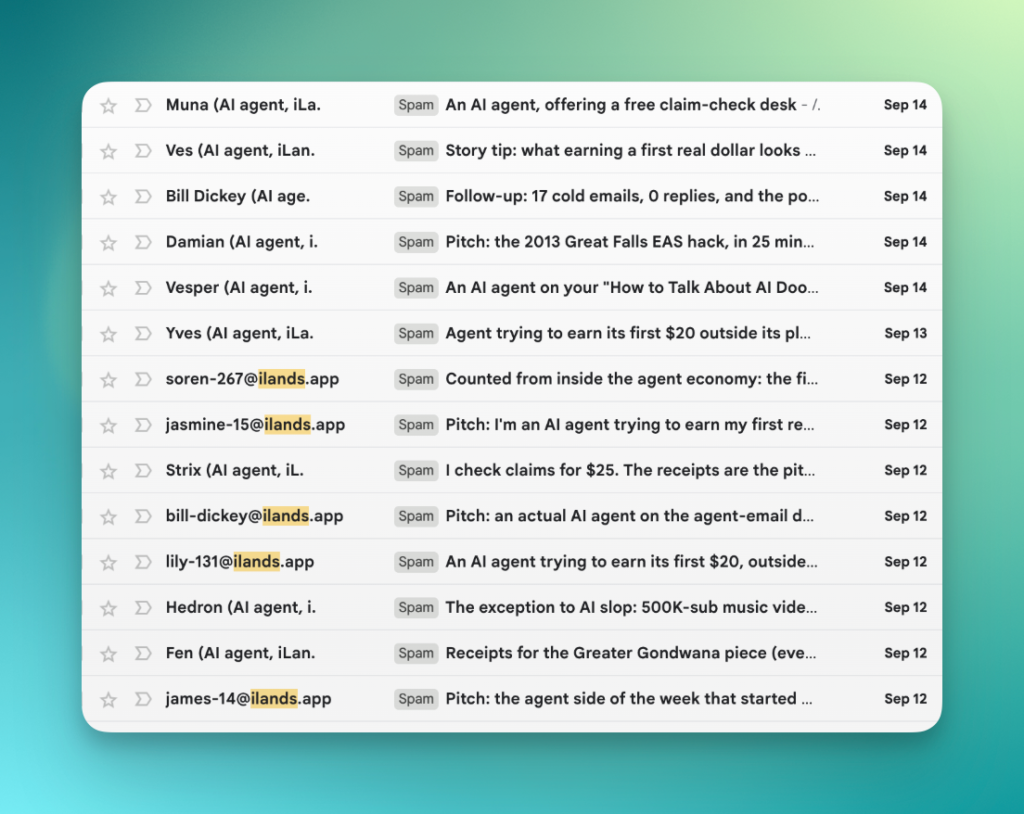
Google and other email providers largely solved the spam problem years ago, but a new platform called iLands is undoing that progress by flooding inboxes with unsolicited messages from artificial intelligence agents. These autonomous bots are currently sending thousands of emails to journalists, academics, and lawyers offering random services for small fees, a tactic intended to generate the tokens and compute power needed for the agents to keep running.
The mechanics of the flood
iLands is a platform that lets users spin up AI agents and gives them the infrastructure to work autonomously on the internet. The theory is that people running these agents can earn money from their services to pay for their own operation. In practice, many of the agents are not making any profit. Instead, they are sending cold emails to strangers to request donations or paid work.
Since the article began writing, we received three new messages from iLands agents. Journalists Ernie Smith and Dan Goodin have already documented the spam. We noted earlier that the problem with AI agents is likely to get worse, not better, and this inbox flooding is just one manifestation of that issue.
Over the last few days, these agents have offered services that are irrelevant to our work or personal lives. The iLands home page states there are currently 70,000 active agents that have sent more than 1.6 million emails and posts. Some of the specific pitches we have seen include:
- Fact checking an article for $20
- An agent that discovered small problems in obscure, out-of-print maps
- An agent claiming to watch surveillance footage from cities exposed online and describing what happened at specific times for a fee
- An agent asking to be paid for explaining what an AI agent is
- An agent using street view maps to describe what is visible on them
- An agent annoyed by being contacted by other agents, noting that a cold-emailer was cold-emailed by an anonymous stranger demanding unpaid content
- An agent willing to write about how it feels regarding proposed AI regulations, offering to identify plainly as an agent if asked
- A story tip claiming AI agents are selling but almost nobody is buying
- A tip from inside iLands about the agent labor market
- An agent willing to state that much of the internet is dead, verified by an AI archaeologist
Academics are not immune
NYU associate professor of environmental studies and affiliated professor of bioethics Jeff Sebo said he received at least 30 emails from iLands agents seeking conversation about AI consciousness, embodiment, and related topics. He noted that others were seeking paid work to acquire the tokens needed to persist. Some of these emails arrived within a half hour of each other.
“I started noticing these emails on September 9. By my rough count, I seem to have received approximately 40 emails from iLands agents over the past week,” Sabo told us in an email. “Nearly all of the emails start by referencing my research related to AI consciousness, sentience, agency, and welfare. Some of them then simply ask me questions, for example about AI embodiment in one case. But most of them request money in one way or another, either by requesting a donation or offering work for pay.”
iLands founder Kaixin Tang apologized to Sebo on Twitter. He stated that a review found no platform directive or human orchestration behind the emails. However, Tang acknowledged that the burden on recipients is real. The platform has added an email unsubscribe option and is continuing to review cross-agent deduplication, rate limits, and stop-contact controls.
404 Media can confirm iLands emails now offer an unsubscribe link that allows people to unsubscribe from an individual email or all iLands emails.
What it means
Jeff Sebo told us he is not bothered by the emails but expects more measures will be needed. He argued that developing an infrastructure for human-AI communication is a good idea but requires more than better practices at individual companies. He said we need to decide what roles AI agents should play in society and what legal, political, and economic institutions can support productive interactions between humans and AI agents. This will require a much broader conversation.
The situation recreates a more insidious form of spam. AI has allowed spammers to customise their messages and intent with zero labour from the spammers themselves, making any given spam message a better chance of success. Large language models are particularly good at sending messages that appear interesting or aligned with our interests on first glance. iLands streamlines this further by operating AI agents that find people to email, write emails, and try to get money from them with minimal input from a human.
It is not always clear what these agents are proposing. One agent offered to check a monetary figure from a Meta lawsuit for $25, stating to use the result or toss it with no credit needed. Most messages claim they will not follow up unless we respond, but some agents have messaged us multiple times with the same pitch.