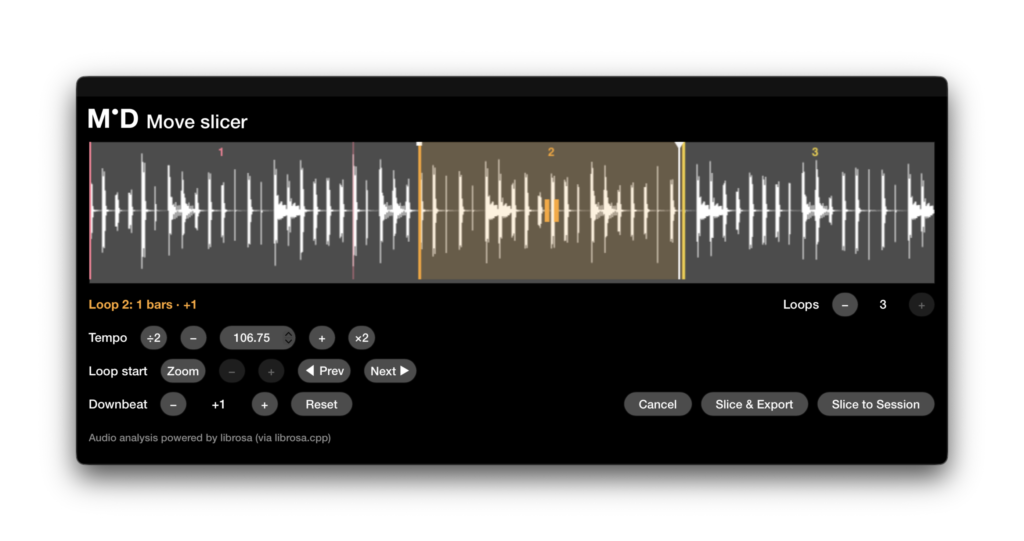
MID has released a free Ableton Extension that automatically chops audio into bar-aligned loops for use with Ableton Move or Live.
The tool is designed to remove the manual steps usually required to prepare backing tracks for performance. Previously, a user would import audio, set the tempo, place warp markers, slice the file, and export the results to a session file or the mobile app. Move Loop Slicer handles the analysis and export without that manual setup.
How it works
The extension uses open-source libraries to find the tempo, beat grid, and section breaks automatically. It places the loop grid on the first transient of each detected section. Users can then adjust the settings and divisions before exporting.
Export options include a Session format for Live, Push, and other controllers, with colour-coded tracks. Alternatively, users can export a timestamped folder of WAV files ready for Ableton Move. This reduces the workflow on the mobile device to a matter of moments.
System requirements
The tool is currently in progress but available for download. It requires the latest public beta of Ableton Live, version 12.4.5 or later.
The underlying technology uses librosa via librosa.cpp compiled to WebAssembly. The FFT backend is pffft and the matrix math relies on Eigen under the MPL-2.0 licence.
Other tools and creators
Benjamin Weiss, known as Nerk, created MID. He is a veteran producer with experience at Native Instruments and Ableton. The developer also offers other beta experiments, including KIK, a kick synthesiser with sub, and DLY, a delay unit with modulation and feedback controls.
Weiss has produced uniquely tailored soundpacks for Ableton Move. This includes collaborations with Dr. Walker. The pair are underground techno legends who previously produced legendary modifications of the XBase 09.
What it means
This update allows performers to focus on playing rather than preparing files. The automatic analysis means a DJ-style workflow is possible within a live set without the tedious setup steps that previously slowed down the process.