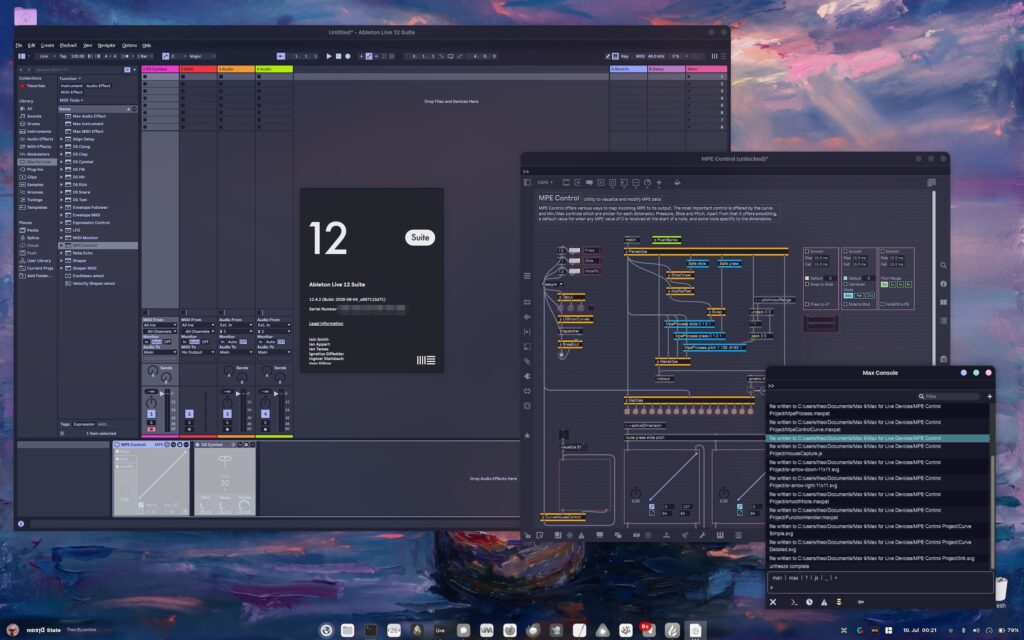
Ableton Live 12, the Push 2 and Push 3 controllers, and Max for Live now run on Linux through an unofficial Wine patch. The setup is unsupported by the maker, yet performance is nearly identical to the native version.
Wine allows Windows software to operate on Linux without an emulator. The name stands for Wine Is Not an Emulator. Because it translates system calls rather than simulating hardware, applications function as if they were built for the host operating system. Gaming communities have adopted this approach widely, proving that users will pay for a functional experience regardless of the underlying platform.
Developers shibco and Cade in Berlin have patched the environment to handle specific Ableton requirements. Their repository lists the following capabilities:
- Full support for Live 12 Suite and Beta versions
- Compatibility with Push 1 and Push 2 hardware
- Device recovery that maintains audio and MIDI connections after disconnection
- Experimental support for Max/MSP and Max for Live
- Native file dialogs that integrate with the desktop XDG portal
- System theme adaptation for dark and light modes
- Use of system fonts for the user interface
- Low-latency audio routing via WineASIO to JACK or PipeWire at 256 frames
- Correct rendering and scaling for VST3, JUCE, and OpenGL editor windows
- HiDPI display scaling that recalibrates on every launch
- Support for the Extensions SDK
- Specific fixes for plugins from Autuira, Pianoteq, SWAM, and KORG
- Reproducible builds
The project is available at https://github.com/shibco/ableton-linux. Push 3 support is currently missing, possibly because the developer did not have the hardware unit available for testing.
It appears some individuals at Ableton were involved in the development, though the project remains unofficial. The author hopes the company will offer official support eventually.
Users can apply their existing paid licenses and plug-ins without issue. This raises a concern about the long-term stability of relying solely on Apple and Microsoft for music production tools. Corporate policy changes, security lockdowns, or shifts in leadership could disrupt workflows without warning. A free and open source operating system offers a layer of independence that reduces this risk.
Many alternatives already exist on Linux, including the open-source Ardour and commercial options from Pianoteq, Bitwig, and Sinevibes. The ecosystem needs to grow further.
The author also notes the project team used local models and Claude Opus for quality assurance and documentation. They disclosed this usage in the repository, stating the tools helped with test automation and setting up the build pipeline.
Local models (Qwen 3.6) and Claude Opus were used during QA testing, documentation checking, and to help setup the build pipleline at the very end of this project’s release.