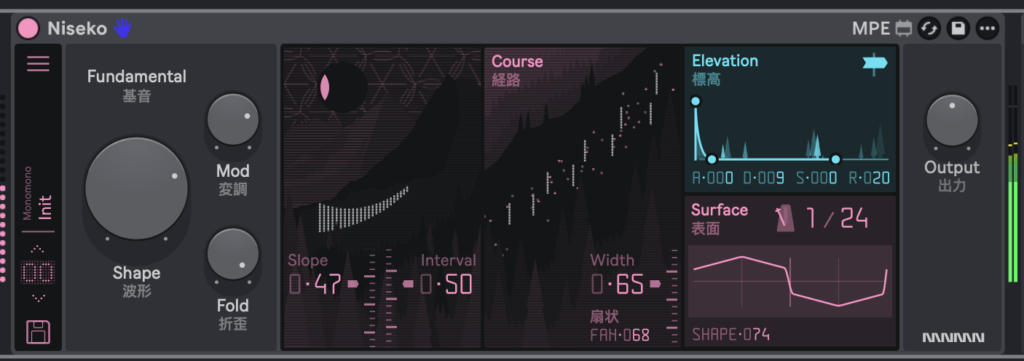
Forget any associations you may have with additive synthesis. Monomono’s Niseko takes that harmonic content and makes it accessible and expressive, via the UI or an input (including Push and MPE).
Niseko even feels a bit like a combination between long-lost, esoteric classic lab synthesizer and contemporary hardware from an alternate universe. (Okay, I wrote that and then read the description, “what would additive synthesis have sounded like as 1980s hardware?” But it almost feels like a fusion of multiple alternate universes!)
It’s got all those elements, internally modulated parameters, 12-bit synthesis, and then this gorgeous, more futuristic UI. You get frequency modulation and wavefolding alongside intuitive width and fan controls. (I even wish I had this as a software module, too, for your consideration!)
Specs:
- 8-voice polyphonic 12-bit additive engine with 24 partials per voice
- Adjustable partial interval, from harmonic to inharmonic tuning
- Per-partial stereo placement with Width and Fan controls
- FM modulation, Wavefold, LFO, ADSR and Glide
- MPE and aftertouch support with back-panel MPE controls
- Built-in preset library with export and import
- Full Push 3 Standalone and Push 2 support
Monomono had already established itself as one of the favorite all-time Max for Live devs. I doubt that this will rival the others for popularity, but make no mistake: I think this one is the best yet. It’s immediately my favorite additive tool in Live. It’s enough to make even the Abletons jealous. (Yeah, yeah, you can do additive synthesis in Operator but in a very limited way…)
Come to think of it, Live has become a treasure trove of unique additive synths. There’s Rainbow Circuit’s wonderful Rift, which is different enough that it makes a nice complement to Niseko, read my previous review:
And there’s Mellisonic’s Polyphylla, too, which just got a 1.5 update and a bunch of sound design recipes. Polyphylla contrasts with Niseko’s more minimalist UI approach with deeper controls, the new version even added extras like the ability to automate the Motion Envelope and Noise On/Off toggle. And that’s why we wind up with so many synthesizers, those nuances of sound architecture and the different interface design almost guarantee that you’ll get different sounds out of Polyphylla than you do in Niseko.
But yeah, let’s pan back: additive synthesis in Live is now a rich sonic resource. It’s not that you need all these synths, but I think that misses the point: these give you wonderful worlds to explore and added inspiration.
Here’s a sketch exploring some of its sounds. I really prefer adding some effects to dry, so you get it routed both into a Reason Rack patch I built (let’s hear it for Osmium and Ripley!), and the new AAS Objeq Delay 2 and MixWaves Electro-Harmonix effects.
Go get it:
If you buy something from a CDM link, we may earn a commission.
Previously: