$159 at solidstatelogic.com. For the maker in the bedroom, this is a rare chance to own a slice of legendary console circuitry without breaking the bank. It strips away the clutter of modern interfaces, offering just the raw, high-quality signal path a producer needs to capture vocals and instruments with authority.
The low-end audio interface market is notoriously crowded, making it difficult for new hardware to cut through the noise. Solid State Logic, however, has a long and revered history in professional production, using that pedigree to anchor its entry-level offerings. The original SSL 2 and 2+ models successfully brought the brand’s renowned circuit design to budding producers, and the range has since expanded with larger models like the 12 and 18. Yet, a gap remained for something compact, affordable, and immediately usable for mobile setups or simple tracking sessions. That gap is now filled by the new SSL 1.
What are SSL 1’s main features?
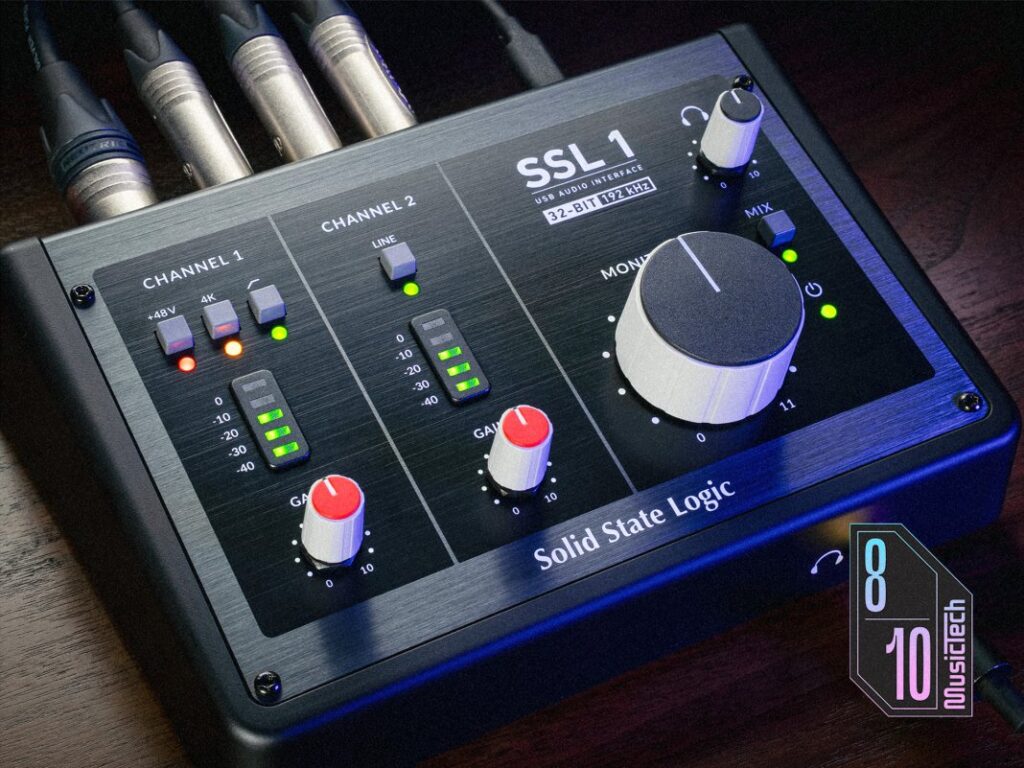
The unit retains the wedge-shaped desktop form factor of the larger 2, 2+, and 12 series, but in a significantly smaller case. The control surface is uncluttered, featuring just four dials. Notably, these controls utilise the same potentiometers and knob-caps found on SSL’s high-end hardware, providing a reassuring tactile quality.
Like its siblings, the SSL 1 offers two input channels. Each has a gain pot and a five-part LED level meter. However, the inputs are not fully flexible; the first channel is mic-only, while the second handles line and instrument signals. This configuration is not ideal for recording stereo line sources like keyboards, which require the 2 or 2+ models. But for hooking up a guitar and a microphone to start recording immediately, it is perfectly adequate.
Two DC-coupled line outputs are mounted on the rear, capable of sending CV signals to analogue synths. Also rear-mounted are the pair of USB-C ports: one for USB-2 data and the other for power delivery if the host device cannot supply sufficient voltage. The only front-panel connector is a 6.35 mm headphone jack, which carries the same signal as the line outputs. These are controlled by a substantial master volume knob, while the headphone output has its own independent amplifier and volume control.
What makes SSL 1 stand out?
The microphone input channel features the same preamp found across the entire SSL range. Options include phantom power, a high-pass filter with a 75 Hz cutoff and 18 dB/octave slope, and the so-called Legacy 4K mode. While this does not engage an actual SSL 4000-series preamp, the 4K mode activates an analogue circuit that emulates the sound of that classic hardware. It adds a high-frequency boost and carefully tailored harmonic distortion, effectively bringing out detail and airiness in vocals while adding definition to many instruments.
This preamp design has consistently impressed reviewers. In a previous assessment of the SSL 18, it was described as “one of the best I’ve heard in this class of interface,” capable of holding its own against much more expensive units.
The second input is simpler, featuring a single button to switch between instrument and line modes. While line mode is useful, most studio line signals are stereo and cannot be handled by this unit without a DI box workaround. Most users will likely use channel 2 to DI an electric guitar, which suggests the input jack should have been located on the front panel for convenience. Channel 2 lacks a mic preamp, meaning the 4K mode is unavailable here. This is understandable given the design philosophy, but it is a missed opportunity; engaging 4K on a DI’d electric guitar often provides a desirable front-end kick that benefits subsequent amp modelling plugins. A DI box can bypass this limitation by routing the instrument to Channel 1’s mic input.
Despite the physical I/O limitations, the SSL 1 includes three additional internal stereo loopback busses. These are particularly useful for live performance or web streaming, allowing you to easily mix other computer sources into the SSL 1’s output or bus audio internally to OBX Studio for streaming.
No-fuss recording solution
Audio interfaces typically offer one of two direct monitoring systems. Higher-end models feature a software mixer within the hardware to blend direct incoming signals with the DAW cue mix. Simpler units use a dial to mix between the direct signal and the DAW output. The SSL 1 takes this further, offering a single button to enable a fixed 50/50 mix. While this prevents achieving a perfect balance between input channels and DAW output, it keeps costs down and is easily managed using the DAW’s master fader.
This simplicity reflects the overall approach of the unit. On macOS, iOS, iPadOS, and Linux, the interface is plug-and-play with no additional software required. On Windows, a quick driver installation is all that is needed. The limitations of the I/O configuration may restrict wider appeal, but the no-nonsense approach ensures there is nothing to bog down the workflow. There is no ambiguity regarding connectors, hardware controls, or software integration.
Most importantly, the quality of the mic preamp, the build, and the pristine, low-noise sound delivered by the 32-bit converters benefit both newcomers and experienced engineers.
Key features
- 2-in / 2-out USB-2 audio interface
- Input 1 is mic-only / input 2 is line/instrument level
- 2 balanced TRS line outputs (DC-coupled)
- 6.3 mm headphone socket
- USB-C connector
- Power from USB bus or dedicated 5v USB power input
- Compatible with macOS, iOS, iPadOS, Linux and Windows
- Balanced, DC-coupled line outputs
- Includes SSL Production Pack software bundle
Key takeaways
- The SSL 1 delivers high-end preamp quality and build at an entry-level price point, making it a compelling choice for bedroom producers.
- While the fixed mic-only/line-instrument input configuration limits stereo line recording, it is perfectly suited for tracking vocals and guitars.
- Internal stereo loopback busses provide essential functionality for live streaming and performance contexts despite the compact form factor.
- The interface prioritises simplicity and plug-and-play usability across all major operating systems, removing the complexity often found in modern audio gear.
Stay ahead of AI. Get the most important stories delivered to your inbox — no spam, no noise.