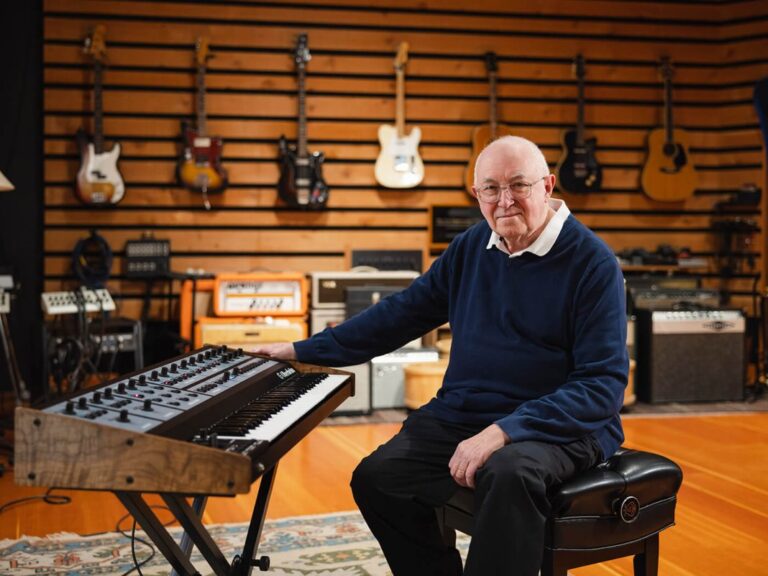
Tom Oberheim refuses to accept the credit history books give him for creating MIDI, calling the claim a joke. He told MusicTech he did not want a digital interface hooking machines together when Dave Smith first proposed the idea in 1983.
A reluctant participant
The 1983 standard allowed computers, synthesizers, controllers and other instruments to speak to each other via a universal digital language. It is widely regarded as one of the most important inventions in music technology and production.
Dave Smith of Sequential led the project alongside contemporaries Dave Rossum, Bob Moog, Don Buchla, Roger Linn and Alan R. Pearlman. Oberheim is often mentioned in the conversation surrounding the technology’s widespread adoption, but he plays down his role in a new interview.
“The history books say that I was involved in [creating] MIDI, and that’s such a joke,” Oberheim says. “When Dave [Smith] did his first paper about tying synthesizers together, it was a digital thing and I wanted absolutely nothing to do with it.”
“I said, ‘Don’t talk to me about a digital interface hooking up machines. I don’t want to do that.”
His position changed after Roland founder Ikutaro Kakehashi started collaborating with Dave Smith and Sequential. The Japanese company subsequently incorporated MIDI technology into their instruments. Oberheim later became the first president of the MIDI Manufacturers Association.
A life in Silicon Valley
While a legendary name in synthesis, Oberheim’s career has not always been in the music world. In the mid 1990s, he opted to work several non-music-related jobs in Silicon Valley, in an environment he calls a “high-tech rat race”.
“I decided in the mid ’90s that it was time for me to go to work and pay the mortgage on the house,” he tells MusicTech. “I just got a job off the internet, and then for the next five or six years I worked three different jobs in Silicon Valley, none having to do with music.”
These jobs included building microcontroller software for traffic light systems, high-level tech writing, and working at a think tank owned by Microsoft co-founder Paul Allen.
“We thought that, ‘Well, if we’re careful, when we get older, we’ll probably be able to pay for the nursing home,'” Oberheim says.
The full interview with Tom Oberheim, as he celebrates his 90th birthday, appears on MusicTech.