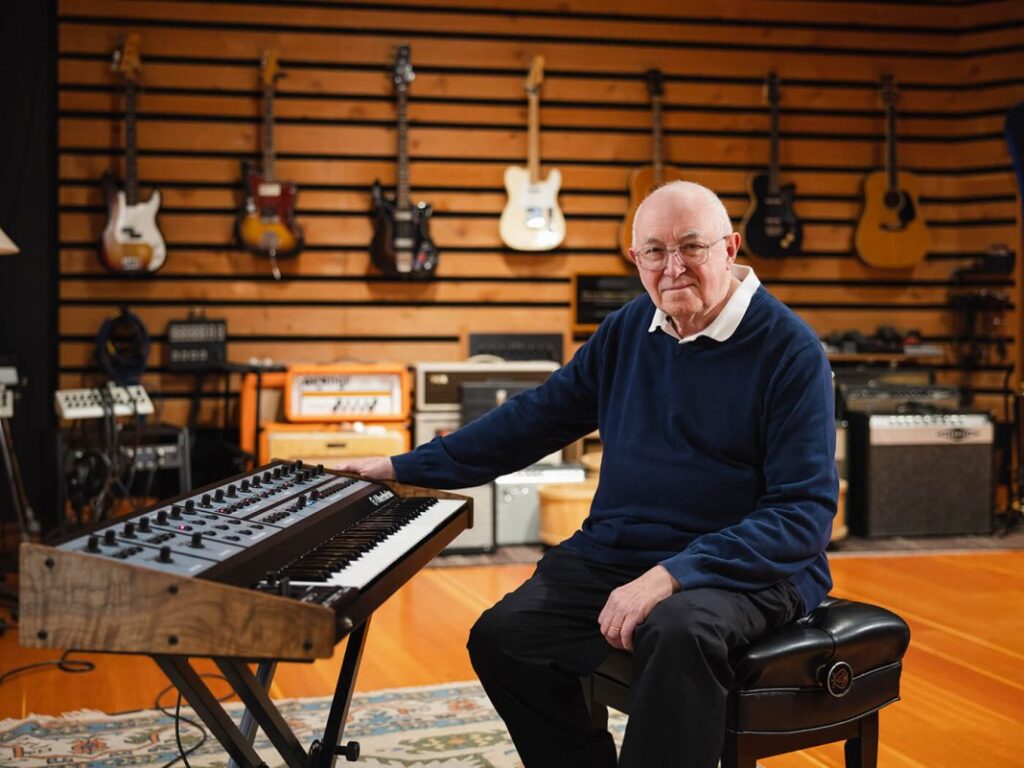
Four days before his 90th birthday, Tom Oberheim recalls staying awake in his Atlanta hotel room in 1979, unable to sleep while worrying about the launch of the Oberheim OB-X.
“I couldn’t sleep,” he says from his home in Northern California. “In 1978 my sales were falling very fast…So I got up, went down to the hotel lobby, and wrote the owner’s manuals for the OB-X. The next day, when the show opens, me and my engineer and my sales guy were wondering, ‘Will we still have a company by the end of the day?'”
The show opened at 10am. By noon, the team had secured half a million dollars in orders.
Forty-seven years later, Oberheim is less worried about survival. His career was not a straight line. He lost the rights to his own name, worked in various Silicon Valley roles for 20 years, and only returned to synthesiser design after a suggestion from Roger Linn. Recent releases, including the OB-X8, the TEO-5, and the Sequential OB-6, mean he no longer loses sleep over the business.
He makes one point clear, chuckling: “I can never retire, first of all.”
Tom celebrated his 90th birthday on 7 July. A new video from the Oberheim company, now part of Sequential, shows the designer receiving greetings from Herbie Hancock, JJ Abrams, Roger Linn, Dave Rossum, Steve Roach, Lisa Coleman and others. A member of the Sequential team told me ahead of the interview that Tom is humble about his work but has touched many people with his instruments.
They were right. We spoke over video while he sat at a desk piled with paperwork and a can of WD-40. He is coy about his impact on music production. If he knows how well he is known, he does not show it.
“I’ll tell you what’s a joy,” Tom says when asked about his influence. He recalls being asked what he does for a living. “Well, I make music synthesizers. And they’d say ‘Oh, I’ve heard of that, but what do they do exactly?’ I say, ‘I’ll show you’, and I take out my cell phone and play them Jump [by Van Halen].” The OB-Xa created the song’s iconic opening riff.
Tom beams. “I get bits and pieces of recognition, which is fun. But overall, I’ve had a wonderful life. I can’t complain.”
Starting one of the industry’s most famous synth companies was not a plan from the 1970s. He admits he got into the business out of desperation. Born in Manhattan, Kansas, he moved to Los Angeles in 1956 to study physics at UCLA part-time. He supported himself with a part-time job as a draftsman at the NCR Corporation, a computer company based 45 minutes from the campus. When his boss left to design circuit boards, he asked Tom to join him.
“It was only 10 minutes from UCLA,” Tom recalls. “I worked for them for a while, just making printed circuit boards and drawing schematics. [It was] a small company with only three engineers, and me and a woman that was building their logic boards. It was in 1957 and there were no books about computers; the industry wasn’t even 10 years old.”
After learning digital logic, Tom built a time-code generator. He finished the task and was given similar projects. After graduating with a degree in physics, he worked in computing for nearly a decade before burning out.
“I was absolutely sick of all that,” he says. “I didn’t want to ever do it again.” Meanwhile, a less lucrative hobby took up more of his time.
Living in Santa Monica in the late 60s, in a one-bedroom apartment, he began making “little boxes” for musician friends, mostly amplifiers for Don Ellis and Joseph Byrd. A friend asked him to build a ring modulator. “I didn’t even know what it was,” he says. After reading an article in a 1961 issue of Electronics magazine, he understood the assignment and built a prototype. He ended up assembling a few.
“A ring modulator drastically changes the [frequency] spectrum [of a signal] and makes for some very weird, very crazy sounds,” Tom explains. “That’s where people were at in 1969. Synthesizers were just barely invented, and it was a few years before the Minimoog [came to market]. Eventually, in 1969, I decided to put that into limited production just by myself — and that was the beginning of Oberheim.”
Chicago Musical Instruments (CMI) approached Tom to produce the ring modulator for them. It sold as the Maestro RM-1A, with estimated sales of around 200 units. The next product, the Maestro PS-1 phase shifter, sold 70,000 units and gave him the funds for new projects.
Synthesisers were not his main focus until he saw the ARP 2600 at the 1971 NAMM Show in Chicago. Tom loved the 2600 and told me in 2024 that he stayed up for “36 hours straight” playing it. He asked ARP to let him be their Los Angeles dealer and sold units to artists such as Lalo Schifrin, Frank Zappa, and Leon Russell.
In those studios, he saw early Moog and ARP sequencers. This sparked an idea: “a digital sequencer where you could load the notes from the synthesiser keyboard,” he says. He developed the DS-2. It had a problem he did not anticipate.
The DS-2 sent pre-programmed sequences to a synth, meaning the performer could not play new notes at the same time. You needed two synthesisers to make this work. Tom created a small “absolute minimum analogue synthesizer module”, the Synthesizer Expander Module (SEM), to load ideas from the DS-2 and play along on the synth simultaneously.
Little did Tom know, the SEM would become the catalyst for his synthesiser company. In January 1975, CMI (which Norlin had acquired) cancelled orders for the Maestro pedals. With a handful of employees to keep, he had to pivot fast. He says that “almost overnight”, he had the idea to link multiple SEM modules, connect an E-Mu digital scanning keyboard, and create a synthesiser: the Oberheim Two Voice and the Oberheim Four Voice were exhibited at the NAMM Show in Chicago in June 1975.
The SEM, the Two Voice and the Four Voice were the earliest examples of the signature Oberheim sound, which is rich, fat and wide. To hear it, listen to Rush’s 1982 prog rock opus Subdivisions, and Eurythmics’ 1983 moody synth-pop hit Sweet Dreams.
“I decided to put in a two-pole filter that [ARP’s Dennis Colin] designed for me — Jim [Cooper, of UCLA] designed the envelope generators and Dave [Rossum] designed the oscillators — I designed the front panel, the power supply and all the metal work. Everybody did a great job, but I wasn’t real happy with the sound.” He took his soldering iron and resistors and tinkered with the signal levels of the oscillators, the filter, and the voltage-controlled amplifier until he found something he liked.
Once he found the sound, the Oberheim team never changed it. “I’m proud to say I had something to do with it,” says Tom.
Despite a turbulent 1978, where sales dropped after Dave Smith’s Sequential Circuits released the Prophet-5, Oberheim had an inspiring seven-year run. It released a string of studio icons, including the DMX drum machine, the OB-X (which “saved the company”, says Tom), the OB-Xa, and the OB-8.
Oberheim was making history, but Tom does not think of it that way. “All we were doing was trying to stay ahead of the mad rush…Roland, Korg, Yamaha, there was a lot of competition. We were on a continual crash programme for several years.”
The money Oberheim Electronics made from this run set Tom up nicely. He married his wife, Jill, and they moved into a small house in Santa Monica, which he remodelled. During our talk, an immensely friendly Jill appeared on camera to say hello and crack a few good jokes about various British and American politicians.
Although he was building synthesisers that defined the sound of 80s music, Tom still does not consider himself a musician, nor does he keep many of his own instruments at home. An OB-Xa, which Prince used for his album 1999, costs around $10,000 today. Tom does not own one, but a framed picture of one hangs on the wall beside him.
“I don’t have room for stuff, and I’m not a collector. I’ve got a couple of SEMs and I’ve got an OB-8, which actually is not here — I’ve loaned it to a friend now for two years,” he says with a laugh.
Oberheim Electronics flourished until 1985, when production of the Matrix 12 synthesiser was delayed and the company went bankrupt. Tom’s lawyer acquired the Oberheim name (although Tom eventually sued this lawyer for legal malpractice) and released the Matrix series. The Oberheim brand under the lawyer hit bankruptcy again in 1988, and guitar company Gibson then purchased the rights to the brand. Roger Linn and Dave Smith’s companies also went out of business around the mid-80s.
Tom tried keeping a foot in the synthesiser business. In 1990 he came up with another idea for an instrument called the SEM Max, but could not make it work. “I was just by myself, and didn’t have a lot of money,” he recalls. “This synthesiser was way too big for me to handle on my own. And so I decided in the mid-90s that it was time for me to go to work and pay the mortgage on the house. I just got a job off the internet, and then for the next five or six years I worked three different jobs in Silicon Valley, none having to do with music.”
These jobs included building microcontroller software for traffic light systems, high-level tech writing, and working at a think tank owned by Microsoft co-founder Paul Allen. From the mid-90s to the late 00s, Tom’s focus was not on building a new, revolutionary instrument or influencing culture, but simply on getting by with his wife.