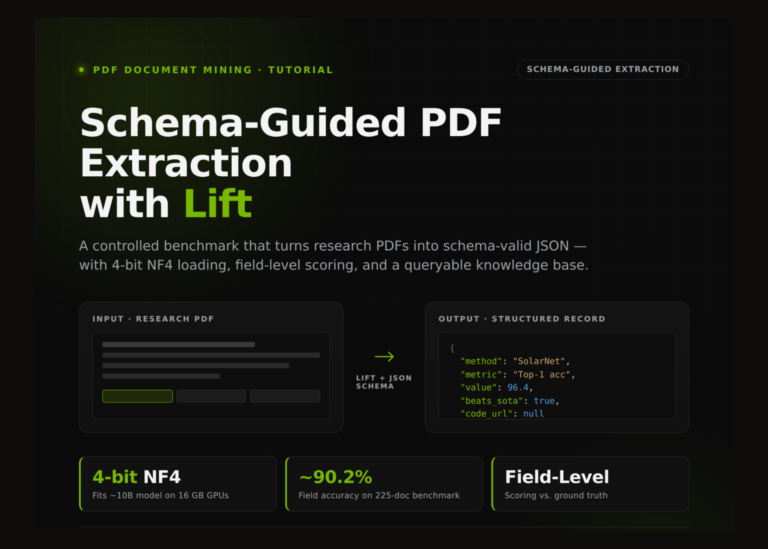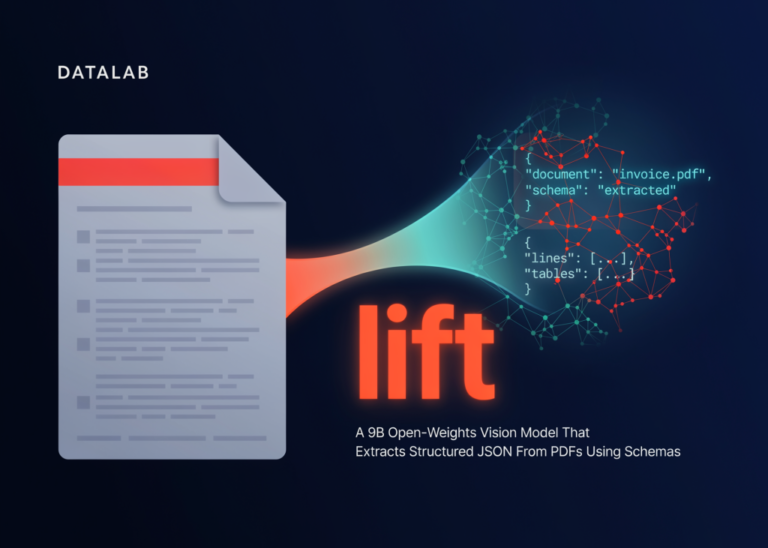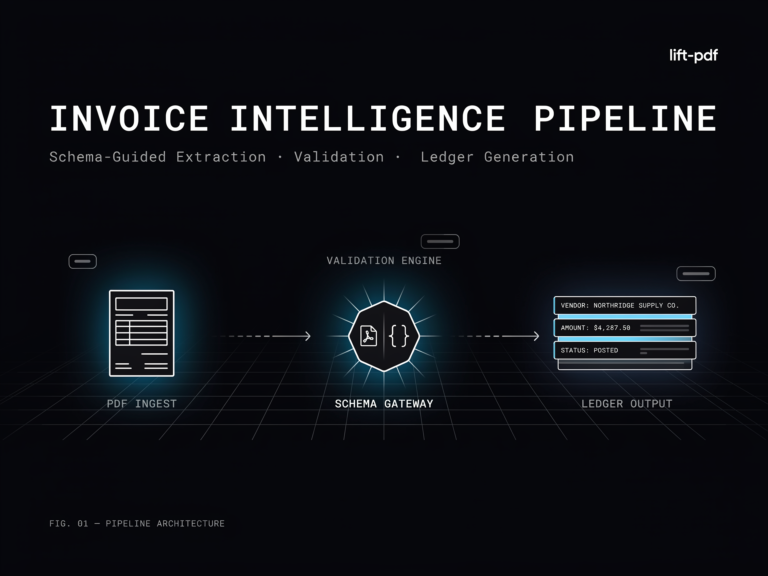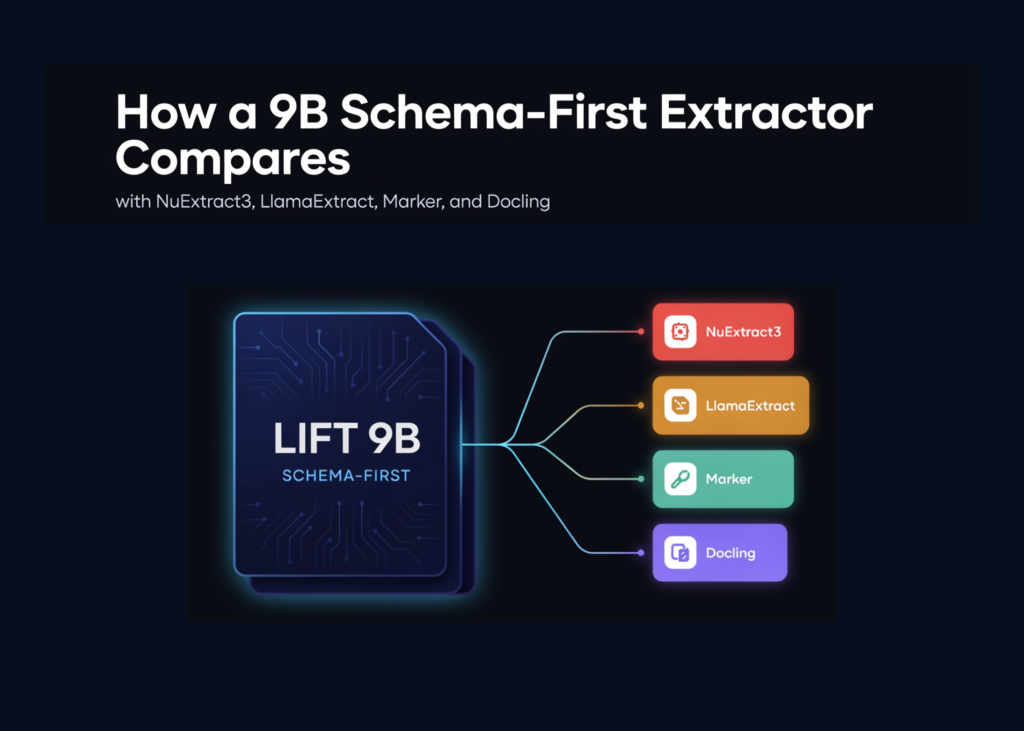
Datalab’s Lift is a focused document extraction tool with a specific promise: give it a PDF or image plus a JSON Schema, and it returns schema-shaped JSON directly. Instead of converting a document to Markdown first and then asking another model to extract fields, Lift reads rendered page images and attempts to emit the final structured object in a single pass. According to Datalab, Lift is a 9B vision model for structured JSON extraction from PDFs and images, supports schema-constrained decoding, and returns JSON that matches the user’s schema.
That positioning matters because Lift is not mainly an OCR engine, not mainly a PDF-to-Markdown converter, and not a full enterprise document review platform. It is best understood as a schema-first document extractor: a model for turning visually complex documents into application-ready fields.
First, the distinction that organizes everything: parsing vs. extraction
Most document AI tools solve one of two different problems:
- Parsers turn documents into faithful intermediate representations: Markdown, HTML, JSON blocks, layout trees, tables, headings, reading order, and chunks for retrieval. Tools such as Docling, MinerU, Marker, Unstructured, PyMuPDF, OCRmyPDF, and Surya primarily fall into this category. Their output is document-shaped.
- Extractors turn documents into the fields an application actually needs. You define a schema — for example, invoice_number, vendor_name, total, due_date, or line_items[] — and the system tries to return those values directly. Lift, NuExtract3, LlamaExtract, Reducto Extract, Extend, Azure Content Understanding, and other cloud extraction APIs belong closer to this category. Their output is schema-shaped.
That distinction matters because many production systems still follow a parse-then-extract pattern: convert a PDF to Markdown or structured text, then send that representation to an LLM with a schema. Lift’s bet is to collapse that workflow into a single visual extraction pass. That can reduce pipeline complexity, but only when the real goal is field extraction rather than faithful document reconstruction.
The competitive map
Lift sits at the intersection of several overlapping categories:
- Open-weight extraction VLMs such as NuExtract3
- Frontier multimodal LLMs with structured-output modes
- Cloud document AI systems such as Azure, Google, and AWS
- Commercial extraction platforms such as Reducto, Extend, LlamaExtract, and Datalab’s own API
- Open-source document parsers such as Docling, MinerU, Marker, and Unstructured
- Structured-generation libraries such as XGrammar, Outlines, Instructor, BAML, and related JSON-output systems
The important point is that not all of these tools are direct competitors. Some compete with Lift directly. Others are adjacent infrastructure. A parser like Docling is not trying to solve the same problem as Lift. A constrained-decoding library is not a document model at all. A commercial extraction platform may include extraction models, citations, review workflows, and compliance infrastructure. Lift is narrower: it is the raw schema-first extractor.
Lift vs. NuExtract3: the closest open-weight comparison
NuExtract3 is probably Lift’s closest open-weight competitor. NuMind describes NuExtract3 as a unified 4B vision-language reasoning model for document understanding, combining structured information extraction with image-to-Markdown conversion for documents such as scans, receipts, forms, invoices, contracts, and tables. Its Hugging Face model card lists it under an Apache-2.0 license.
The contrast is straightforward. Lift is larger at 9B and, in Datalab’s own benchmark, reports stronger field accuracy than NuExtract3: 90.2% versus 81.5%. NuExtract3 is smaller, more permissively licensed, and also positioned as a Markdown-conversion model.
So the practical decision is not only accuracy. If the priorities are permissive licensing, smaller local deployment, and a single model that can also convert documents to Markdown, NuExtract3 is attractive. If the priority is schema-first field extraction with Datalab’s reported speed-accuracy trade-off, Lift becomes more compelling.
Lift vs. frontier multimodal LLMs
A common alternative is to send the document to a frontier multimodal LLM and ask for structured output. In Datalab’s benchmark, Gemini Flash 3.5 slightly outperforms Lift on field accuracy and full-document accuracy, while Lift is much faster in the reported setup: 9.5 seconds median latency for Lift versus 28.1 seconds for Gemini Flash 3.5.
That does not mean Lift is always better. Frontier models remain attractive when volume is modest, setup time matters more than infrastructure control, and cloud processing is acceptable. Lift’s advantage appears when latency, data residency, repeatable self-hosting, and large-volume cost control matter.
Lift vs. cloud document AI platforms
Azure AI Document Intelligence, Azure Content Understanding, Google Document AI, and AWS Textract are managed cloud services rather than just models. They provide enterprise infrastructure for document processing, including deployment controls, service reliability, monitoring, procurement processes, and integration with broader cloud ecosystems. Microsoft describes Azure Content Understanding as a way to transform unstructured data into structured, machine-readable information while preserving structural relationships.
In Datalab’s benchmark, Azure Content Understanding reports lower field accuracy and higher latency than Lift, but it includes citations, which Lift’s open weights do not. Datalab’s own hosted API also adds per-field verification, citations, and confidence scores beyond the open model.
This is the cloud tradeoff. Cloud platforms are usually easier to adopt within companies already standardized on Azure, Google Cloud, or AWS. They may also be stronger choices when enterprise governance matters more than raw speed. Lift’s counterargument is portability: teams can run the extraction model locally or through their own vLLM deployment rather than sending every document to a hosted API.
For handwriting-heavy, low-quality scans, clinical forms, annotation-heavy documents, or regulated workflows requiring traceability, the cloud and managed platforms should be benchmarked directly against Lift rather than assumed inferior.
Lift vs. commercial extraction platforms
Reducto, Extend, LlamaExtract, Mindee, and Datalab’s own hosted API occupy a different layer of the market. They are not only extraction models; they are extraction systems. Their value is not limited to field accuracy. They add provenance, review workflows, schema management, confidence scoring, citations, deployment controls, and enterprise compliance.
Reducto’s Extract product is positioned around schema-typed JSON extraction with optional citations, while its Parse product emphasizes typed blocks, bounding boxes, and confidence scores. LlamaExtract similarly advertises custom-schema extraction with granular citations and confidence scores.
This is where Lift’s open model is intentionally thinner. The open weights prioritize fast, schema-first extraction. Datalab’s hosted API adds the production features that many regulated workflows require: per-field verification, citations, and confidence scores.
So the comparison is not simply ‘Lift vs. Reducto’ or ‘Lift vs. LlamaExtract.’ It is model vs. platform. Lift is appealing when you want a self-hosted raw extractor. Managed platforms are stronger when auditability, citations, confidence, human review, and compliance matter as much as the extracted values.
Lift vs. Marker
Marker is especially relevant because it also comes from Datalab. Marker converts documents to Markdown, JSON, chunks, and HTML, and supports PDFs, images, PPTX, DOCX, XLSX, HTML, and EPUB. Its repository also notes support for tables, forms, equations, inline math, links, references, code blocks, image extraction, artifact removal, custom formatting, and beta structured extraction with JSON Schema.
The difference is emphasis. Marker is a broad document conversion framework. It is useful when the goal is to make a document readable, searchable, chunkable, or RAG-ready. Lift is more specialized: it tries to produce the final field-level JSON object directly.
A practical pipeline may use both. Marker can parse the full document for search, retrieval, or human review. Lift can extract the specific fields needed by an application: same company, adjacent tools, different jobs.
Lift vs. Docling
Docling is one of the strongest open-source document conversion frameworks. Its GitHub repository describes support for multiple formats, including PDF, DOCX, PPTX, XLSX, HTML, EPUB, audio formats, images, LaTeX, and plain text. It also emphasizes advanced PDF understanding, page layout, reading order, table structure, code, formulas, image classification, and a unified DoclingDocument representation.
That makes Docling a better fit when the document itself is the artifact. If the goal is to preserve layout, convert documents for downstream AI workflows, build RAG pipelines, or standardize many document types into a structured representation, Docling is the more natural tool.
Lift is a better fit when the output schema is already known, and the business goal is not to preserve the entire document but to extract specific fields. In short: Docling is for document conversion; Lift is for field extraction.
Lift vs. MinerU
MinerU is another strong parser, especially for complex and scientific documents. Its repository emphasizes table-to-HTML conversion, OCR for scanned or garbled PDFs, OCR support for 109 languages, multiple output formats such as Markdown and JSON, with results sorted by reading order, and visualization outputs for checking extraction quality.
This makes MinerU attractive for research papers, technical reports, scientific PDFs, formulas, tables, and multi-column layouts. It aims to preserve the document’s structure so that the resulting representation can be used for reading, indexing, RAG, or downstream processing.
Lift should not be treated as a replacement for MinerU. MinerU says, in effect, “Here is a faithful machine-readable version of the document.” Lift says, “Here are the fields your schema asked for.” Those are related but different tasks.
Lift vs. Unstructured
Unstructured is best understood as an ingestion and preprocessing toolkit for LLM workflows. Its open-source library provides components for ingesting and preprocessing images and text documents, including PDFs, HTML, Word documents, and more. Its partitioning functions break documents into elements such as Title, NarrativeText, and ListItem, allowing developers to choose which content to retain for downstream applications.
Unstructured is strong as an ETL layer: collect documents, partition them, clean them, and prepare them for indexing or LLM workflows. Lift is not trying to be a general ingestion framework. It is trying to extract schema-bound fields.
Use Unstructured when the challenge is document ingestion at scale. Use Lift when the challenge is turning visually complex documents into typed JSON fields.
Lift vs. OCRmyPDF, PyMuPDF, and classical PDF tools
OCRmyPDF adds an OCR text layer to scanned PDFs, making them searchable and copyable. It is excellent for digitization, archival workflows, and preparing scanned PDFs for search.
PyMuPDF is a high-performance Python library for extracting, analyzing, converting, rendering, and manipulating PDFs and other documents. It gives developers low-level control and high-level APIs for deterministic document processing.
These tools are not direct competitors to Lift. They are lower-level document-processing infrastructure. If every document follows the same layout and the extraction logic can be written with deterministic rules, PyMuPDF or similar tools may be faster, cheaper, and easier to audit. If the documents are scanned and need searchable text, OCRmyPDF solves that layer cleanly. Lift becomes useful when rule-based extraction becomes brittle because the document layout varies or fields must be inferred visually.
Lift vs. structured-generation libraries
Lift’s schema-constrained decoding is important, but it is not the only system capable of producing valid JSON. The broader ecosystem includes grammar-based and validation-based tools such as XGrammar, Outlines, Instructor, BAML, and related structured-output systems. JSONSchemaBench, for example, evaluates constrained-decoding frameworks across efficiency, schema coverage, and output quality, reflecting the importance of structured output in modern LLM applications.
That means Lift’s main differentiation is not simply “valid JSON.” The stronger claim is that Lift combines a document-specialized vision model with schema-constrained generation. A generic LLM plus a structured-output wrapper may return valid JSON, but it may still misread the page, miss a table value, or hallucinate a field. Independent work reinforces why this gap matters: ExtractBench, an open benchmark for end-to-end PDF-to-JSON extraction, finds that even frontier models degrade sharply as schema breadth and output volume grow. Lift bets that the model itself is trained for document extraction, not merely wrapped with a JSON validator.
The caveat remains essential: valid JSON is not the same as correct JSON. A schema can guarantee shape, but it cannot guarantee that the extracted invoice total, policy number, contract date, or account number is correct.
Head-to-head: the dimensions that actually decide it
| Tool / Category | Best use case | Local deployment | Schema-first extraction | Provenance |
| Lift | Fast self-hosted extraction from PDFs/images into JSON Schema | Yes | Yes | No in open weights |
| NuExtract3 | Smaller permissive open-weight extractor plus Markdown conversion | Yes | Yes, via templates | No |
| Frontier multimodal LLMs | Quick high-accuracy extraction without hosting your own model | No | Yes, depending on provider | Limited / varies |
| Datalab API | Higher-accuracy managed extraction with verification | Hosted / commercial options | Yes | Yes |
| Reducto / Extend / LlamaExtract | Auditable production extraction workflows | Hosted / enterprise options | Yes | Yes |
| Azure / Google / AWS document AI | Enterprise cloud document AI and managed compliance | No | Varies | Varies |
| Docling / Marker / MinerU / Unstructured | Document parsing, Markdown, layout, and RAG ingestion | Yes | Not primarily | Not primarily |
| OCRmyPDF / PyMuPDF / pdfplumber-style tools | OCR layers, deterministic extraction, PDF manipulation | Yes | No | No |
| Instructor / Outlines / XGrammar / BAML | Structured-output layer around existing models | Yes / varies | Yes | No |
Where Lift genuinely wins
- Speed-per-accuracy at the open-weight tier: This is the real story in the numbers. Among everything that clears ~90% field accuracy, Lift is by far the fastest (9.5s vs. 28–31s for Gemini and Datalab’s API, 74s for Azure). The only faster model, NuExtract3, is nine points less accurate. If you’re processing millions of pages and need “good enough” fields now, Lift’s position on the speed/accuracy frontier is legitimately strong.
- True single-pass, multi-page handling: Lift ingests a whole multi-page document at once and can resolve values that span pages — a real pain point for chunk-and-stitch pipelines built on parsers.
- Ergonomics: Standard JSON Schema in, valid JSON out, with a CLI for single files or whole directories, a Python API, a reusable in-process model, and a Streamlit “Schema Studio” for iterating on schemas against real documents. For a research-tier open release, that’s an unusually complete developer surface.
- Pedigree: Datalab has shipped credible, widely adopted document models before — Marker, Surya, and Chandra collectively pull tens of thousands of GitHub stars and count Anthropic, Harvard, Stanford, and MIT among their users. Lift isn’t a first attempt from an unknown; it’s the extraction-specialized entry in a proven family.
Sources
- Lift GitHub repository: https://github.com/datalab-to/lift
- NuExtract3 Hugging Face model card: https://huggingface.co/numind/NuExtract3
- Azure Content Understanding document elements: https://learn.microsoft.com/en-us/azure/ai-services/content-understanding/document/elements
- Reducto Extract: https://reducto.ai/extract
- LlamaExtract by LlamaIndex: https://www.llamaindex.ai/llamaextract
- Marker GitHub repository: https://github.com/datalab-to/marker
- Docling GitHub repository: https://github.com/docling-project/docling
- MinerU GitHub repository: https://github.com/opendatalab/mineru
- Unstructured GitHub repository: https://github.com/Unstructured-IO/unstructured
- OCRmyPDF documentation: https://ocrmypdf.readthedocs.io/
- PyMuPDF text extraction documentation: https://pymupdf.readthedocs.io/en/latest/recipes-text.html
- JSONSchemaBench paper: https://arxiv.org/abs/2501.10868
- ExtractBench paper: https://arxiv.org/abs/2602.12247
The post Datalab Lift vs the Field: How a 9B Schema-First Extractor Compares with NuExtract3, LlamaExtract, Marker, and Docling appeared first on MarkTechPost.