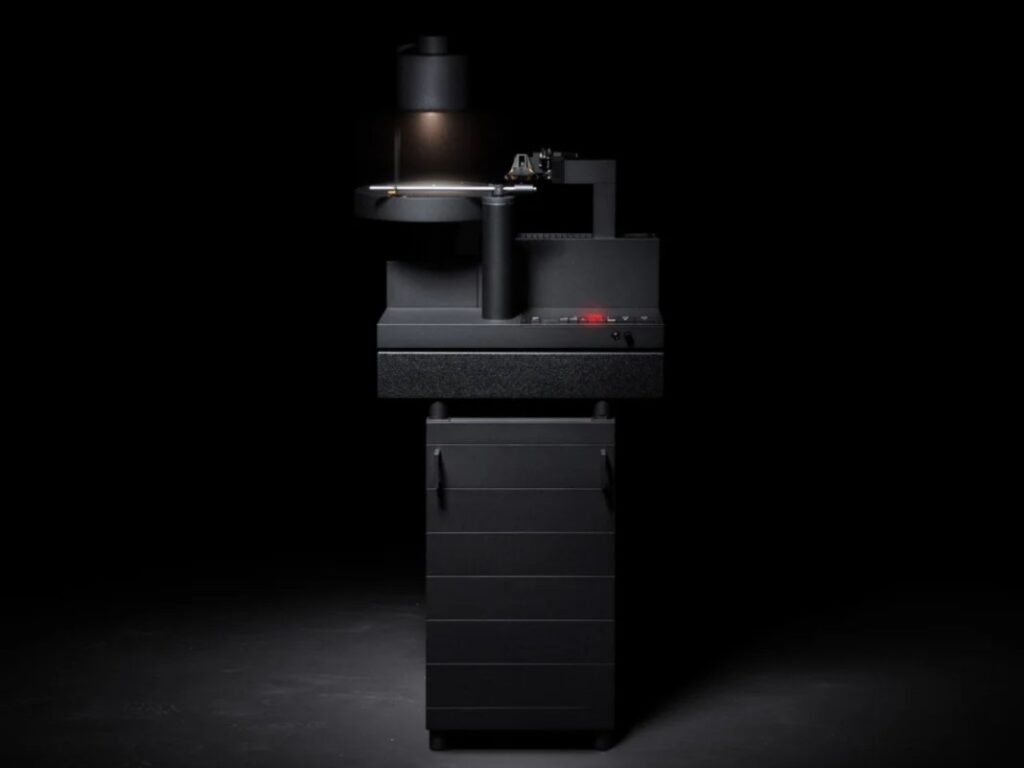
Teenage Engineering has released the APC-2, a 104kg record-cutting lathe designed to replace the need for traditional pressing plants.
Developed in partnership with Swiss firm SUPERSENSE, the machine allows artists to cut original playback discs in real time. It combines a stereo feedback cutting head with a direct-drive motor, built-in amplifier, vacuum pump, and Wi-Fi connectivity for remote control.
The problem with old machines
The current vinyl industry relies heavily on restored vintage lathes, specifically the Neumann VMS70 and VMS80. The number of engineers capable of maintaining these units is shrinking rapidly. Replicating the performance of the cutting head remains one of the most difficult engineering challenges in the sector.
To solve this, Teenage Engineering teamed up with Flo Kaufmann, whose DIALBA cutting heads are known to match or exceed the output of the original Neumann equipment.
The APC-2 integrates the cutting hardware with a vacuum suction system, a custom playback tonearm, power supply, and Wi-Fi configuration into a single unit.
Removing the gatekeeper
According to the company, the APC-2’s primary function is not technical but structural.
Traditionally, cutting a record required access to a closed system involving approval from a record label and significant resources. For a long time, the machine itself acted as a gatekeeper. Teenage Engineering hopes the APC-2 removes that barrier.
By changing who gets to cut records and how they do it, the machine aims to modernise the process for artists, studios, and small-scale manufacturers.
What it means
The team behind SUPERSENSE believes this approach could lead to millions of records that would never exist through traditional large-scale production.
The vision is not to compete with factories, but to enable small-batch releases, on-demand cuts, and the immediate physicalisation of live performances.
“This is about accessibility: small editions, records on demand, different shapes and sizes, made anywhere,” says Kaufmann. “It’s about creating a new environment for making records. Not factories, but beautiful spaces where sound can be captured and turned into a physical object in the same moment.”
The company plans to introduce the machine slowly to understand how people actually want to use it. They aim to move beyond the limits of the old system by observing what users make and what they need.