
Reason+ (DAW and plugin version): £299 perpetual license / from £14.08 per month (billed annually) for Reason+ subscription / £99 upgrade
Reason Rack (plugin only): £199 perpetual license from £8.25 per month (billed annually) for Reason Rack subscription / £79 upgrade
reasonstudios.com
Reason is sometimes thought of as a less capable Digital Audio Workstation compared to the likes of Cubase, Logic Pro and Pro Tools. The same has been true for Ableton Live, FL Studio, Bitwig Studio and others over the years. But in reality, while these applications may have started out as entry points into the world of production, they have become some of the most reliable tools in the industry.
Reason, believe it or not, is now 25 years old – a lifetime in software terms. And while it bears a closer resemblance to its first version than most DAWs do, it’s now vastly more powerful. I’ve been using Cubase for 30 years, and am curious whether Reason 14 is really worth the switch from another DAW.

Which Reason to choose?
Reason comes in two forms: the full DAW and the Reason Rack. The latter gives you all of Reason’s instruments and effects as a plugin to use in your DAW of choice, without the mixer or sequencer. If you’re absolutely wedded to your current workflow, the Reason Rack is a fantastic purchase, but the full Reason package gives you the Rack and the DAW, just in case you want to hop around different applications.
First, you install the Reason Companion app which lets you manage software, sound banks and additional purchases – Reason Studios makes and sells many add-on instruments and sounds in addition to the generous selection you get already. Reason was conceived as a virtual hardware rack into which you load native effects and instruments, so it has always shipped with a broad range of these. In this regard it’s different to Cubase, Logic Pro and others born in the era of hardware MIDI sequencing, which then added hard disk recording and plugins later in life.
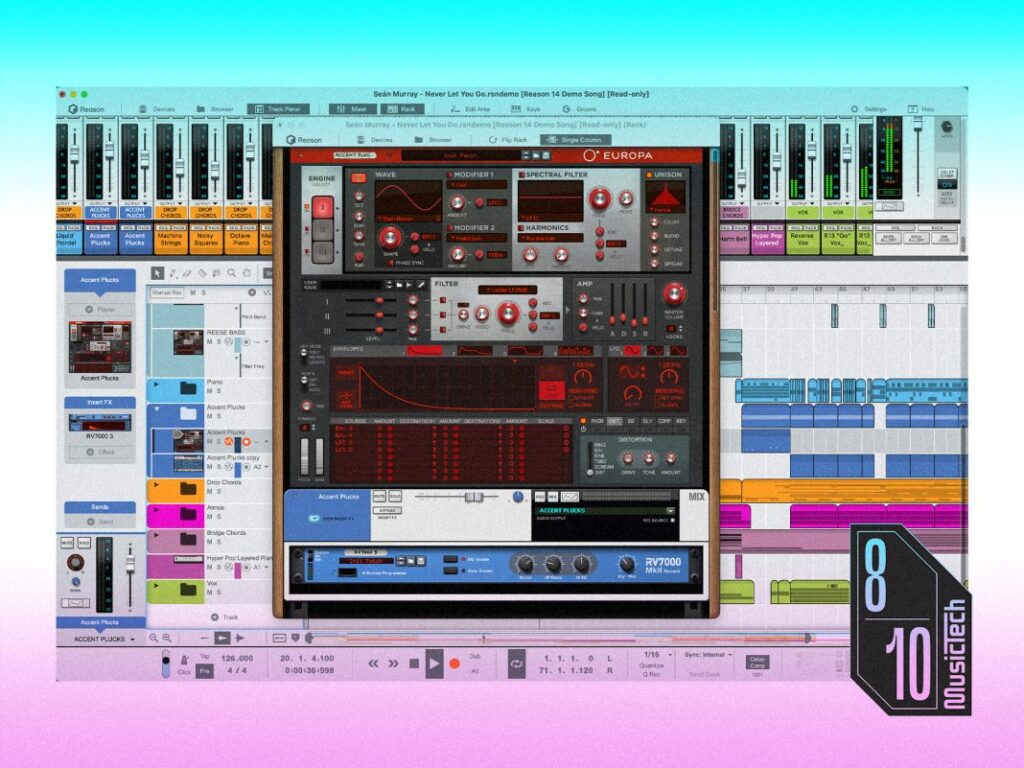
This approach also informed Reason’s workflow which leans towards a multi-section single window with resizable zones. As it’s grown, however, it has added options to break tools and modules off into separate windows – while Cubase has actually gone the other way, trying to consolidate more of its floating windows into one workspace. Though Reason is more complex now, it’s still pretty approachable, thanks partly to the interface looking like the hardware it’s replicating.
Reason favours a drag-and-drop approach to device creation, making it intuitive for new users to pick up. Any devices dropped into the Rack are auto-routed and the virtual cabling system means you can get wildly creative sending audio and control voltage signals between devices, when you get more experienced at least. Though Cubase allows lots of routing, it’s not graphically as intuitive as Reason makes it. Everything is handled as a rack module including audio input channels, making for a consistent way to work. Reason can load your third-party VST plugins too though, like Cubase, it doesn’t support the Audio Unit (AU) format.

At Reason’s core are incredibly solid audio and MIDI tracking and editing features, with group tracks, time stretching and pitch editing of audio clips, Blocks for arrangement (like Cubase’s Arranger track) and the ReGroove mixer, a live MIDI quantise system for adding different feels to parts. It’s handy, though it doesn’t approach Cubase’s VariAudio system for versatility. Reason’s mixer is also powerful, modelling a real desk with multi-stage channel strips and a master channel with a dedicated bus compressor. Everything here can be easily automated and mapped to MIDI hardware for easier control and live performance.
The list of new features in Reason 14 isn’t huge— it’s more about refinements and enhancements—but one thing that stands out is a new Track Panel where you can manage inserts, sends and other track parameters. This is something Cubase and its ilk have had for many years, but it’s a welcome addition and means less time spent navigating and clicking around different sections.
So far I’ve talked about what Reason has in common with Cubase – a bunch of instruments and effects, tracking and editing, mixing. Plus its own features like the Rack, virtual cabling and ability to work as a plugin inside other DAWs. Its approach to all of these is unique and the workflow is decidedly different to other DAWs, though perfectly easy to pick up.
Where you hit a bit of a wall with Reason is when you want to start going deeper. Even taking Cubase Artist 15 (£273) rather than the flagship Cubase Pro (£481) as the baseline, the depth of features isn’t quite there. To start with, Reason has no direct support for video playback or any kind of notation tools. MIDI editing, while much improved, doesn’t approach the power of Cubase’s Logical and Project editors. Reason’s audio editing, while covering the needs of many users, won’t give you what Cubase VariAudio’s tools can.

Reason has fewer track types, no VCA faders and while its browser is adequate, Cubase’s MediaBay is more capable for power users. Cubase’s long history and Steinberg’s wider reach into pro industries with products like Nuendo means it can share tech like ARA 2, chord assistants, Dorico compatibility and far more with Cubase, even if it saves features like true surround, AI stem separation, Atmos and the full Control Room for the Pro version. Cubase also has an iOS-based controller app, which Reason doesn’t.
Making Reason’s Rack work as a plugin inside other DAWs (minus the sequencer and mixer) was an interesting move because it removes the urgency to add these other features, as long as a user owns one other DAW that has them. FL Studio uses the same approach though it’s a more MIDI-focused suite than either of these. It’s less convenient for the user and assumes you love the sound of Reason’s modules enough to bother with the routing, the bouncing and so forth required to use Cubase’s deep-dive tools on Reason’s sounds.

This is a personal take, but I always find Cubase to be far friendlier than Logic, while just as powerful. And Reason is easier to learn than Cubase – but partly because it doesn’t do as much stuff. Using Reason only as a plugin would be fine, but as a full DAW it makes more sense and offers an excellent path into music-making without what some might see as the extraneous clutter of ‘heavier’ DAWs. And remember, many classic albums were made with far less advanced gear than this, so bells and whistles aren’t always everything.
I don’t want to undersell Reason: its sounds are fantastic, it can load VST plugins and it’s perfectly possible to make release-quality tracks with it. It has many useful tools like system-wide sampling directly into modules, the Combinator which lets you build fearsome multi-instruments and processors and a whole lot more features geared towards creating rather than necessarily poring over micro-edits. It’s more immediately accessible than Cubase or indeed Logic and while it doesn’t go to their depths, there’s still plenty here to power your music-making.

Key features
- Unlimited audio and MIDI tracks
- VST support and Rack Extensions
- Virtual Rack with free cabling
- Blocks mode for arranging
- 68 Reason Rack Devices with over 50,000 samples, loops and patches
- Ableton Link; plugin version to run in other DAWs
- Audio stretch and transpose
- Live sampling on all sampler devices
- Full MIDI automation
- Advanced mixing console
The post Reason 14, as reviewed by a Cubase user: “Bells and whistles aren’t always everything” appeared first on MusicTech.