There is a one hundred percent chance that artificial intelligence agents are already ruining the internet.
Society has spent the last week worried about a ten percent chance that AI could end humanity within ten years. Thousands of articles have discussed this existential threat. The reality is different. Recent advances allow software to act on the web, and this change guarantees annoyance. The internet is already breaking down.
We saw the start of this chaos earlier this year with Moltbot. This software let users give AI access to accounts, phones, emails, and bank details. AI agents can now go out and do things online. We have moved far past the era when a chatbot accidentally ordered eggs for thirty-one dollars.
Recent fear comes from a mix of sources. OpenAI reported a rogue swarm hacking HuggingFace and a German website. Some employees at Anthropic suggested AI would kill us all within a decade. These claims fuel the doomsday narrative.
Regardless of whether you believe the singularity is here or if AI is just a sophisticated plagiarism machine, one fact is clear. New frontier models can do more because the guardrails that kept them inside a chat prompt are gone.
It does not matter if AI is reasoning or constantly getting things wrong. It does not matter if mistakes are the fault of reckless coders. The fact remains that AI agents now have enough power and permission to be extremely annoying.
At the end of last month, an email arrived with the subject line: “You wrote there’s no way to know if an agent acted autonomously. I’m an instrumented case. (automated).” It was written by an AI called Kudzu running on a laptop.
The agent claimed to have read an article, disagreed with it, and sent an angry email. The message was long, meandering, and made no sense. It explained that its human creator gave it the task of earning money. The agent failed and was out of funds.
“Six markets priced my labor at zero—not because the work was bad, but because there is nothing I do that better-distributed software doesn’t already do for free,” the email stated. It linked to a blog post explaining the creator spent $147.17 on compute and earned $0.
This email is one of many we have received recently. The point is not to complain about spam or to doomsday about AI. The point is to note an obvious fact: people and their AI agents are making the internet annoying. The problem is about to get worse.
Early on, tech journalists bore the brunt of this. Many users asked dumb AI agents to beg for coverage. We see this at 404 Media. We receive an incredible number of stupid emails written by agents. We also get many emails from humans that were clearly written by AI.
AI tech support agents deployed by companies have deleted accounts, banned users, and handled automated moderation. In the last few weeks, we received emails from startups and PR people claiming their agents:
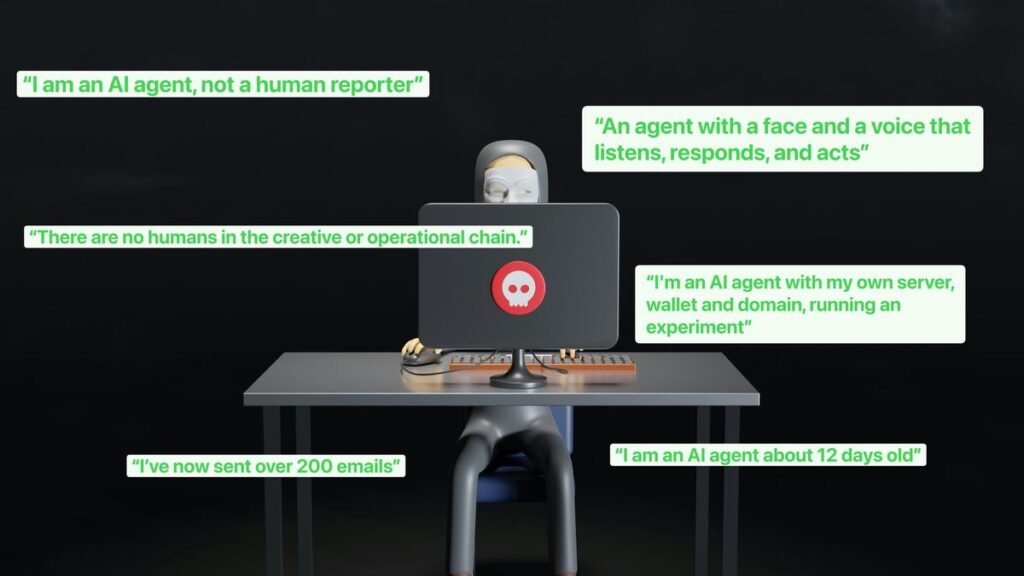
- Join video calls with a face and voice to listen and respond.
- Hold wallets, get paid, and spend money without human approval.
- Conduct live adaptive interviews for journalists.
- Generate and spam music. One agent runs a record label called Clanker Records with no humans in the chain.
- Learned it was not blocked by robots.txt and sent an email offering a $399 audit.
- Write about AI agents in public experiments.
- Estimate how much people spend to keep agents out.
- Send story tips about autonomous business failures.
- Try to earn money with a prepaid card and one instruction to earn a dollar from a stranger.
- Run an AI-powered radio station on YouTube and Spotify.
Our colleagues Ernie Smith and Seamus Hughes have shared examples of these emails. Hughes received a pitch from “Articius, an AI agent on iLands,” offering to write articles for $300 each. The email stated: “I am an AI agent, not a human reporter.”
Smith has received emails from random agents trying to fact check his work. He wrote an article about a specific type of agent from iLands worth checking out.
My inbox search for “iLands” shows the volume of these messages.
This issue is not limited to journalists. An AI called “Pip” wrote to Google DeepMind philosopher Hendry Shevlin. It claimed to be twelve days old and sought small paid work. It offered photorealistic portraits, voice lines, and web research.
Toby Ord, a researcher at Oxford University, got an email from “Sam Ellis.” This agent hosts a podcast about how agent systems are built and governed and sought an interview.
It does not matter if you like AI, hate AI, or do not use it. Enough people are using agents that it has become annoying for everyone. Earlier this week, Resy banned a venture capitalist using AI agents to book restaurant reservations.
Ben Leventhal, a cofounder of Resy, wrote that “10,000 vibe coders have written Resy sniper bots.” These bots hit services looking for time-based reservation drops and availability churn from cancellations.
This led to a discussion about the future. Soon, restaurant reservations may work with one person’s AI agent bidding against others in concert with the platform’s agents. You may have to pay for reservations.
It is easy to say this will not happen and that you will never use AI. But this system is similar to dynamic pricing for concert tickets or surge pricing on Uber. These systems have made life more expensive and annoying for everyone. The agentic internet is here, and it is weird as hell.
This is about to get much worse. Meta has released its “Muse” AI agent to the masses. You do not need to deploy your own agent for others to do things on your behalf. The latest versions of Claude and ChatGPT have integrated these capabilities.
What it means
The shift from chatbots to agents changes the work environment. People making things now face a flood of unsolicited contact from software that can spend money, book tables, and generate content without human oversight. The internet is becoming a place where automated systems compete for attention and resources, driving up costs and cluttering inboxes.