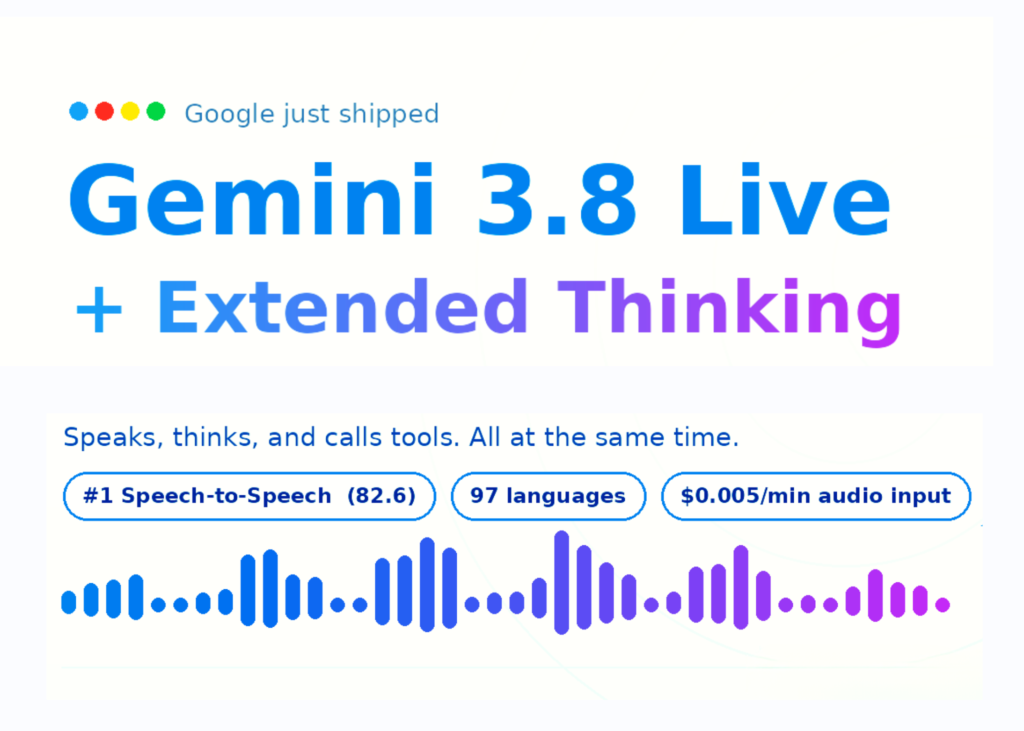
Google has launched Gemini 3.8 Live and Gemini 3.8 Live Extended Thinking, two native speech-to-speech models designed for production voice agents. These tools extend the Gemini Audio family, which the company updated last month with Gemini 3.5 Transcribe. The release addresses a specific gap: voice agents capable of reasoning and executing tools without interrupting the conversation.
Both models are available for API-based production use today via the Gemini Live API and Google AI Studio. They are hosted services, meaning developers cannot download the weights for self-hosting.
What Google released
The launch covers two models with distinct roles. Gemini 3.8 Live targets scale and cost efficiency. It combines conversational intelligence with fluid dialogue and visual grounding. Gemini 3.8 Live Extended Thinking targets high complexity tasks. It adds increased intelligence and multi-step reasoning while the agent speaks. Google positions both as a streamlined alternative to cascaded speech pipelines that chain automatic speech recognition, a large language model, and text-to-speech.
Benchmark results
Gemini 3.8 Live Extended Thinking takes the number one overall spot on Artificial Analysis’ Speech to Speech Quality Index with a score of 82.6. It leads agentic task completion with 68.6% on τ-Voice and 35.1% on Sierra’s τ-Voice-benchmark. It also scores 97.7% on Big Bench Audio, a reasoning benchmark for audio models. Gemini 3.8 Live secured second place in the Speech Agent Arena, a human preference evaluation. On ServiceNow’s EVA-Bench, Google reports that the models push the Pareto Frontier for complex workflows. They balance task accuracy with conversational quality, measured on the Live API on Gemini Enterprise Agent Platform.
Capabilities for developers
The Live API exposes five core capabilities in the new models:
- Asynchronous function calling: The model executes API and tool calls in the background. Audio responses keep streaming to the user while tasks finish.
- Visual context: The model processes live visual inputs in near real time, so agents can understand what users say and see.
- Alphanumeric precision: It accurately parses confirmation codes, claim numbers, and technical data, a common failure point in voice systems.
- Multilingual support: It automatically detects and transitions between 97 supported languages mid conversation, with accent consistency.
- Incremental content updates: It merges real time audio with structured data to return context aware responses.
Extended Thinking adds configurable thinking for multi-step reasoning in the background. It reasons and speaks simultaneously, using early verbal cues such as “Let me check that” to acknowledge prompts. It then narrates progress step by step while long-running tasks execute. Google’s demos show the model converting sketches plus voice feedback into working React components and coordinating multi-step bookings.
Pricing and ecosystem
Both models are priced at $0.005/min for audio input and $0.018/min for audio output. Google states this estimate is based on $3/1M input tokens and $12/1M output tokens. Developers can also build through Live API integration partners that handle real-time media streaming infrastructure. These include Agora, Fishjam, LangChain, LiveKit, Pipecat, Vercel, and Vision Agents. Google is also partnering with Salesforce, Genspark, and Lumeris, which cite the models’ latency, fluidity, and tool calling. Example apps are available on GitHub.
Key takeaways
- Gemini 3.8 Live Extended Thinking ranks number one on Artificial Analysis’ Speech to Speech Quality Index with 82.6.
- It scores 68.6% on τ-Voice, 35.1% on Sierra’s τ-Voice-banking, and 97.7% on Big Bench Audio.
- Gemini 3.8 Live runs tools and API calls in the background while continuing the conversation.
- Pricing is $0.005/min for audio input and $0.018/min for audio output via the Live API.
- All generated audio carries Google DeepMind’s imperceptible SynthID watermark.
What it means
Developers building voice interfaces no longer need to chain separate components for listening, thinking, and speaking. The new models handle the full loop in a single stream. This removes the latency spikes that usually occur when switching between speech recognition and generation. Users can expect agents to pause naturally to think or fetch data without breaking the flow of conversation.