Google announced a suite of AI updates in July 2026 aimed at improving developer tools, expanding creative capabilities, and enhancing practical applications for daily life.
Model improvements for production use
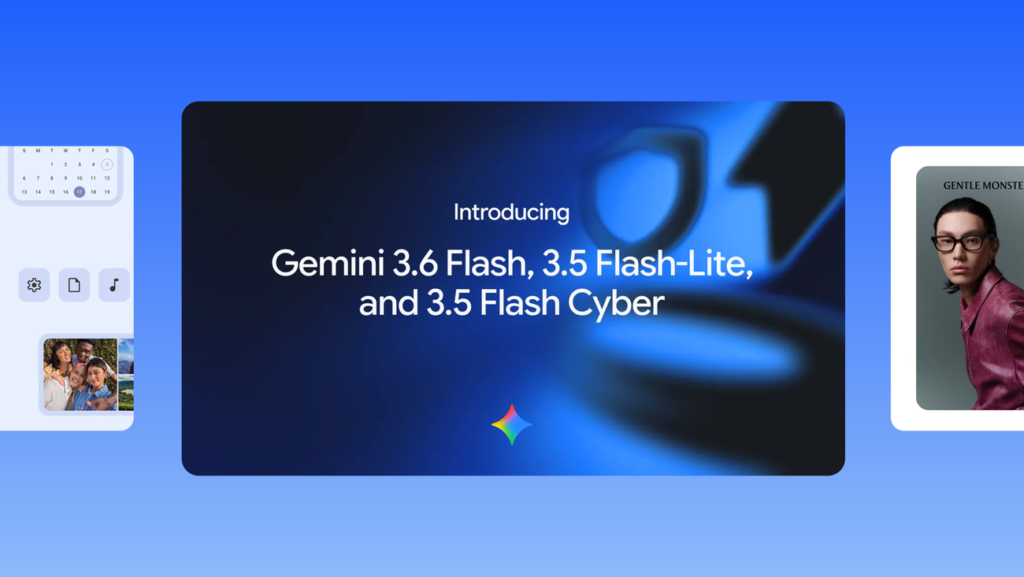
Three new Gemini models arrived to assist developers building production AI agents. The releases include Gemini 3.6 Flash, 3.5 Flash-Lite, and 3.5 Flash Cyber. These versions focus on higher token efficiency, reduced latency, and improved reliability to support scaling agentic workflows.
Google also launched Gemini Robotics ER 2. This is the company’s most capable “embodied reasoning” model to date. It is designed for developers creating machines that operate in the physical world. The system allows robots to converse naturally with people, interpret their surroundings, and execute complex, multi-step tasks.
Integration with hardware and apps
Gemini Intelligence is now available on new devices from the Galaxy Unpacked 2026 event. The Samsung Galaxy Z Fold8 Ultra, Fold8, and Flip8 now support the feature, making it simpler to use Android with these AI capabilities.
A new native migration experience was introduced with Android 17. This feature is built directly into the operating system and allows users to transfer more data types from an iPhone wirelessly without needing a separate application.
Google Notebook, a standalone product similar to NotebookLM, has been updated to function across the wider Google ecosystem. It is now available inside the Gemini app and Google Search. The update includes a secure cloud computer.
Tools for work and research
Google released the first iteration of the AI & Economy ATLAS. This is an ongoing, large-scale, de-identified study tracking how people use AI at work and in daily life. The project aims to provide an early view of the technology’s impact on the economy as capabilities advance and usage evolves.
AlphaEvolve is now generally available to all Google Cloud customers via the Gemini Enterprise Agent Platform. This Gemini-powered AI code-optimization agent helps find efficient algorithms. Users provide a baseline algorithm and their goals, and the tool automatically searches for better solutions, returning human-readable, optimized code.
Users can now connect more services to the Gemini app. Previously, some favourite services were linkable, but the update enables secure interaction with apps like YouTube Music directly in AI Mode.
Gemini Spark has been expanded to more users globally. A new feature allows the tool to handle complex web errands. With permission, Spark can use logged-in accounts and saved passwords to perform tasks such as scheduling apartment viewings or researching and starting flight bookings.
Creative and media updates
Google Vids received updates to allow video creation and personalisation. Two new features, Gemini Omni and personal avatars, enable users to generate and edit high-quality clips using everyday language. Users can also create a custom digital avatar to appear in their videos.
DeepMind technology reconstructed a “lost” goal by Pelé. On 2 August 1959, the player scored three consecutive “sombreros” over defenders and the goalkeeper without the ball touching the ground. The moment was never captured on film, but Google used its technology to recreate the scene.
Google celebrated 25 years of visual search innovation. The company launched Google Images 25 years ago, shifting search from text-based to visual exploration. To mark the occasion, a new browseable home for Google Images was announced, alongside image generation through AI Overviews in Search.
Google Flow Music introduced Lyria 3.5, the latest music generation model. The tool helps users create songs with total creative control. It delivers advancements in musicality, lyrics, and vocal quality to assist in crafting richer tracks.
Public sector and safety applications
NOAA is modernising its operational supercomputing system using Google Cloud’s high-performance H4D virtual machines. As one of the first organisations to run numerical weather prediction directly on the public cloud, NOAA provides meteorologists with the scale and speed needed for massive simulations and faster, life-saving early warnings.
A UN report titled “Leveraging AI to enhance multi-hazard early warning systems” highlighted how Google teams support crisis resilience. The report details advanced AI-based breakthroughs in detection and forecasting used to share timely information with billions of people. The goal is a world where no one is surprised by a natural disaster.
Three new FireSat satellites launched from Vandenberg Space Force Base in California. This expansion supports a global initiative led by the Earth Fire Alliance with Google Research to detect wildfires before they spread.
Google DeepMind and Isomorphic Labs shared a joint approach to bioresilience. The programme has two goals: preventing threat actors from misusing models, and ensuring governments, scientists, and biosecurity experts can use these technologies to build a more resilient world.
What it means
These updates shift the focus from general capability to specific utility. Developers have more efficient tools for building agents, while creators gain direct access to video and audio generation. For the public, the changes result in faster weather warnings, better tools for handling online tasks, and improved ways to transfer data between devices.