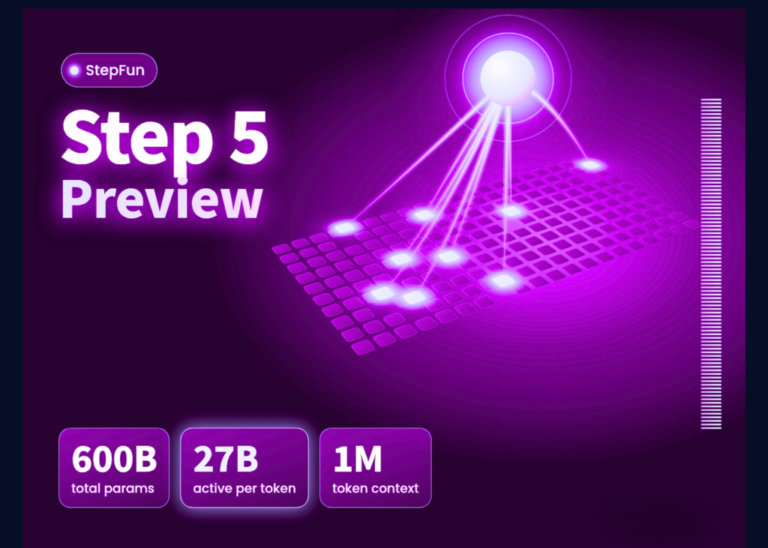
StepFun has released Step 5 Preview as open weights. The model features a 600 billion parameter Mixture-of-Experts architecture with 27 billion parameters active per token and a context window of one million tokens. Checkpoints in FP8 and BF16 formats are available on Hugging Face and ModelScope.
Technical specifications
Developers can now self-host this model for coding agents, document analysis, and finance workflows. However, the hardware requirements are substantial. The FP8 version requires four Blackwell B300 GPUs or eight H200 GPUs. The BF16 version needs eight B300s or sixteen H200s.
StepFun positions the model for software engineering, professional knowledge work, and finance. It is designed to navigate large codebases, coordinate changes across multiple files, and run code to iterate on results. The system also processes long documents, charts, screenshots, and video to generate structured reports.
The API launched on September 20. The weights followed on October 14.
Architecture details
Only 27 billion of the 600 billion parameters activate per token. StepFun’s technical team provides the following specifics on the internals:
- Depth: 92 transformer blocks arranged in a narrow, deep design.
- Attention mix: Gated sliding-window attention and full attention layers are interleaved in a 3:1 ratio.
- Sparse GQA: Full-attention layers select 4,096 history tokens per query, scored in blocks of eight.
- Speculative decoding: An MTP-3 head delivers roughly a 30% end-to-end speedup.
- Training: FP8 mixed precision with reinforcement learning on million-level verifiable agentic environments.
Benchmark performance
StepFun ran its own evaluations at the High reasoning setting. Rivals in the comparison chart ran at Max effort, meaning the figures are not like-for-like.
StepFun-reported results include:
- DeepSWE v1.1: 67.7
- Terminal-Bench 4.0: 33.3
- Agents’ Last Exam (ALE-CLI): 29.5
Independent numbers from Artificial Analysis via OpenRouter show an Intelligence Index score of 43.7. The model hits 88.3% on AA-LCR long-context reasoning and 46.5% on Humanity’s Last Exam. GDPval-AA lands at 54.3%.
Results from Vals AI highlight specific weak spots. SRE Bench is 0.4%. Harvey’s Legal Agent Benchmark is 9.2%.
On finance, the model scores 66.4% on FrontierFinance. This beats GLM-5.3 and Kimi K3 but trails Claude Opus 5 at 69.7%.
Comparison with other open-weight models
| Feature | Step 5 Preview | GLM-5.3 | Kimi K3 |
|---|---|---|---|
| Total parameters | 600B | 753B | 2.8T |
| Active parameters | 27B | Not disclosed | 104B |
| Context window | 1M | 1M | 1M |
| Input modalities | Text, image (API adds video) | Text only | Text, image |
| Weight formats | FP8, BF16 | BF16, FP8 | MXFP4 weights |
| License | StepFun Model License 1.0 | GLM-5.3 license | Kimi K3 License |
| Minimum listed self-host setup | 4x B300 (FP8) | Not disclosed | Not disclosed |
| DeepSWE v1.1 (StepFun-reported) | 67.7 | 66.9 | 67.5 |
| Terminal-Bench 4.0 (StepFun-reported) | 33.3 | 41.9 | 12.6 |
| FrontierFinance (StepFun-reported) | 66.4 | 64.1 | 62.6 |
| API price per 1M tokens (in / out) | $1.00 / $2.70 | Not disclosed | $3.00 / $15.00 |
Benchmark rows come from StepFun’s comparison chart, transcribed by CellCog and eesel.
Hardware requirements
This is a data-center model. The FP8 checkpoint alone is 650.32 GB. Listed configurations are:
- FP8 on vLLM or SGLang: 4 B300 GPUs or 8 H200 GPUs, each on one node.
- BF16 on vLLM: 1 node with 8 B300 GPUs, or 2 nodes with 16 H200 GPUs.
- Transformers: Offline generation only. The full BF16 shard workflow is not yet validated end to end.
vLLM and SGLang ship dedicated Docker images with OpenAI-compatible APIs. On Blackwell, expert-parallel modes use the MegaMoE backend. StepFun recommends temperature 1.0, top_p 0.95 and top_k 0.
API pricing
The StepFun API charges $1.00 per 1M input tokens and $2.70 per 1M output tokens. Cache hits cost $0.10 per 1M. Output pricing includes reasoning tokens. The API supports low, medium and high reasoning effort, tool calling and JSON Schema output.
What it means
The release provides a high-capacity alternative for teams running their own infrastructure. While the model does not match the raw scores of closed proprietary systems like GPT-6 Astra or Claude Opus 5, it offers a viable option for long-context reasoning tasks where self-hosting is a priority. The weak performance on Terminal-Bench 4.0 suggests caution for users relying on the model for complex terminal operations.