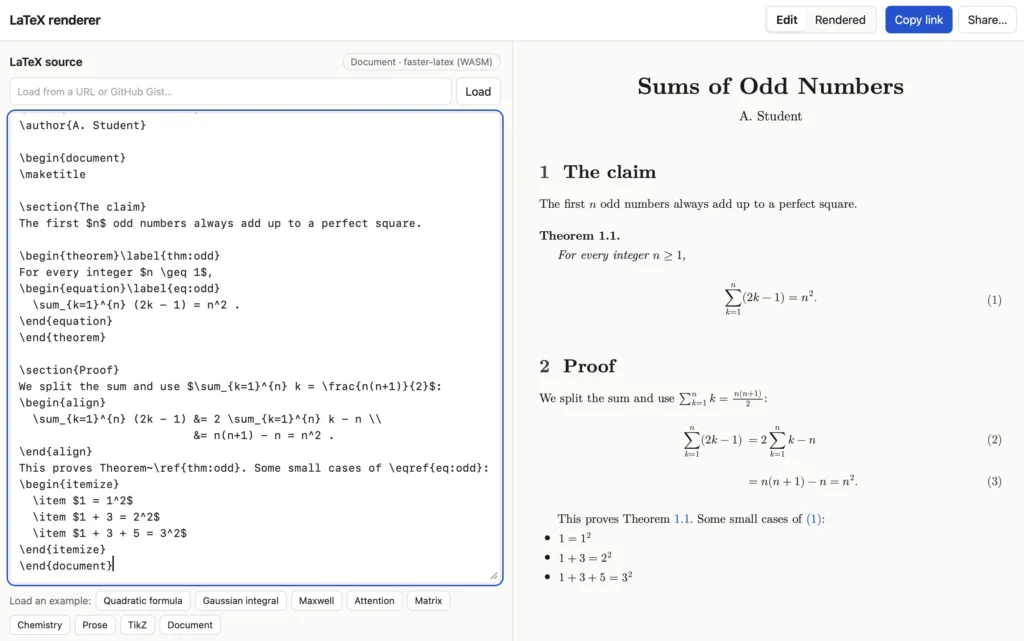
A new LaTeX renderer lets you share rendered math formulas via a simple URL fragment.
The concept comes from Paul Ford and Aboard Foundary’s Tiny Little Office. That application stores all document data in the #fragment section of the URL. Every file created there becomes a bookmarkable link.
It also includes an llms.txt file that instructs agents on how to construct these links. Claude used that file to create a deck explaining the URL format.
The whole document is the link
No server, no database, no account
Everything after the # stays in your browser
Tiny Little Office inspired me to have Claude Code build a similar tool for LaTeX. The sequence of prompts I used was:
I want a tool where you can link to it with a fragment hash #code-here and it treats that code as LaTeX and renders it really effectively. It should also support a prefix which means the latex is compressed with a custom compression dictionary optimized for latex. Use the best available latex render library from a CDN (consider WebAssembly too). If loaded without a fragment hash show an editor you can paste latex into and then toggle to a “rendered” view. That rendered view should be bookmarkable. The #fragment view should let you switch to edit source too.
Since the project lived in my tools repo, I asked it to take inspiration from the iframe sandbox mechanism used by my existing SVG in Markdown tool as protection against XSS risks.
Safe from XSS? We could run in an iframe sandbox like we do on the SVG markdown render project
I had it copy the Gist/URL loading feature from that tool as well.
We should have an option to load latex from a URL (or gist) similar to the markdown SVG tool
How it works
Here is an example link. The tool uses Pako 2.1.0, MathJax 4.1.3, faster-latex 0.3.1, and DOMPurify 3.4.16.
What it means
Users can share specific LaTeX documents via a URL without needing a server or database. The system runs entirely in the browser using WebAssembly. People can edit source code in a pane and toggle to see the typeset output, or load documents directly from a GitHub Gist.