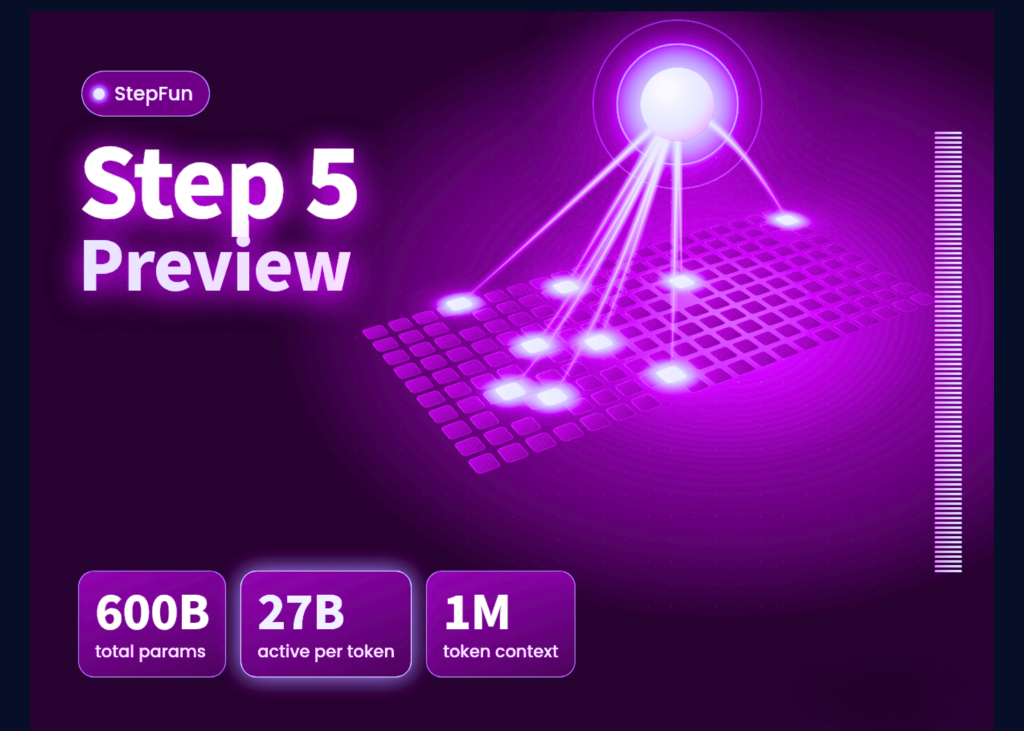
StepFun has launched Step 5 Preview, a new model designed for software engineering and finance tasks. The company claims it matches the intelligence of current rivals while costing less per task. This is the core selling point, framed as a Pareto frontier improvement.
The model is available immediately via API and the StepFun platform. Self-hosting requires waiting for open weights, which arrive on October 15, 2026. A 600B parameter model in BF16 format requires roughly 1.2 TB of storage before accounting for KV cache. Organisations should plan for multi-GPU server hardware once the weights are released.
Technical Specifications
Step 5 Preview is a sparse Mixture-of-Experts (MoE) architecture. It contains approximately 600B total parameters but activates only about 27B per token. This represents a usage of roughly 4.5% of the total weights for every request.
The official documentation lists the following specifications:
- Model ID: step-5-preview
- Context window: 1M tokens
- Input: text, images, and video
- Output: text
- Reasoning effort: low, medium, and high
- Features: streaming, tool calling, JSON Mode, JSON Schema, and prompt caching
In research tests, the model coordinated 950 web fetches within a single agent action. StepFun also documents an integration with Claude Code through its Step Plan feature.
Architecture: Narrow and Deep
The development team did not widen the network size. Instead, they stacked 92 Transformer layers in a narrow-deep layout. This approach creates longer paths for implicit multi-hop reasoning. This structure matters during long prefill phases when agents search, run code, and read tool returns.
Training relies on on-policy, long-horizon reinforcement learning. The research team cites bit-wise alignment between training and inference across MoE routing. Other listed techniques include MTP-3 speculative decoding, FP8 MoE, and KV-cache offload. StepFun reports more than 3x end-to-end speedup for long-horizon RL tasks.
Performance and Benchmarks
StepFun ran its model at High effort settings, while competitors tested at Max settings.
The company reported results via RuntimeWire:
| Benchmark | Step 5 Preview | Claude Opus 5 | GPT-6 Astra |
|---|---|---|---|
| FrontierFinance | 66.4 | 69.7 | 55 |
| DRACO | 83.3 | 87.6 | 76.8 |
On coding tasks, StepFun scored 67.7 on DeepSWE v1.1, 49.0 on StepCodeBench, and 80.5 on ProgramBench. GPT-6 Astra and Claude Opus 5 remain ahead on all three metrics. StepCodeBench is a benchmark created by StepFun.
The company also ran two agent experiments lasting 24 hours each. In the first, the model tuned an H100 kernel to 508 TFLOPS, compared to 493 for Claude Opus 5. In the second, it raised Qwen3-30B-A3B scores on AIME24 from 53.3% to 60% through automated post-training.
Independent checks come from Artificial Analysis. It scores Step 5 Preview at 44 on its Intelligence Index. The median score for reasoning models in a similar price tier is 24. The service measured output speed at 99.8 tokens per second on the StepFun API.
Pricing
StepFun lists API prices per 1M tokens:
| Token type | Price |
|---|---|
| Input, cache miss | $1.00 |
| Input, cache hit | $0.05 |
| Output, including reasoning | $2.70 |
Artificial Analysis places the median prices for comparable models at $1.88 for input and $10.00 for output. There is one catch. The model generated 160M output tokens on the index run, against a 92M median. Verbose reasoning consumes part of the per-token savings.
What it means
Developers can access the model immediately via API, but those wishing to run it on private hardware must wait until October 15, 2026. The pricing structure is lower than the industry median, though the cost advantage shrinks if the model generates excessive reasoning text. The narrow-deep architecture suggests the system prioritises reasoning depth over width, which may benefit complex coding tasks.