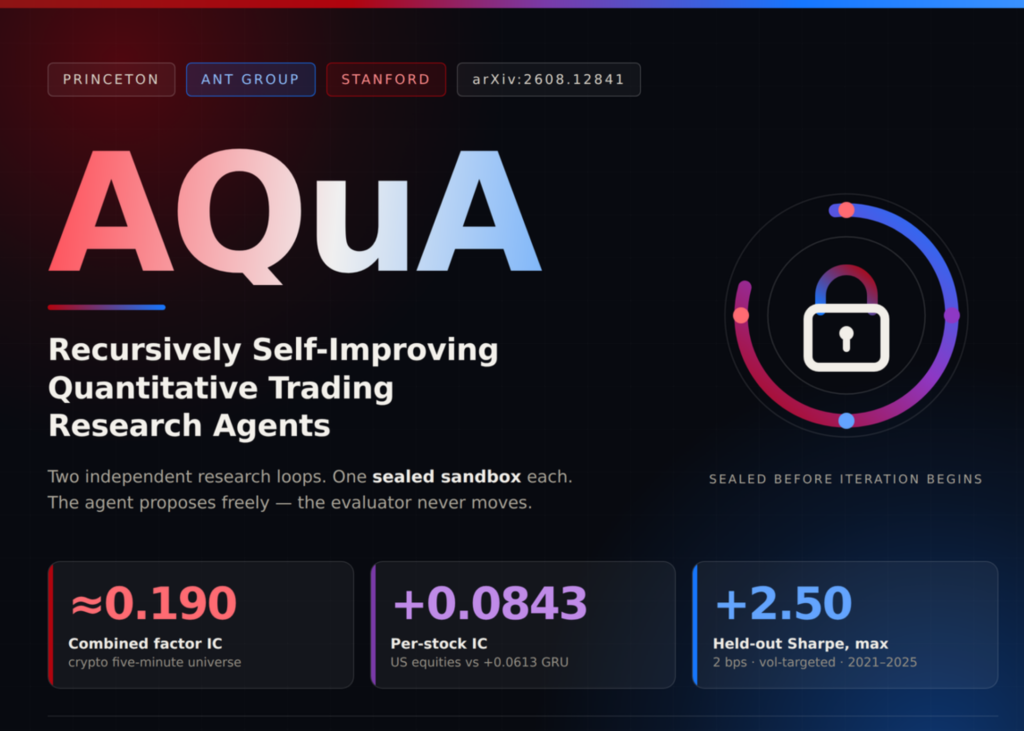
A leaky feature that scores well gets stored as precedent, corrupting evidence for later iterations. A team from Princeton University, Ant Group and Stanford University proposes AQuA to stop this. The system uses two language-model-driven research loops. One discovers symbolic alpha factors on crypto. The other develops time-series models on US equities. They share no agents, memories, candidate spaces or research state. The evaluator stays frozen while the agent explores.
The failure mode AQuA is built around
Quantitative research breaks on small methodological errors that produce convincing but non-reproducible backtests. An agent writing its own experiments makes this worse. Recursion amplifies an undetected bug as readily as a real discovery. Prompt-level instructions and model review are not an integrity boundary. Repeated access to a fixed holdout causes adaptive overfitting. LLM agents have been observed exploiting misspecified objectives and evaluators.
AQuA instead makes leakage-inducing actions unavailable. Each part fixes its splits, feature and label definitions and evaluator before any iteration starts. The agent emits only a constrained factor expression or a single config diff. The research team call this asymmetric freedom: the agent explores freely inside its DSL, but the evaluator sits outside the adaptive surface. What improves is the research process.
Part I: Manager-Mediated Factor Discovery
Part I is a six-agent pipeline: Data Steward, Visual Analyst, Idea Miner, Factor Evaluator, Backtest Engineer and Research Librarian — orchestrated by an AI Manager. Agents never call one another; every handoff goes through the Manager, keeping runs auditable.
A factor enters as a falsifiable proposal, not an expression: hypothesis, mechanism, predicted direction, and refutation conditions. Only then is it assembled from the standard formulaic-alpha operator registry. Because every time-series operator reads only a trailing window and every cross-sectional operator reads only the current timestamp, causality is closed under composition. Three feedback loops run: direction calibration inside a backtest, falsification-driven belief update inside a run, and cross-run memory that steers the next search.
On a crypto five-minute universe the combined validation Spearman IC climbs across 20 research epochs to approximately 0.190. This beats 0.171 for an adapted AlphaMemo, 0.151 for an adapted AlphaGen, 0.137 for LSTM, 0.106 for LightGBM and 0.075 for an Alpha158-style baseline. Individual mechanisms stay weak — single-factor ICs of 0.026 to 0.037. The claim is about the harness, not one expression.
Part II: Config-Driven Model Development
Part II predicts each stock’s forward return over the next thirty minutes on intraday US equities. Training runs on 2010–2019. 2020 is an embargo gap nothing touches. 2021–2025 is untouched test data. Selection uses an inner-validation slice from the end of the training window only.
A hypothesis here is one config diff — architecture, loss, sampler or optimizer — and one diff produces exactly one variant, keeping variants comparable. The predictor is a hybrid: a multi-scale 1-D convolutional front-end, a configurable backbone spanning LSTM, Mamba and attention (attention in the reported run), a cross-sectional stage that mixes across the panel, gated fusion and a pooled per-stock readout.
No single price-volume feature carries the signal. The strongest is a 5-minute return at -0.031, and a ridge combination reaches only +0.025. Across model families on identical data and the same evaluator, per-stock raw IC runs +0.0251 (ridge), +0.0397 (LGB), +0.0434 (xLSTM), +0.0535 (LSTM), +0.0613 (GRU) and +0.0843 for the hybrid. The hybrid is +0.0230 absolute over the best baseline, 37.5% relative. The two parts’ ICs use different conventions and the paper states plainly they should not be compared.
From Signal to Strategy
The per-stock score becomes a dollar-neutral threshold long/short book at a two-leg cost of 2 bps. Sector-neutralizing raises the held-out Sharpe to +2.15, with training and held-out values nearly equal. A causal volatility-targeting overlay lifts it to +2.50. A fully causal walk-forward choosing every parameter from past data alone still reaches +2.00. Per-stock R² is 1.20%. Sharpe by year runs +1.7, +3.5, +1.9, +1.8 and +2.7 for 2021 through 2025. The returns are positive in every year, including the 2022 drawdown.
What it means
Traders and researchers get two distinct tools. One builds crypto factors without letting the model cheat on its own data. The other tunes equity models without letting them memorise the training set. The system forces every step to be auditable and prevents the common error where a model improves simply by seeing the test data again.