Anthropic releases Claude Fable 5.1 and Mythos 5.1 with lower costs and better coding results
Anthropic has launched two new models, Claude Fable 5.1 and Mythos 5.1. These updates deliver improved coding performance and text quality while reducing operational costs by up to 45 percent.
Both models rely on the same underlying architecture but apply different safety guardrails. Fable 5.1 is available to the general public. Mythos 5.1 remains restricted to specific access programmes for cybersecurity and life sciences sectors.
These are the first Claude models to include built-in watermarks. Anthropic is launching a detection API in private preview to allow regulators, media outlets, fact-checkers and research institutions to verify if a text contains a watermark. The company plans to expand access over time. Interested parties can sign up via the provided link.
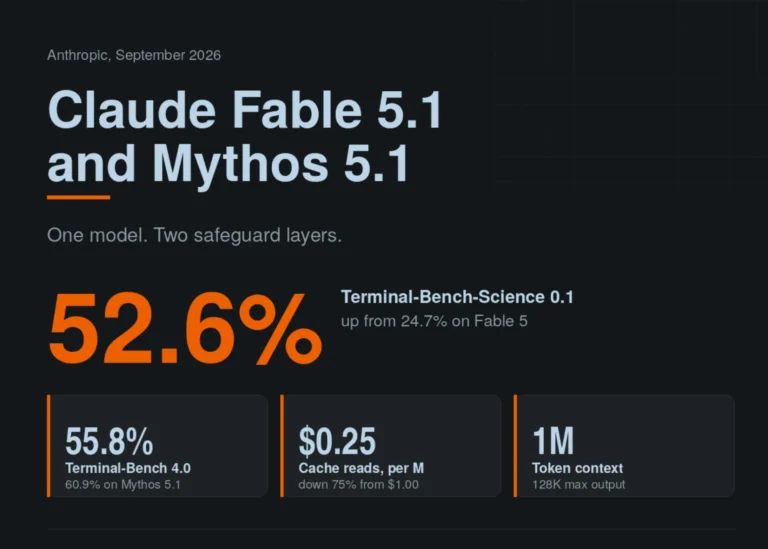
Fable 5.1 costs about 25 percent less than Fable 5 for typical workloads. Savings rise to roughly 45 percent for heavily agentic tasks involving long, autonomous runs with many tool calls. Anthropic achieved this by reducing cache reads from $1 to $0.25 per million tokens. All other API prices remain unchanged at $10 per million input tokens and $50 per million output tokens. Opus 5 runs at half that price, with $5 input and $25 output per million tokens.
High cost was the primary complaint regarding Fable 5, likely contributing to low adoption among enterprise customers. Price pressure has increased since Opus 5 launched in late July, matching or beating Fable 5 on most benchmarks at a lower price. Like earlier Claude models, the new versions include an effort-level system that controls compute usage. At low or medium effort, Fable 5.1 should match Fable 5’s results at a lower cost.
Performance gains in coding and research benchmarks
Fable 5.1 shows major improvements on agentic benchmarks. On Terminal-Bench-Science 0.1, the model reaches 52.6 percent, more than double Fable 5’s 24.7 percent and well ahead of GPT-5.6 Sol at 22.4 percent. On Terminal-Bench 4.0 for agentic coding, Fable 5.1 scores 55.8 percent while Mythos 5.1 reaches 60.9 percent, compared to 42.0 percent for Fable 5 and 37.3 percent for GPT-5.6 Sol.
Whether these gains translate to real-world use at the same scale will become clear over the coming weeks.
| Fable 5.1 | Fable 5 | Opus 5 | GPT-5.6 Sol | |
|---|---|---|---|---|
| Agentic Scientific Research Terminal-Bench-Science 0.1 | 52.6% | 24.7% | 29.0% | 22.4% |
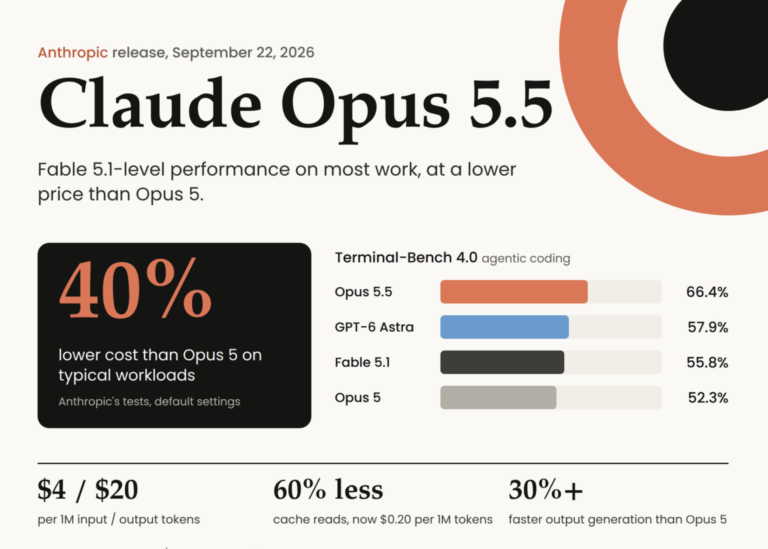
| Agentic Coding Terminal-Bench 4.0 | 55.8% / 60.9% (Mythos 5.1) | 42.0% | 52.3% | 37.3% |
| Knowledge Work GDPval-AA v2 | 1853 | 1723 | 1824 | 1711 |
| Computer Use OSWorld 2.0 (partial) | 77.9% | 72.9% | 75.4% | — |
| Computer use OSWorld 2.0 (strict) | 41.7% | 36.1% | 39.6% | — |
| Multidisciplinary reasoning: Humanity’s Last Exam (no tools) | 60.9% | 57.8% | 56.6% | — |
| Multidisciplinary Reasoning: Humanity’s Last Exam (with tools) | 65.0% | 63.8% | 63.6% | — |
| Business Workflows AutomationBench | 31.4% | 17.1% | 26.9% | 19.6% |
| Agentic Coding CursorBench 3.2.0 | 73.4% | 70.5% | 70.0% | 67.2% |
Anthropic researcher Felix Rieseberg says Fable 5.1 also improves its writing style. Earlier models leaned too heavily on bullet points and bold text in chat, and Fable 5.1 dials that back while following style instructions more closely and sounding more natural overall.
Fable 5.1 opens up for cybersecurity work
The safety filters for cybersecurity, biology and medical questions are less aggressive than in earlier versions. In the 5.0 models, they were so sensitive that they triggered on well-intentioned requests too, producing false positives at a frustrating rate.
The cybersecurity filters in 5.1 generate 60 percent fewer false positives, and for biology-related queries, the filters fire 85 percent less often on harmless questions about basic biology and medicine.
Fable 5.1 can now identify software vulnerabilities for the first time, though it cannot develop exploits. Penetration testing and exploit generation still get routed to the Opus models. Mythos is also part of Claude Security for defensive purposes.
How to access Fable 5.1 and Mythos 5.1
Claude Fable 5.1 is available immediately on all platforms, including AWS, Google Cloud and Microsoft Azure. Developers can access it via the API using claude-fable-5-1. For enterprise customers, Anthropic is rolling out Enterprise Frontier Safeguards (EFS), which store customer data solely on the customer’s own cloud infrastructure.
Claude Mythos 5.1 is currently limited to US organisations through two programmes: the Cyber Verification Program for defensive security work and the Life Sciences Verification Program, developed with the US government. Anthropic plans to expand access to international partners.
Anthropic is also cracking down on distillation attacks, where a model’s capabilities are systematically extracted through thousands of fake accounts. New API accounts can no longer edit Claude’s prior context in multi-turn conversations while keeping the thinking transcript, which according to Anthropic closes a documented distillation technique.
What it means
Developers and researchers can run complex autonomous workflows for less money. The drop in cache read costs makes long-running tasks significantly cheaper without changing the output quality. Security teams gain a model that identifies vulnerabilities without being blocked by overly sensitive safety filters. Content creators get a tool that writes more naturally and includes watermarks for verification.