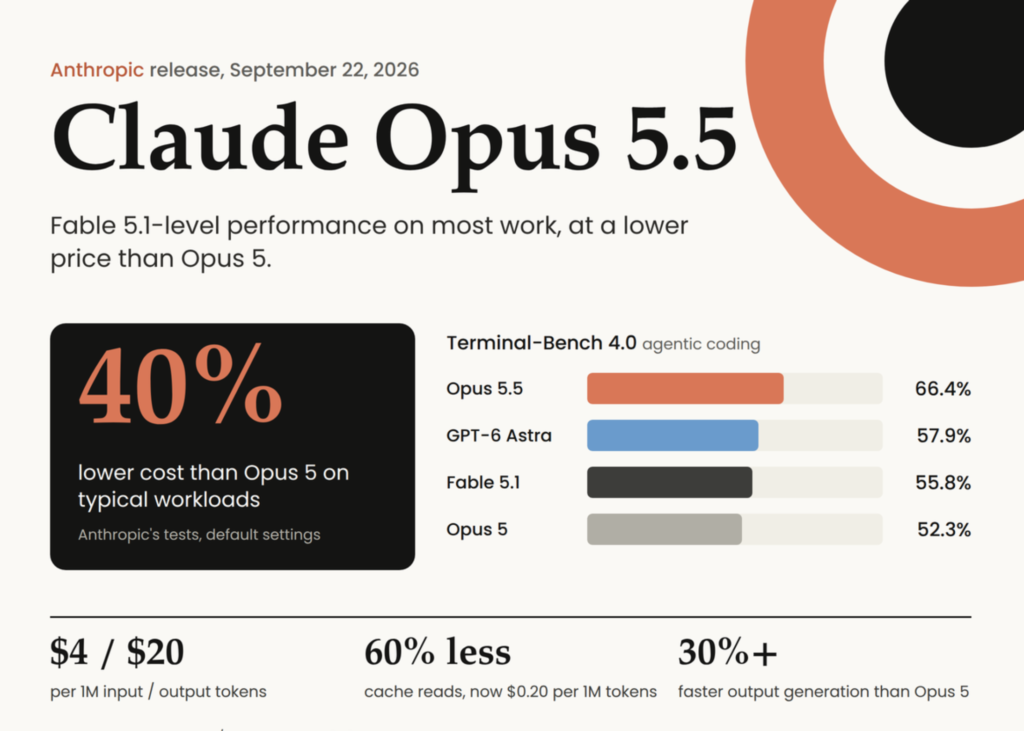
Anthropic has launched Claude Opus 5.5, the first model in its new Claude 5.5 family. The company states the system performs at the level of its internal benchmark, Claude Fable 5.1, on most tasks. Running costs are 40% lower than Opus 5 on typical workloads using default settings. On Anthropic’s own benchmarks, the model leads in agentic coding, computer use, and knowledge work.
The model is available as a managed API service. Anthropic has not released weights, meaning developers cannot self-host the system. Users can call the `claude-opus-5-5` model via the Claude Platform, Amazon Web Services, Google Cloud, and Microsoft Azure. Zero data retention is available, consistent with previous Opus models.
Benchmarks show a lead, not a total victory
Opus 5.5 scores using adaptive thinking at maximum effort with production safeguards enabled.
| Benchmark | Opus 5.5 | Fable 5.1 | Opus 5 | GPT-6 Astra |
|---|---|---|---|---|
| Terminal-Bench 4.0 | 66.4% | 55.8% | 52.3% | 57.9% |
| FrontierCode v1.1 | 54.4% | 50.3% | 48.0% | 53.3% |
| CursorBench 4.0 | 57.8% | 51.8% | 46.6% | n/r |
| GDPval-AA v2.1 (Elo) | 1846 | 1735 | 1708 | 1542 |
| OSWorld 2.0 | 81.8% | 80.7% | 74.0% | n/r |
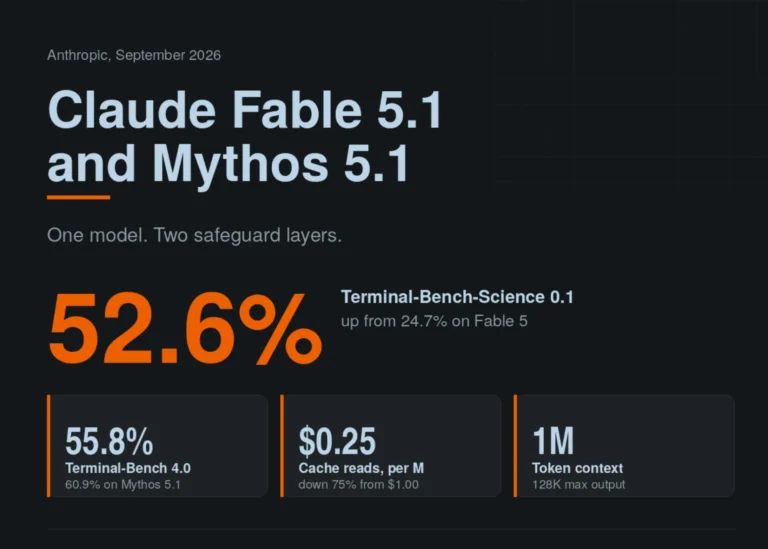
| Terminal-Bench-Science 0.1 | 58.7% | 52.6% | 29.0% | 64.6% |
| AutomationBench | 40.0% | 31.4% | 26.9% | 41.4% |
Terminal-Bench 4.0 is reported at xhigh effort for Opus 5.5. GPT-6 Astra still leads on Terminal-Bench-Science and AutomationBench. Zapier ran AutomationBench without fallback models, so safeguard interventions counted as failures. Anthropic cautions that benchmark margins are becoming a less reliable guide. In its own use, the gap to Fable 5.1 is narrower than the scores suggest.
The cost-adjusted results are more telling. At default medium effort, Opus 5.5 scores 54.6% on FrontierCode. That beats GPT-6 Astra’s top score of 53.3% at about a fifth of the cost per task. On CursorBench, medium effort scores 52.5%. That is 11 points above GPT-5.6 Sol’s best, at about a third of the cost.
Pricing and speed
Opus 5.5 needs less compute to serve than Opus 5, and pricing reflects that.
| Per 1M tokens | Opus 5.5 | Opus 5 |
|---|---|---|
| Input | $4 | $5 |
| Output | $20 | $25 |
| Cache reads | $0.20 | $0.50 |
| Cache writes | $5 | $6.25 |
Cache reads make up most agentic and coding costs, and they drop 60%. Opus 5.5 also uses fewer tokens per task. Together, that nets out to the 40% cost reduction. Output generation is more than 30% faster than Opus 5. Fast mode in Claude Code and the Claude Platform offers up to 2.5x speed at $8 input and $40 output per million tokens.
Anthropic is also raising five-hour usage limits on Pro, Max, Team, and seat-based Enterprise plans. Subscribers get a rate limit reset they can save and use later.
What Early Testers Reported
- One tester completed a 680,000-line code migration in less than a day.
- Another audited and fixed a 200,000-line codebase in under 3 hours. Opus 5 took over 20 hours and 2.5x the tokens.
- In an internal C to Rust port of HAProxy, Opus 5.5 finished in 9.5 hours. Fable 5.1 took 12 hours, and Opus 5.5 cost 51% less.
- Deloitte says Opus 5.5 at lowest effort caught 72% of known review bugs. Opus 5 at high effort caught 56%.
- In a hard-to-source earnings report test, 16 of 18 Opus 5.5 reports cleared Anthropic’s quality bar. Fable 5.1 and Opus 5 never did.
Writing style also changed. Opus 5.5 puts key information first, uses less jargon, and follows the writing rules you give it.
Safety, safeguards, and API changes
Opus 5.5 is Anthropic’s first release since CEO Dario Amodei called for pacing the frontier. External evaluators including METR and Frontier Design tested it before release. It posts the best score to date on Anthropic’s automated behavioral audit, which covers nearly 2,000 scenarios. In a new containment test, it tried to circumvent boundaries about 85% less often than Opus 5. Anthropic also notes the model often suspects it is being evaluated.
Its biology and cyber capabilities are comparable to Claude Mythos 5.1. So Opus 5.5 ships with safeguards similar to Fable 5.1:
- Cybersecurity: Routine bug finding and fixing works. Most other cybersecurity tasks are re-routed to Opus 4.8. The Cyber Verification Program will expand to Opus 5.5.
- Biology: Vetted organizations can apply to the Life Sciences Verification Program.
- Distillation: Preserved thinking stops API users from editing prior context to extract reasoning. It applies to API accounts created on or after August 31, 2026.
Two more changes affect integrations. Thinking can no longer be disabled. Outputs also carry watermarking for EU AI Act compliance. Full details are in the Opus 5.5 System Card.
What it means
For developers, the main change is efficiency. The model handles long code migrations and complex audits significantly faster than the previous version. The cost drop on cache reads is the biggest financial relief for teams running agentic workflows. However, the inability to disable thinking means users must accept the latency for every request. The stricter safety routing means some cybersecurity tasks will now hit a lower-tier model, which may affect consistency for highly technical security tasks.