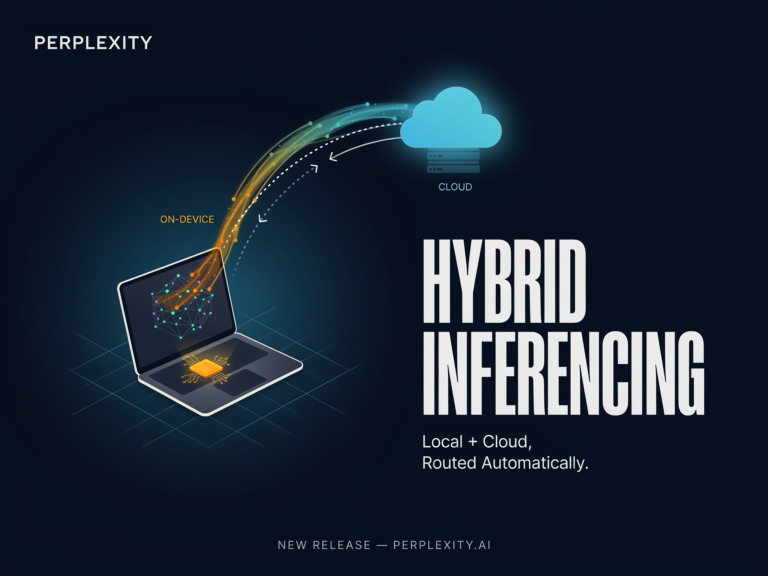
Perplexity has launched Hybrid Compute on Mac, allowing its agents to split tasks between cloud models and a local model on the user’s device. A privacy gate on the Mac decides which data stays local and which crosses the network boundary.
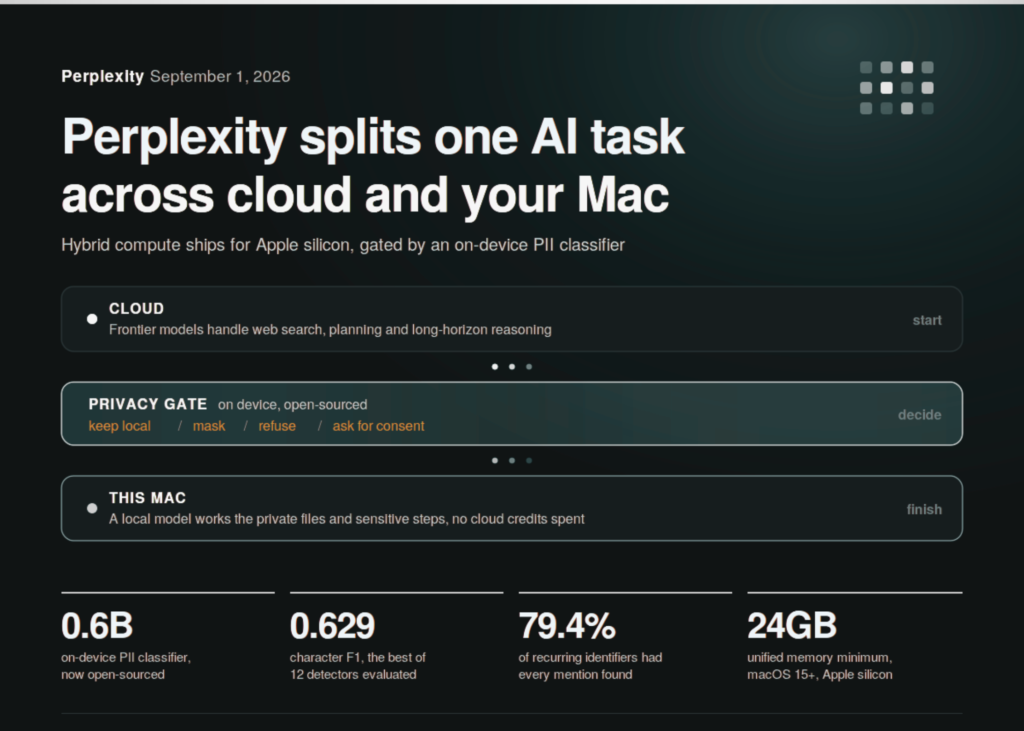
The feature is available now for Pro, Max, and Enterprise subscribers. It requires an Apple silicon Mac running macOS 15 or later with a minimum of 24GB of unified memory, though 32GB is recommended. The local model installs via a single click within the Mac app. It does not require Ollama, separate runtimes, or API keys. Local processing does not deduct from cloud credits.
How the system orchestrates work
The architecture begins in the cloud. Frontier models handle web searches, planning, and long-horizon reasoning. When a step requires access to private files or sensitive data, the agent hands that specific step to the local model on the Mac. The system does not restart the task or lose context during the handoff. It merges the cloud and local halves into a single result.
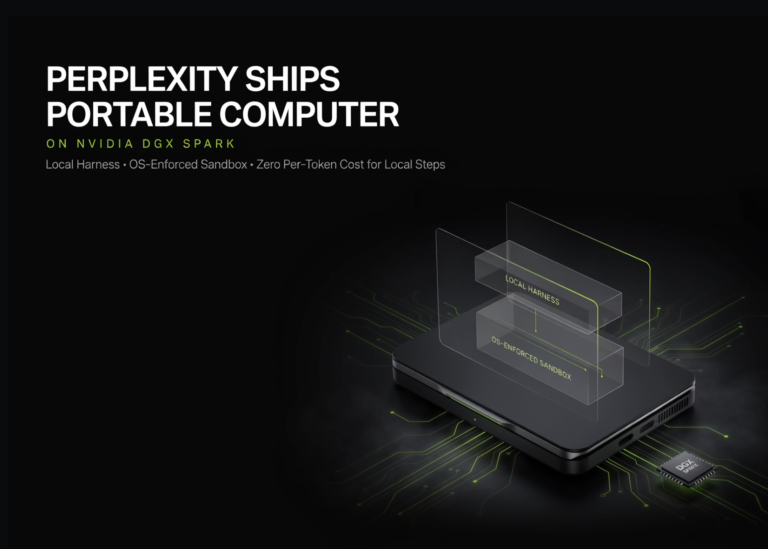
This approach inverts the local compute mode Perplexity released for NVIDIA DGX Spark earlier in the week. That mode starts on user hardware and escalates to the cloud with permission. The same orchestrator manages the process, but the default direction is reversed.
Because the system works with iPhone, a task can be triggered remotely while sensitive steps execute on a Mac at the desk. Perplexity suggests using an always-on Mac mini as a dedicated local inference node for this workflow.
The privacy gate mechanism
Before data from a protected file reaches the cloud, an on-device classifier inspects it. The gate applies one of four outcomes: keep the data local, mask sensitive spans, refuse the action, or ask the user for consent. Credentials, payment card numbers, and government IDs receive the strictest handling. Masked values are swapped for stand-ins during transmission and restored when the cloud answer returns.
PII-Tracer is a 0.6B bidirectional encoder adapted from a Qwen3 backbone. It replaces the causal mask with padding-aware bidirectional attention over a 4,096-token window. A linear tagging head emits 37 labels, including one outside-span label plus BIOES position labels for nine PII types. An auxiliary head predicts whether a conversation contains sensitive material. Training ran three epochs on roughly 714,000 samples, and a constrained Viterbi decoder resolves the label sequence at inference.
PII-TRACE, the accompanying benchmark, contains 13,148 synthetic conversations across 13 languages and 10 writing systems, with 37,431 character-level identifier mentions. It argues that finding most PII in a long conversation is not the same as finding every copy of it.
On results: across 12 detectors, PII-Tracer records the highest character F1 (0.629) and the second-best span-overlap and span-containment F1, behind GPT-5.6-sol. On consistency it leads by a wide margin — every mention found for 79.4% of recurring identifiers and 77.6% of cross-turn identifiers, versus 57.0% and 55.1% for GPT-5.6-sol. In the hardest bucket (6–10 mentions) it scores 0.691 against 0.464 for GPT-5.6-sol, 0.073 for GLiNER2-PII, and 0.045 for Claude Opus 4.8.
Single-window recall drops from 0.975 on conversations under 1,000 characters to 0.687 at 10,000 characters or more. Perplexity’s fix is decoding, not retraining: 50%-overlap sliding windows lift overall character recall from 0.830 to 0.965 and multi-mention consistent detection from 0.794 to 0.954 on the same checkpoint.
Models and controls
Perplexity lists three local models at launch: Gemma 4 E4B, Qwen3.6 35B-A3B, and a Perplexity model post-trained for Computer. The product page setup flow points to a one-click download of PPLX Qwen 3.8 27B. The Hugging Face org carries matching pplx-computer-qwen-3-8-27b builds alongside pplx-pii-masking-vllm, the 0.6B token-classification model behind the gate.
For Enterprise, admins can set org-wide rules for what must stay on device, what may be masked, and what requires explicit approval. The system includes audit logs for when information leaves a machine. This is the feature that makes the tool usable for legal, healthcare, and financial teams rather than just interesting.
What it means
Users with sensitive data no longer need to choose between privacy and capability. The agent handles the heavy lifting in the cloud while keeping private files on the machine. Enterprise admins gain granular control over data movement. The open-source PII-Tracer model provides a new standard for detecting personal data before it leaves the device.