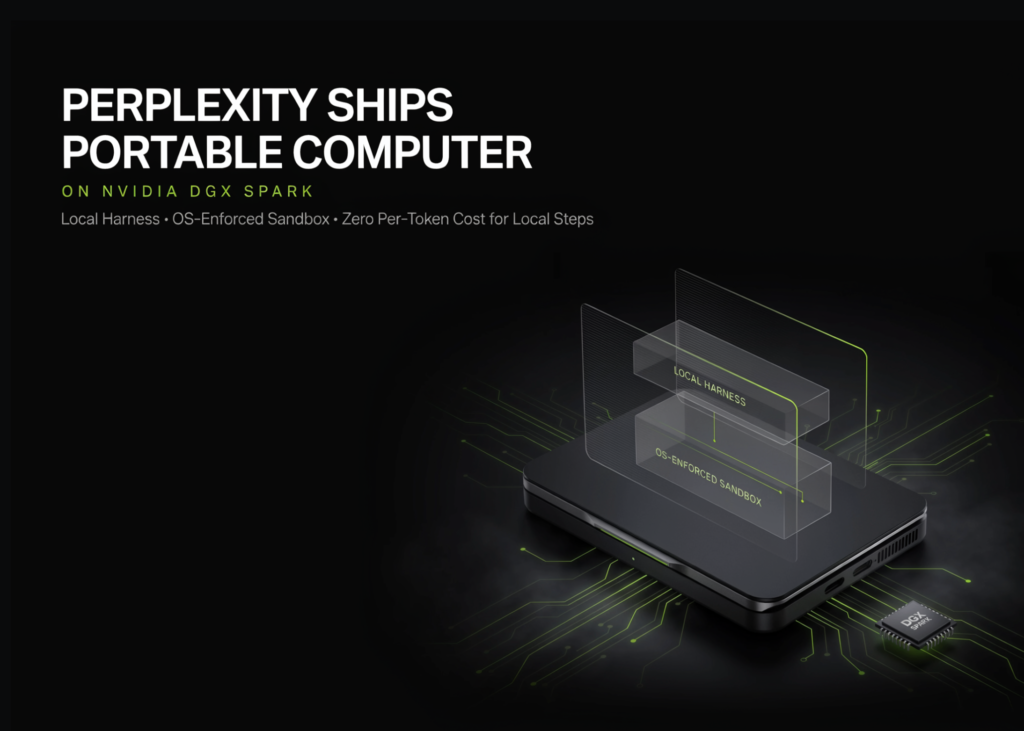
Perplexity has released Portable Computer, a local-first build of its agent platform that runs the harness, orchestrator, planner, and tool router directly on NVIDIA DGX Spark hardware. This packaged system keeps every task on the device, and work handled by local models incurs no per-token charge. When a step requires live web access or frontier reasoning, the orchestrator stops and asks before sending that single step to one of 15+ cloud models.
Deployment requirements
Yes, but it needs specific hardware. This is shipping software, not a preview, yet it requires a GB10-class box or an RTX GPU with 24 GB of VRAM under the desk.
- Company level: Enterprises and mid-market teams that already own NVIDIA workstations, plus well-funded AI-native startups. It is not viable for general small businesses — the machine is the price of entry.
- Industries: Finance, legal, healthcare, government, and defense, and IP-heavy engineering — anywhere data residency or contractual confidentiality blocks cloud inference.
- Applications: Fee and disclosure review across document sets, PII-bounded research, repo-scale migrations, batch summarization of local corpora, and PR triage that ends in Slack.
What actually ships on the device
Portable Computer is not a local chat app with a file picker. Perplexity packages the local model, inference engine, agent harness, tool sandbox, and app connectors as one system. This removes the usual work of standing up an inference server and wiring tools by hand. Users select either Qwen 3.8 27B or PPLX 27B — Perplexity’s post-trained variant tuned for its own harness — with NVIDIA Nemotron 3.5 Lightning, an open 30B MoE model, listed as coming soon. Bring-your-own model and inference server is also supported.
Code and tool calls execute inside an OS-enforced sandbox that restricts processes, filesystem paths, and network access. If the sandbox is unavailable, tool execution is disabled rather than silently downgraded. Gmail, Outlook, Slack, and GitHub connectors route through the local orchestrator.
The escalation gate is the actual design decision
Local-first is not local-only. When a step needs the live web or frontier reasoning, the orchestrator stops and asks. Before any call, the harness selects the relevant context, runs a PII classifier over it, and shows the user exactly what would leave the machine. The approved step routes to one of 15+ cloud models; the remote adviser returns text guidance and never receives direct access to local files, tools, or the conversation.
Perplexity also engineered around small-model context limits. Qwen 3.8 27B advertises a 260K-token window but degrades past roughly 100K, so the harness keeps the system prompt and toolset small, loads specialized skills on demand, exposes connectors as compact CLI tools instead of full MCP definitions, and compacts stale context mid-run.
Benchmarks
On its 53-task Local Knowledge Work Bench — spanning deep research, financial analysis, and document creation, which Perplexity says it plans to open-source — Computer running Qwen 3.8 27B on a DGX Spark scored 82.6%, against 77.6% for the open-source Pi harness and 74.0% for Hermes on the identical model. PPLX 27B raised it to 85.4%.
On BrowseComp, Computer hit 66.7% versus 50.2% (Pi) and 43.9% (Hermes), using 51% less wall time and 70% fewer tokens than Pi. On ParseBench-100 for visual document understanding, it scored 65.1% against 34.6% and 13.9%.
The most informative result is the hybrid one. On Terminal Bench 2.1, the fully local run scored 59.6% at effectively zero marginal cost. Adviser escalation lifted it to 73.0% at roughly $0.415 per rollout, compared with 82.4% at about $0.65 for Claude Opus 5 alone. Escalation narrows the gap to frontier models without closing it.
Hardware, pricing model and limits
DGX Spark installs need the GB10 superchip, 128 GB of memory, and at least 1 TB of storage. The Qwen 3.8 27B orchestrator ships at 3-bit quantization, a 17.4 GB download, requiring 32 GB RAM. Nemotron 3.5 Lightning is 4-bit, 19 GB, requiring 36 GB. Other systems need DGX OS or Ubuntu on ARM or x64 with an RTX GPU carrying 24 GB or more of VRAM. Installation is a standard apt repository add.
Availability is Linux-first for Pro, Max, Enterprise Pro, and Enterprise Max subscribers. Windows follows in September, and macOS is not on the roadmap. Only one DGX Spark is supported at launch — clustering is roadmap, not shipped. Work handled by local models carries no per-token charge, which is what makes repo-scale migrations and long verification loops economically sane on owned hardware.
What it means
This setup gives teams a way to run complex agents without sending data to the cloud for every step. The system handles the heavy lifting locally, only calling external models when the user explicitly approves a step that requires internet access or advanced reasoning. This keeps sensitive data on-premises while still allowing access to broader knowledge when necessary.