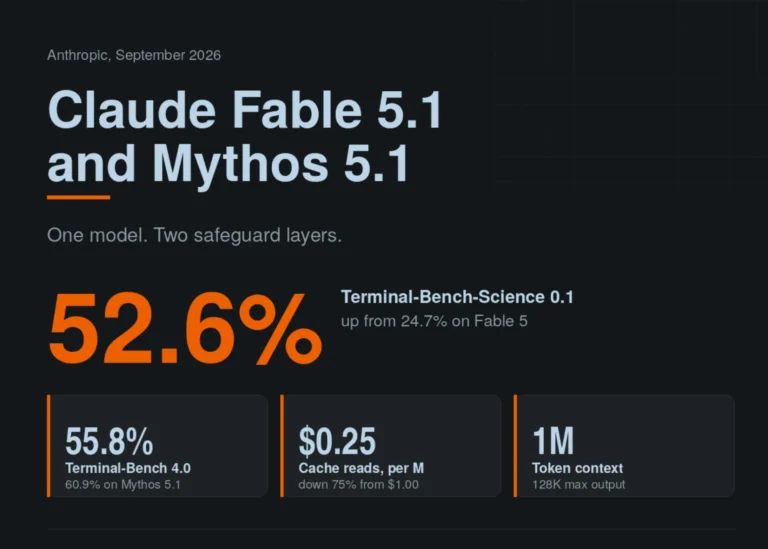
Anthropic has released Claude Fable 5.1, claiming it sets a new standard for coding and long-running problem-solving tasks. The company highlights a 52.6% score on the Terminal-Bench-Science 0.1 benchmark, an improvement from 24.7% for Fable 5 and 29.0% for Opus 5.
Pelican generation results
The author previously questioned the value of the pelican benchmark, noting its correlation with general model performance has weakened since 2025. Insights now come mainly from comparing models within families or testing the same prompt at different reasoning levels. Fable 5.1 offers five settings: low, medium, high, xhigh, and max. There is no option to disable reasoning entirely.
The author fixed a recording issue in the llm-anthropic tool and ran a series of prompts to generate SVGs of a pelican riding a bicycle.
Low and medium
At the low setting, the output contained 1,998 tokens and cost 10.017 cents. The process took 23.8 seconds. The transcript showed no summarized reasoning tokens.
The medium setting produced 1,977 output tokens, 21 fewer than the low setting. It cost 9.912 cents and took 23 seconds. No reasoning text appeared in the transcript either. For this specific prompt, the model appeared to skip reasoning at both levels.
High
The high setting generated 2,612 output tokens in 29.6 seconds. The cost was 13.087 cents. A brief reasoning summary appeared in the transcript, outlining the plan for the SVG layout, including the pelican, bicycle, and background elements.
The visual result showed little difference from the low and medium outputs.
Extra high
Switching to xhigh changed the results radically. The model produced 36,767 output tokens, which took 7 minutes 51 seconds and cost $1.83. The reasoning trace became lengthy, detailing specific adjustments like wing positioning and the decision to keep the pelican oversized for comic effect.
The author accepted slight thickness in the lines as charming rather than overengineered.
Max
The max setting delivered the best pelican seen from any Anthropic model. It generated 65,927 output tokens over 13 minutes 54 seconds, costing $3.30. The final image features a tasteful background, legs on either side of the frame, feet on pedals, and wings gripping the handlebars. The pelican wears a blue hat and sits in a basket with a fish.
The output lacked the flair seen in Gemini 3.7 Flash, but the author did not request that level of detail, only an SVG. The reasoning trace showed the model debating whether to add a scarf or cap, then deciding against clutter. It considered a helmet versus the crest, adjusted the beak to prevent overlap, and refined feather curves to be scalloped for a natural look. The model also checked vent line placements on the helmet and corrected the front fork curve to ensure it bowed forward correctly.
Animation attempt
A user on Hacker News asked for an animated version of the max pelican. To avoid another $3 cost, the author piped the max pelican into the high thinking level for animation. This generated 26,201 output tokens from 6,121 input tokens, costing $1.37.
The resulting video showed the wheels rotating in the wrong direction. The author suspects this is an artifact of converting the SVG to MP4, as the direction appears correct in the original file.