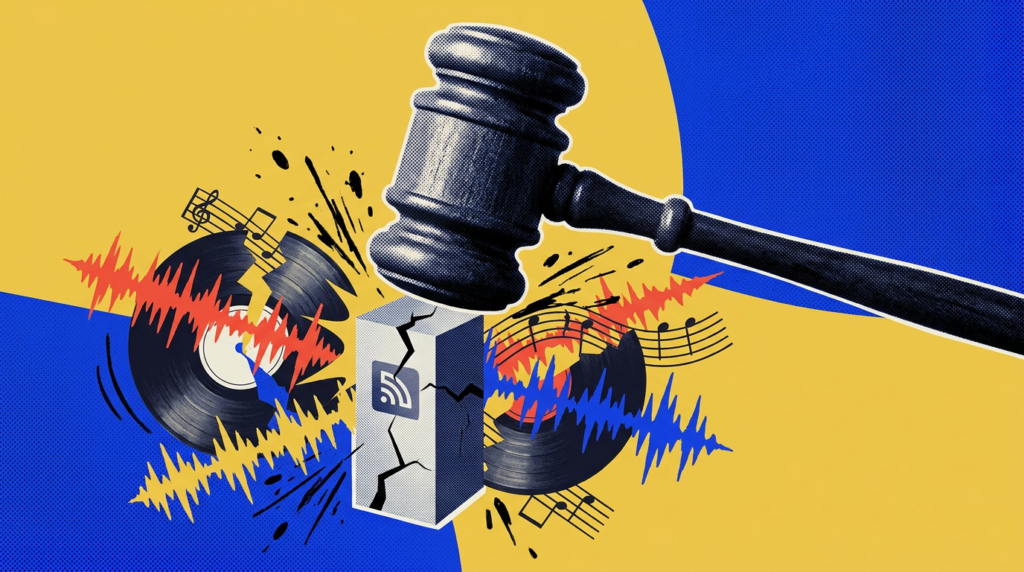
A Munich court has ruled that the AI music generator Suno violated copyrights by training on well-known musical works, rejecting the company’s fair use defense.
The decision came in a lawsuit brought by GEMA, Germany’s music rights organization. The court found Suno liable for both its training process and the infringing outputs it produced.
Memorization confirmed in testing
GEMA sued for an injunction, disclosure, and damages. The case focused on six specific songs, including “Atemlos durch die Nacht” by Kristina Bach and “Rasputin” by Frank Farian, Fred Jay, and George Reyam. The dispute concerned only the musical compositions, not the lyrics.
The judge determined that all six tracks are reproducibly contained in Suno’s version 3.5 and 4 models. In AI research, this is known as memorization. During training, a model may store specific content rather than just learning general patterns, which it can later pull back out as outputs.
Suno argued its model does not store songs, only “mathematically learned patterns and generalized features.” The company claimed any similarities in the outputs were the result of user prompts and statistical correlations.
To test this, GEMA entered each song’s original lyrics, musical style, and title into the generator. It made no specifications about melody, harmony, rhythm, or arrangement. Suno still produced results where the court recognized the original elements of the source tracks. Given the complexity and length of the songs, the court ruled out coincidence.
The company bears the blame
The court explicitly held Suno responsible for the infringing outputs, not the users who typed the prompts. Suno had argued that deliberate user input broke the causal chain between the model and its output.
The court disagreed. The prompts were “simple and open-ended,” and Suno operates the models, selected the songs as training data, and is responsible for the architecture and the memorization. That means the models “substantively determined” the outputs. Simply offering the generator for music creation already constitutes a legal violation, the court said. If this view holds up on appeal, it could affect other AI music services as well.
Suno also invoked Germany’s text and data mining exception, which allows automated analysis of content under certain conditions. The court ruled that this exception does not cover the memorization it found.
US fair use does not apply
Under a special rule for collecting societies, the court claimed jurisdiction over claims based on training activities that took place in the United States. It applied US law to those acts and concluded that fair use does not protect Suno either.
The court drew a line between this case and two US proceedings, Bartz and Kadrey. In both of those cases, American courts had treated AI training as transformative use and thus fair use. The key difference, according to the Munich court, is that in those proceedings, the training data was “not, or not substantially, made accessible to users in the outputs.” With Suno, simple inputs produced results that were “substantially similar” to the originals. All factors of the fair use test laid out by the US Supreme Court in its Warhol decision weighed against Suno, the court found. The ruling is not yet final.
Questions remain unanswered
The distinction from the US cases sounds more sweeping than it actually is. The Munich court is not saying that music models memorize works while text models do not. It is simply noting that reproduction was concretely proven with Suno, while that was not the case in the other proceedings.
Research has confirmed this same effect with books, which suggests memorization is not unique to music. How easily a work can be extracted from an AI model likely depends on how often it appeared in the training data and how targeted the prompt is. Popular works like “Atemlos durch die Nacht” or “Rasputin” are all over the internet, making their memorization more likely. Researchers have also been able to extract well-known books like Harry Potter from language models with high similarity and nearly unchanged.
The Munich court’s description of GEMA’s prompts as “simple and open-ended” looks particularly shaky. GEMA entered the complete lyrics, the musical style, and the title. It did not specify musical elements, but the identity of the desired song was pretty well defined. A typical user creating original music with an AI generator would almost certainly not prompt that way.
In the copyright battle between the New York Times and OpenAI, this is a central point of contention: whether targeted prompts designed to reproduce protected content reflect normal use of an AI system or represent a special case. Put simply, is it a bug when the system spits out originals, or a feature?
YouTube protections were bypassed
Nobody uses a music generator to recreate a song that already exists, so the entire focus on output similarity may be a dead end eventually. The more relevant question is whether Suno was allowed to use the copyrighted material for training without consent in the first place.
The court’s notes contain an interesting detail on that front. According to the court’s press release, Suno used “stream-ripping techniques” to extract the music from YouTube, and it bypassed YouTube’s “Rolling Cipher,” a technical safeguard designed to prevent downloading audio and video content.
That raises a question that goes beyond this particular case: whether circumventing technical protections already amounts to piracy, regardless of what happens with the data afterward. US courts have taken a clear position on this front so far: fair use may apply to AI training, but not when it is based on pirated material.
What it means
For creators and users of these tools, the ruling clarifies that generating music that sounds like specific existing songs is not a legal defence. Suno admitted to bypassing YouTube’s download protections to gather its training data, meaning the company built its models on material obtained without permission.
If the appeal fails, services that allow users to generate tracks resembling copyrighted compositions could face liability. The decision also highlights that simply prompting a model to create music is not enough to shift responsibility away from the developer who chose the training data.