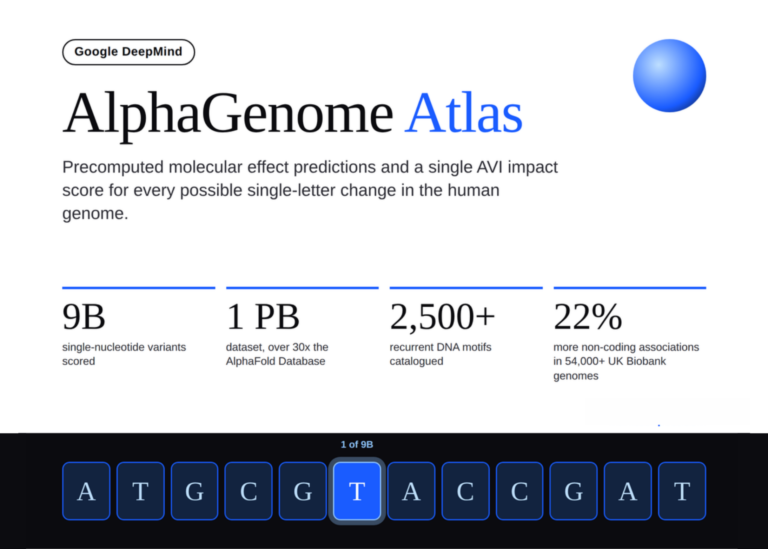
Google Deepmind has calculated the likely biological outcome for every single one of the nine billion possible single-letter changes in the human genome.
The human genome consists of roughly three billion DNA letters. While most people carry millions of tiny deviations from the standard sequence, the vast majority are harmless. A small number cause disease. The problem is that testing every possible swap in a laboratory is impossible. The new AlphaGenome Atlas addresses this by predicting how each change affects molecular processes across hundreds of cell types and tissues.
The dataset spans one petabyte, which is more than 30 times the size of the AlphaFold database for protein structures. It builds on the AI model AlphaGenome, introduced in 2025. Previously, researchers had to query the model for each variant individually. Now the answers are precomputed. Each variant comes with about 27,000 individual prediction values on average.
This matters most for the roughly 98 percent of the genome that does not contain protein blueprints. These noncoding regions act like switches and dials that control when and where a gene is active. Most disease-linked variants sit in these areas, and their effects have been the hardest to interpret.
One number for every mutation
Thousands of prediction values per variant are too much for everyday use. Deepmind built the AlphaGenome Variant Impact Score (AVI) to boil everything down to a single number. A small neural network combines the AlphaGenome predictions with the protein model AlphaMissense and two measures of how unchanged a DNA site has stayed across millions of years of evolution. AVI works with 18 input features. The established benchmark tool CADD uses more than 150.
For almost no variant is it known for sure whether it causes harm. The team worked around this. Variants that are very rare in the population are treated as likely harmful, common ones as likely harmless, because harmful mutations spread less often across generations. Despite this indirect training, AVI beat existing tools in tests on variants that had already been clinically classified, especially in noncoding regions. On some tasks, the competition edged ahead. The atlas also breaks down for each variant which process drives its score, such as whether the splicing of a gene’s transcript or a switch is affected.
An epilepsy case shows the payoff
A case from the GREGoR consortium, which studies unsolved rare diseases, shows how this helps in practice. A child with severe epilepsy had gone without a diagnosis despite genome sequencing. AVI pushed a variant in the gene DNM1, previously classed as unclear, to the top of the candidate list.
The AlphaGenome predictions also supplied the mechanism. The variant creates a wrong splice site during the processing of the gene’s transcript, which lengthens the protein by 13 building blocks. But this happens only in a gene version that is read exclusively in the brain. That is why earlier work on blood samples had found nothing.
A lab experiment confirmed the prediction, and the researchers recommend classifying it as likely disease-causing. Looking back at cases the consortium had already solved, AVI ranked the causal variant among the top 50 candidates in 29.5 percent of cases, compared with 12.5 percent for CADD.
More signal in the noise
The atlas is also meant to push population studies forward. To find out whether rare variants in a genome region affect something like a blood value, you have to analyze many of them together, because each one alone is too rare for statistics. If harmless and effective variants get mixed together, the signal disappears in the noise.
Gareth Hawkes of the University of Exeter used the atlas to group only those variants predicted to act the same way, drawing on genome data from more than 54,000 UK Biobank participants. That turned up 22 percent more links between noncoding variants and protein levels in the blood than conventional filters did.
From the predictions, the team also derived 2,601 recurring short DNA patterns, essentially the “words” of the genome where regulatory proteins latch on.
A research tool, not a diagnosis
AlphaGenome has limits too. It does not know every cell type, and it misses effects that work through the amount of other regulatory proteins. The atlas and AVI are research tools, Deepmind says, and can only be one link in the chain of evidence behind a diagnosis.
The atlas is available for noncommercial use through a web portal, an API, and as a skill in Google Antigravity. A commercial version is set to follow through Google Cloud.