Jake Welch has spent three years 3D scanning public restrooms across America and uploading the results to a website called The Restroom Archive.
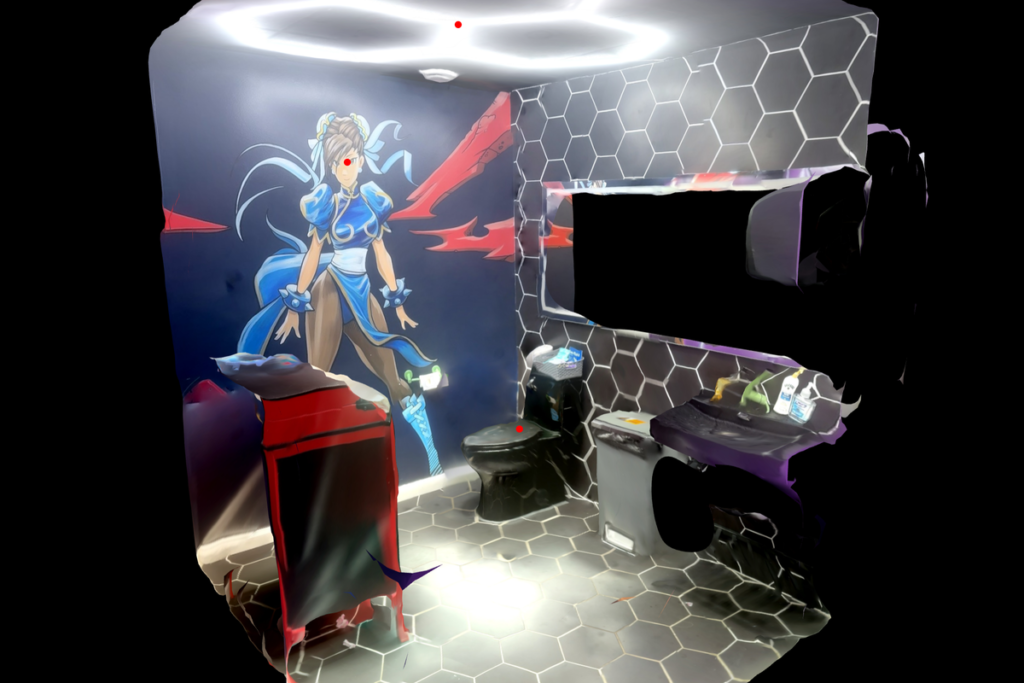
The site describes itself as an ongoing repository of publicly accessible restrooms. A visitor lands on a random scan, its location, and a brief description. One entry is Hurricane, Utah’s Gypsy Emporium Antique Mall. It was scanned on April 11, 2026. Paintings of a squirt gun decorate two of the four walls. The text explains that access requires passing through the antique mall, a back hallway, and the door of a jail cell.
Welch, the site’s creator and head archivist, told 404 Media the project began as a joke. He is a freelance designer based in New York City. He discovered Polycam, a smartphone photogrammetry app, and went out with friends one night. They stayed out late and he started scanning an IHOP restaurant. He returned home and he and his wife laughed at the idea. He kept doing it. After scanning the restaurant, Welch went on a road trip with friends and scanned every restroom they encountered.
After five or six scans, he noticed details he found amusing or interesting. He noted a weird trash can from outside placed inside a restroom. He also noted a hand dryer plugged into an outlet right below it. He said these things were hilarious but also interesting. Some scans are scary. They show wear from people passing through. Others are well-designed, well-decorated, or super eclectic. He said he started to see them as storytelling. They reflect the culture of the location and the people using them.
Welch said the most frightening restrooms are often on highway truck stops. He pointed to the Minute Market in Washington, Utah. He described it as grimy looking. He also mentioned an amp in Barstow, California. He said the bar was totally graffitied and worn. The mirror is completely covered and you cannot see in it. He said they are often scary.
He observed vast regional differences in America’s toilets. He thinks it has a lot to do with suburban versus urban areas. Most of his restrooms in Utah are quite spacious. There is a lot of chain restaurants in Utah. Here in New York, all the restrooms are really small and impromptu. He often scans them in tiny hole-in-the-wall restaurants where you have to walk through the kitchen to get to the back. He said it is obvious that they do not let everybody use the restroom. These ones are usually a little bit more decrepit, a little bit more neglected, or sometimes they use them like storage rooms. They are a little bit more multifunctional because space is tighter in New York.
After three years of scanning and uploading, Welch decided to overhaul the Archive and open it up to public submissions. There are submission agreements that people have to abide by, but they are really loose. They involve making sure the scans are quality. They involve making sure people are not scanning anything too terrible or too gross. Welch has to vet all of them before they are posted. He also ensures people are not trespassing or scanning private residential restrooms.
Most Android and iOS smartphones can handle scanning a bathroom. Welch preferred his iPhone. If it is a pro model, it has lidar, which uses lasers in your phone to measure distance. He said he does not even know why they have that. He feels like the use cases are kind of limited. But for him, he cannot get any other phone besides a pro model anymore because he likes the lidar too much for bathroom scanning.
There are better methods of scanning that would create cleaner and more accurate visions of the world’s bathrooms. He had a lot of people in the comments on some of his videos saying he should use Gaussian splats. They are a newer technique for making 3D models and they are a lot higher fidelity. They are built up with blurry-looking point clouds and they are a little bit more crisp. But he kind of likes the aesthetic of the blobby, stitched together photogrammetry. It feels like it is befitting of the space.
He also liked the strange abysses the iPhone makes. Another aspect of the lidar is that since it is lasers, when it bounces off a reflective surface you get really weird artifacts. He said that is why, if you look at a lot of the scans, a lot of the trash cans or a lot of the mirrors get really really wacky. He thinks that is fun.
When he set out to redesign the site a few weeks ago, Welch said it was important that he take it as seriously as possible. The contrast between the strange subject matter and the serious archive was important. He started doing a lot of research on real life internet archives used by museums and libraries. He also started doing research on public bathroom signage. He pulled together conventions to design a new website. Part of that was the descriptions. There is something about the subject matter being so funny and humorous and taboo that made him want to completely steer away from that and take the archive 100% seriously.
The redesign and a viral Instagram reel drove traffic to the Archive. Submissions started to come. He had a few from around the world. He had one in Dublin that is a typical tavern-pub bathroom. In the description they said the walls were covered with tags of left-wing groups and soccer clubs. He said to his untrained eye, as an American, he would not have known.
There were new and different kinds of scary public bathrooms. The very first user-submitted submission was in the basement of the Tri-Cities airport in Tennessee. It had been completely gutted. It was just a dirt room. He opened it up and asked himself what the hell he was looking at. He noticed in the corner, like the ghost of an imprint of a urinal with the plumbing still attached. He said he was like oh my God, this is a restroom. It was such a left field submission, but it was honestly kind of validating to him of why he should open it up to the public.
Welch told me he envisioned a future where bathroom scans poured in from around the world. He said it is cool to see new restrooms. He is hoping that it gets attention in other parts of the world where maybe restroom designs are different.
What it means
Welch needs scans in South Carolina. He asked people to sign up to be an archivist.