Space manufacturing currently relies on two options: waiting for trips to the International Space Station or partnering with a few startups that launch spacecraft into orbit and bring them back. The vehicle that completes this round-trip more often than any other is a SpaceX Falcon 9 rocket booster. This booster made 163 round-trips last year and has already flown more than 100 times this year. Besxar, a startup, says it has secured agreement from Elon Musk’s space company to prototype an orbital semiconductor factory across a dozen flights with the booster.
The problem with Earth
Besxar was founded by Ashley Pilipiszyn, a former OpenAI staffer. The company aims to make key precursors for advanced semiconductors by taking advantage of the vacuum of space. Chip fabs on Earth are hugely complex infrastructure projects because they require pressurised clean rooms to keep out microscopic dust and contaminants that could ruin a chip during production. Pilipiszyn argues that a new generation of rockets offers an alternative to all that infrastructure. She has raised almost $14 million to do it, including a $9 million seed round led by Dauntless Ventures and Overture VC.
“We’re at a time where it’s actually more cost-effective to go where the physics already works,” she told TechCrunch. “Don’t do it on Earth where you’re fighting physics.”
First flights
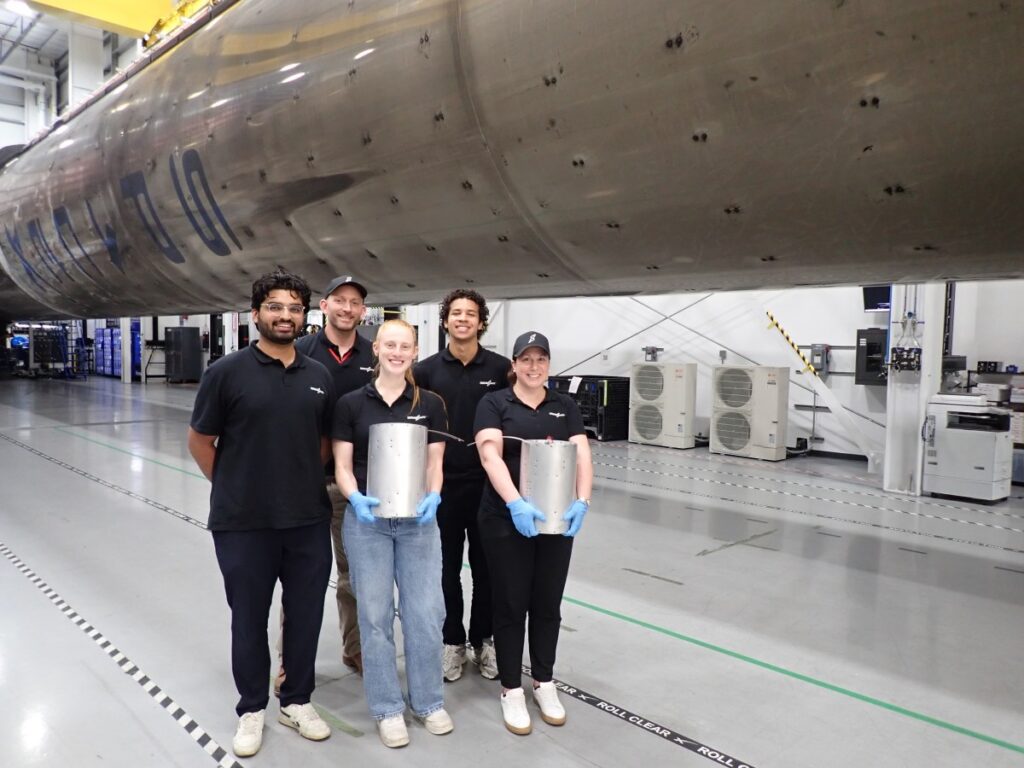
The company’s first two fabships, small canisters designed to carry and test semiconductor materials in orbit, flew on a July Starlink mission. They were intended to prove that the canisters could survive a launch, protect wafer samples from contamination, and expose them to the vacuum of space. Besxar succeeded in these objectives despite a malfunction in the flight data system in one canister, which the company is currently investigating.
“The flown samples were the cleanest and had the least amount of particulate matter compared to … non-flown terrestrial wafers, which is fantastic for us as we scale up,” Pilipiszyn told TechCrunch.
Next steps
Besxar expects to keep iterating over the next two years. The ultimate goal is flying larger fabs onboard a vehicle like SpaceX’s Starship, the company’s next-generation rocket still in development. Pilipiszyn first approached SpaceX three years ago to talk about buying flights on Starship and eventually settled on the booster payload deal as a way to de-risk her technology in the meantime. Next up is heating the wafers, then depositing one material on the wafers, then two materials, and so forth.
Once it is producing qualification samples, Besxar—named after “beskar,” the metal used in Star Wars to make Mandalorian armor—wants to supply leading chipmakers with the wafers used to make the kinds of advanced chips that regulate electrical power in data centers, robots and electric vehicles.
What it means
There are a number of companies working to leverage the space environment for higher-quality semiconductors, including United Semiconductors and Space Forge, but all face the same difficulty: the limited ability to return a meaningful volume of product. Pilipiszyn expects to start to scale up to hundreds and then thousands of wafers per fab, but that path depends on cheap rockets. That in turn requires SpaceX to get Starship operational—or competitors like Rocket Lab and Stoke Space getting their own next-generation rockets off the ground.
“We believe that there is a solid transport layer now, so we can focus on the application layer,” she told TechCrunch. “We can just focus on our core manufacturing and getting our products back down to earth to market as quickly as possible.”