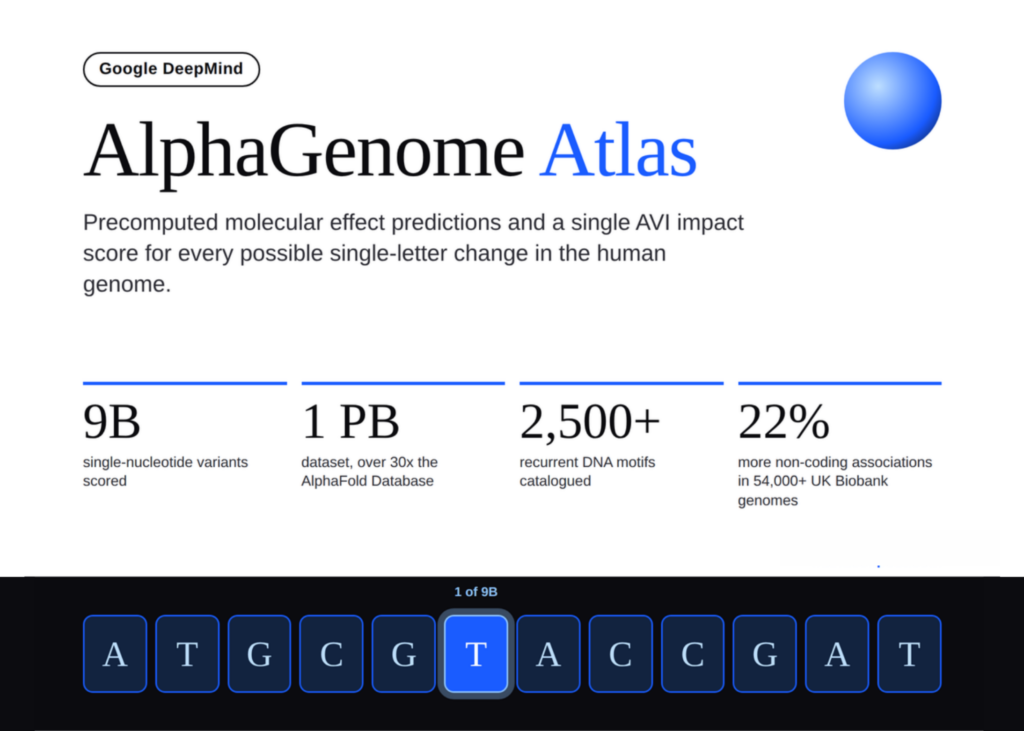
Google DeepMind has released the AlphaGenome Atlas, a database containing precomputed predictions for the molecular effects of roughly 9 billion single-letter changes in the human genome.
The new resource also introduces the AlphaGenome Variant Impact (AVI) score, a single figure that ranks variants by predicted impact. It includes per-variant feature attributions and a genome-wide collection of DNA motifs. Researchers can access the tool for free via a web portal, the AlphaGenome API, or as a skill within Google Antigravity.
Commercial access on Google Cloud is listed as coming soon. The underlying AlphaGenome model is already available for academic use on GitHub and for commercial use on Model Garden.
From one model to a genome-wide map
AlphaGenome, released in June 2025, predicts how a DNA variant changes molecular processes such as gene expression and RNA splicing. Previously, researchers used it for one variant or one region at a time. The Atlas changes the unit of work by storing outputs for all 9 billion single-nucleotide variants. This produces a 1-petabyte dataset.
This is more than 30 times larger than the AlphaFold Database, which holds over 200 million protein structure predictions. Testing 9 billion mutations in a lab is not feasible, and running a large model on demand for each candidate variant is slow for genome-scale studies. A lookup table with attached interpretation removes both bottlenecks.
What is inside the Atlas
The Atlas exposes four linked resources:
- Molecular effect predictions: thousands of predictions per variant, covering multiple aspects of gene regulation across hundreds of human and mouse cell types and tissues.
- AVI score: a single impact number per variant. It combines AlphaGenome’s regulatory predictions with AlphaMissense, DeepMind’s model for protein-altering variants, so it works in both coding regions, about 2% of the genome, and non-coding regions, the other 98%.
- AVI feature attributions: each score is decomposed into additive contributions from interpretable categories such as chromatin accessibility, splicing, and conservation, so a researcher can see which process a variant is predicted to disrupt.
- DNA sequence motifs: a compendium of over 2,500 recurrent short sequences, with genomic locations, including transcription factor binding sites.
DeepMind reports that the AVI score delivers best-in-class performance across many variant pathogenicity and rare disease benchmarks. The technical report carries the benchmark details.
Early results from external collaborators
Three research groups used the Atlas before launch, and their results anchor the announcement:
- Rare disease: Working with the GREGoR Consortium, Laura Covill and Anne O’Donnell-Luria at the Broad Institute used the AVI score to reprioritize variants that earlier analyses had overlooked. The score surfaced a variant in DNM1, a gene strongly linked to epileptic encephalopathy. The underlying AlphaGenome predictions showed the mechanism: the variant created an incorrect splice site that abnormally extended the resulting protein. Experimental screens validated the prediction and found nearby variants with similar effects.
- Population genetics: Gareth Hawkes, a Medical Research Council fellow at the University of Exeter, applied the Atlas to whole-genome data from over 54,000 UK Biobank participants. Grouping rare variants by predicted molecular effect uncovered 22% more non-coding associations than would otherwise be detectable, pinpointing regulatory variants that drive circulating levels of proteins such as PLA2G7 and EGLN1. Filtering to the 1% of non-coding variants that the Atlas rates most impactful, Hawkes identified 19 genomic regions associated with body mass index.
- Regulatory grammar: Julia Zeitlinger and Melanie Weilert at the Stowers Institute for Medical Research used the motif resource to separate transcription factors that only change DNA accessibility from those that also switch genes on and off.
What it means for researchers
For people making things, the change is practical. Researchers no longer need to wait for a model to finish calculating the effect of every single mutation they are studying. They can query a finished database instantly. This removes the computational bottleneck for large-scale studies and allows teams to focus on interpreting the results rather than waiting for them to generate.