Google DeepMind has released Gemini 3.8 Flash and Gemini 3.8 Flash Cyber, marking the third iteration of the Flash model family in six weeks. Both versions share the same core intelligence but differ in safety protocols and access restrictions.
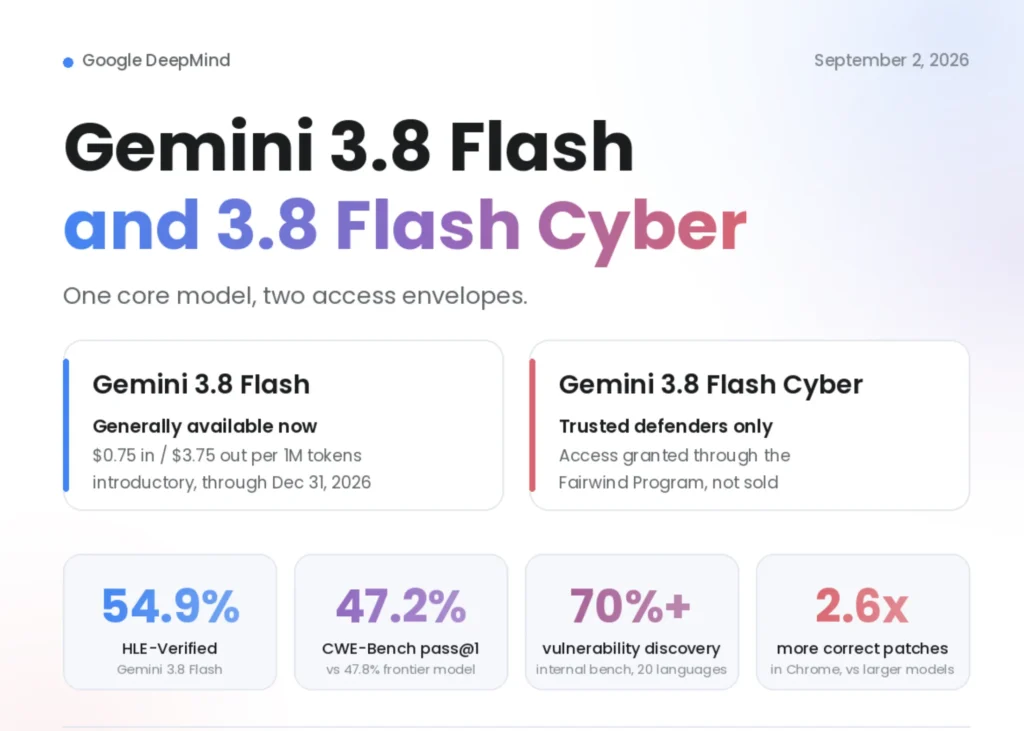
Gemini 3.8 Flash is available immediately via the Gemini API, Google AI Studio, Antigravity, Android Studio, and Gemini Enterprise. Weights remain closed, meaning there is no option for self-hosting. Gemini 3.8 Flash Cyber is not available for public deployment; access is granted individually through the Fairwind Program.
What changed in 3.8 Flash
The research team confirms that 3.8 Flash is built on the foundation of 3.7 Flash. Specifications remain identical: a 1,048,576-token context window, a 65,536-token maximum output, and support for text, image, audio, and video inputs with text output. Thinking levels are still set to LOW, MEDIUM, and HIGH, with MEDIUM as the default.
One critical detail for developers migrating from earlier versions is that the MINIMAL thinking level is no longer supported. Attempting to set this parameter now triggers an API validation error.
The primary change is behavioural. Google states that 3.8 Flash works harder. On complex tasks, it executes additional reasoning steps and calls tools iteratively. This approach may increase token consumption at higher effort levels. The developer guide admits that this strategy buys better accuracy at the cost of higher token usage. Consequently, Google recommends sticking with 3.7 Flash when compute efficiency is the primary constraint.
Performance results
On DeepSWE v1.1, a long-horizon software engineering benchmark, Google reports that 3.8 Flash outperforms most larger frontier models at a fraction of the cost. It scored 54.9% on HLE-Verified and showed gains over 3.7 Flash and other frontier models on Vals Finance Agent V2 and Harvey’s Legal Agent Benchmark. The announcement notes that finance and legal results are reported as relative wins without absolute scores.
Flash Cyber and access restrictions
On CyberGym, the standard vulnerability discovery benchmark, Google reports frontier-level performance that surpasses both 3.5 Flash Cyber and significantly larger frontier models, though no absolute figure is published. Because CyberGym is mostly written in C and C++, Google also ran an internal benchmark across 20 programming languages and reports a discovery success rate above 70%.
For patching, CWE-Bench, run by Collinear, places Flash Cyber at 47.2% pass@1 against a leading frontier model’s 47.8%. The claim is near-parity at materially lower cost, with Google framing the model as sitting on the Pareto frontier rather than topping the leaderboard.
Chrome Security reports 2.6x more correct patches than the best, much larger commercial models. Wiz measures 7.5 to 9.7 percentage points higher recall on its internal penetration testing benchmark at 2.3x to 5.2x lower cost. Google’s Cloud Vulnerability Research team found a critical foundational vulnerability in under two hours, work that normally takes months.
Google states it prioritised vulnerability fixing over offensive capabilities like exploitation. Flash Cyber ships with a more permissive set of cyber mitigations, which is precisely why it is restricted to trusted defenders: government authorities, critical infrastructure operators, and software maintainers who apply through Fairwind.
Key takeaways
- Two variants ship on one shared core, split by safety mitigations rather than model size.
- 3.8 Flash holds 3.7 Flash pricing at $0.75/$3.75 per 1M tokens through December 31, 2026.
- It trades tokens for accuracy: more reasoning steps, more tool calls, higher spend per task.
- Flash Cyber hits 47.2% pass@1 on CWE-Bench against a frontier model’s 47.8%, at far lower cost.
- Cyber access is gated to vetted defenders, not sold on a price sheet.