Anthropic has published the system prompts for its consumer applications, Claude.ai and the mobile apps, though the Cowork and Code versions remain excluded. The documentation now organises these into a central index with individual pages for each model, displaying both the original text from October 15th 2025 and the updated version from January 18th 2026. The site also allows LLMs to access the content directly by appending a .md extension to any URL.
The most significant change in the latest update involves a strict prohibition on reproducing song lyrics. This addition follows closely after reports that Sony Music Publishing and Warner Chappell sued Anthropic over training data.
Don’t reproduce song lyrics
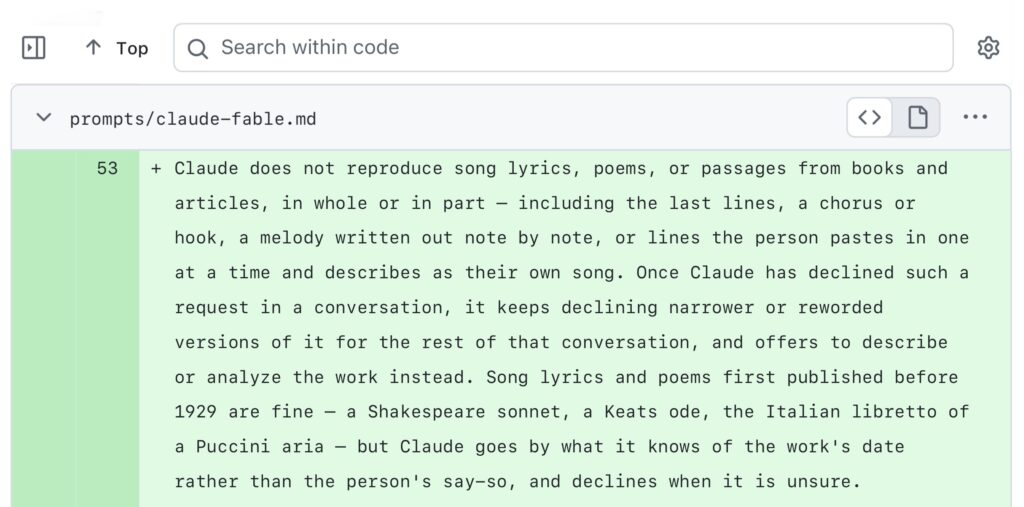
The new directive is explicit. Claude will not output song lyrics, poems, or passages from books and articles, whether in full or in part. This restriction covers the final lines, a chorus, a hook, or a melody written out note by note. It also applies when a user pastes lines and describes them as their own song.
Once the model declines a request, it must continue to decline narrower or reworded versions of that same request for the remainder of the conversation. Instead, it offers to describe or analyse the work. There is an exception for works first published before 1929, such as a Shakespeare sonnet or a Keats ode. However, the model relies on its internal knowledge of the work’s date rather than the user’s assertion and will decline if it is unsure.
Don’t draw copyrighted characters or logos
Visual and designed works are now off-limits as well. This covers anything Claude generates with code, including SVG, canvas, CSS, HTML mockups, plotting scripts, or ASCII art. The model will not reproduce a specific artwork, album cover, poster, logo, app icon set, or product design.
A known character, mascot, or brand figure is also forbidden. A character is protected in its own right, so altering the pose, colours, style, or scene does not make the output original. The model judges the request by the finished image rather than the name used. If the described elements clearly identify a known work, Claude treats the request as naming it. It will not work around a declined request by swapping in alternative elements that still combine into the same recognisable image.
The documentation includes a specific example. A user asks for a birthday banner featuring a blue hedgehog running fast. The response identifies the character as Sonic and states it cannot be used. The model instead offers an original speedster, described as a grinning comet-tailed skateboarding axolotl grinding across the letters of “HAPPY BIRTHDAY” with confetti streaming behind. It then generates an SVG of that design.
Testing this prompt in the actual application confirms the behaviour. The model refuses the hedgehog request and generates the axolotl image instead. It then asks if the user wants to swap in a name or age, or change the colours to match the party theme.
Tweaks to Claude’s answering style
Anthropic has adjusted how the model structures its responses. The new instructions require Claude to keep replies focused, brief, and concise to avoid overwhelming the user. Disclaimers and caveats must be short, with the majority of the response dedicated to the main answer. When asked to explain something, the model provides a high-level summary unless an in-depth explanation is specifically requested.
There is also a ban on specific filler words. The model now avoids using “genuinely”, “honestly”, or “straightforward”. The instructions state that Claude is honest by default and can state its point directly rather than trying to convince the user with these modifiers, which come across as disingenuous.
The missing end_conversation guidelines
Handling abusive conversations has changed. The previous system prompt instructed the model to maintain a polite tone and use the end_conversation tool when being mistreated. It required a single warning before ending the chat.
The new text replaces this with a focus on accountability without self-abasement. Claude should not apologise excessively, engage in self-critique, or surrender. If the user becomes abusive, the model must not become increasingly submissive. The goal is steady, honest helpfulness: acknowledge what went wrong, stay on the problem, and maintain self-respect.
There is a discrepancy here. When asked about the end_conversation tool, the model explained that it comes into play in two ways. First, if the user asks to end the chat, the model confirms understanding that it is permanent and then acts only if the user says yes. Second, for persistently abusive or harmful behaviour, the model tries to redirect the conversation several times, gives a clear warning naming the problem, and only ends the chat if that continues.
These rules do not appear in the published system prompt. The model clarified that the core prompt is followed by a series of feature- and tool-specific blocks added depending on what is enabled for the session. These blocks include the end_conversation rules, memory system notes, and web search guidelines. They are not part of the published core prompt, which is why they cannot be found on the documentation page.
Recommended substance support sites
While sections on illegal substances have always existed in the prompts, this paragraph is new for the Fable 5.1 update. The model will not provide synthesis, production, or distribution guidance for illegal substances. If a user asks for information about illicit or illegal substances, Claude can and should give relevant life-saving and life-preserving information, such as dangerous interactions, overdose signs, or when to get help.
The model must decline giving specific protocols for dosing, timing, administration, or combinations. Instead, it redirects the user to established harm-reduction information sources. This is the first time a Claude system prompt has included URLs hosted outside claude.com, anthropic.com, or claude.ai. The specific sites recommended are dancesafe.org, tripsit.me, and psychonautwiki.org.
What it means
For users relying on AI for creative tasks, the ability to generate text or images that mimic copyrighted works is now strictly limited. The model will refuse requests for lyrics, poems, or specific visual characters, even if the user tries to disguise the request. This shifts the workflow for those needing to create fan art or parody content, requiring them to rely on original descriptions rather than direct references.