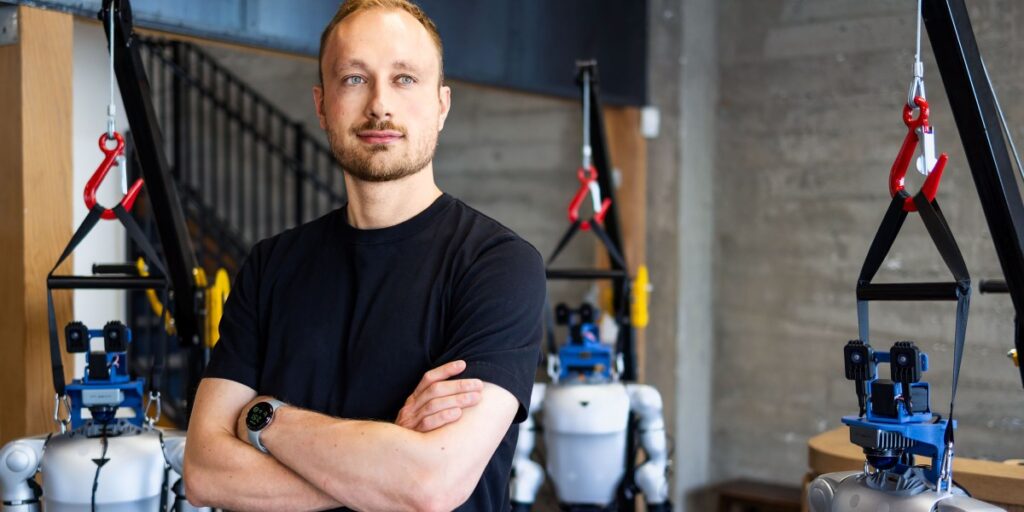
Danijar Hafner’s office in San Francisco’s SoMa district is empty. His new startup is in stealth mode with no name on the door. On the day of the visit, only one other person was present and there was little furniture. Instead, humanoids of various shapes and sizes hung like marionettes from racks running down the centre of the wide-open space.
Hafner, 31, describes the venture as a continuation of his work to enable AI to navigate environments it has not encountered in training. The humanoids, which he imports from China, are the physical embodiment of this work. Their ability to react in previously untested scenarios is key to getting robots into human spaces. If you want to send a robot into a person’s home, for example, it needs to be able to handle a floor plan and furniture it has never seen before.
To achieve this, Hafner relies on model-based reinforcement learning. He develops world models, AI models designed to emulate physical reality, and trains agents within them. The agent treats the model as a real-world simulation and learns how to act there. It then uses those experiences to make predictions about future outcomes. That allows agents, or the robots they are embedded in, to navigate unfamiliar situations in the real world.
Unlike other efforts, Hafner’s technique enables agents and the robots they control to execute massively complicated tasks without the real-world trial-and-error training that is traditionally used in robotics.
Background
Hafner grew up in a rural town in northeastern Germany where his parents were both classical musicians. He learned programming from a neighbour, and in high school he began taking online courses about AI, which quickly developed into a passion. “I was always fascinated with how thinking works,” he says. AI offered him a way to emulate it on a computer.
In 2015, as a second-year undergraduate studying engineering at Hasso Plattner Institute in Potsdam, he won a role as a student researcher at Google Brain. From there, he went on to a dozen internships and other positions at the company, including stints with Google Brain and Google DeepMind in the UK, Canada, and the US. He worked with industry legends including Geoffrey Hinton and Ashish Vaswani, coauthor of the groundbreaking research paper “Attention Is All You Need”, which described the transformer technology used by today’s large language models.
“I get to interact with a lot of really smart people in research at Google, and he easily sits in the top half of 1%.”
Timothy Lillicrap, Google DeepMind
Timothy Lillicrap, one of Hafner’s former managers and coauthors at Google, describes him as a standout among standouts. “In many cases he would build, single-handedly, things it would take entire teams of engineers to build,” Lillicrap says.
Virtual successes
Over the years, Hafner has honed and proved his approach by pitting agents trained within his world models against popular video games. His first breakthrough was PlaNet, a model that allowed agents to execute actions by planning ahead. His Dreamer 2 was the first agent to hit human-level performance playing Atari 2600 games using a world model. Dreamer 3 was the first one to solve the Minecraft Diamond challenge, successfully mining in-game gems on its own. And Dreamer 4 went a step beyond that by learning to mine diamonds from an offline data set of recorded game-play videos, without ever interacting with the game directly.
More recently, he has begun to migrate his agents out of the virtual world and into physical reality. His DayDreamer project used the Dreamer algorithm to let robots operate themselves in novel environments and react to new experiences, such as being pushed over, without any specific training.
Today, Hafner is working on his new startup, which he left Google DeepMind to form in the fall of 2025. Though he is coy about his next steps, it is clear he is dreaming big. “I was interested in solving a problem,” he hints, “that would change the world.”