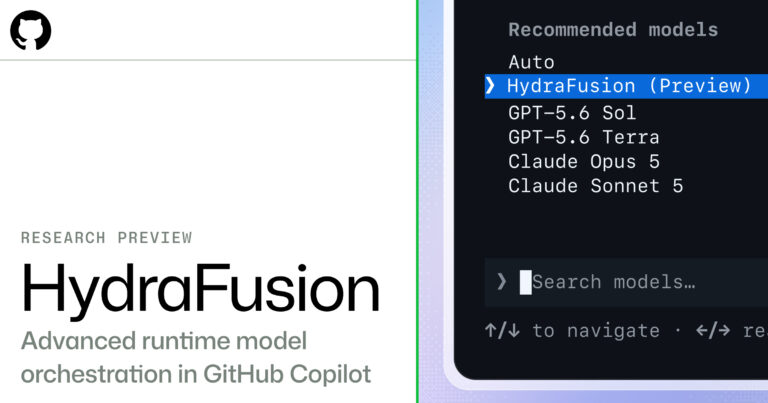
GitHub has launched Project HydraFusion, a research preview that constructs a unique execution plan for every coding request rather than assigning a single model to handle the task. This system can draft code with one model, have a second model critique the result, or escalate to a stronger model if the initial attempt fails a quality check. Developers select HydraFusion once, similar to choosing any other model.
Availability and setup
The tool is currently available only as a research preview for users on all GitHub Copilot plans. Access is restricted to the GitHub Copilot CLI. There are no open weights and no option for self-hosting. To enable it, run /update, then /experimental on, and finally /model to select HydraFusion (Research Preview). Billing applies per token consumed by the models invoked within the workflow, charged at each model’s standard rate.
How the system operates
HydraFusion extends the Auto model selection feature GitHub released earlier in 2026. While the earlier system matches a task to one best-suited model, HydraFusion treats workflow selection as an optimisation problem. It reads capability signals for reasoning, code generation, debugging, and tool use. The system then picks the least complex workflow expected to clear the quality bar, spending extra model calls only where they are likely to help.
Execution patterns
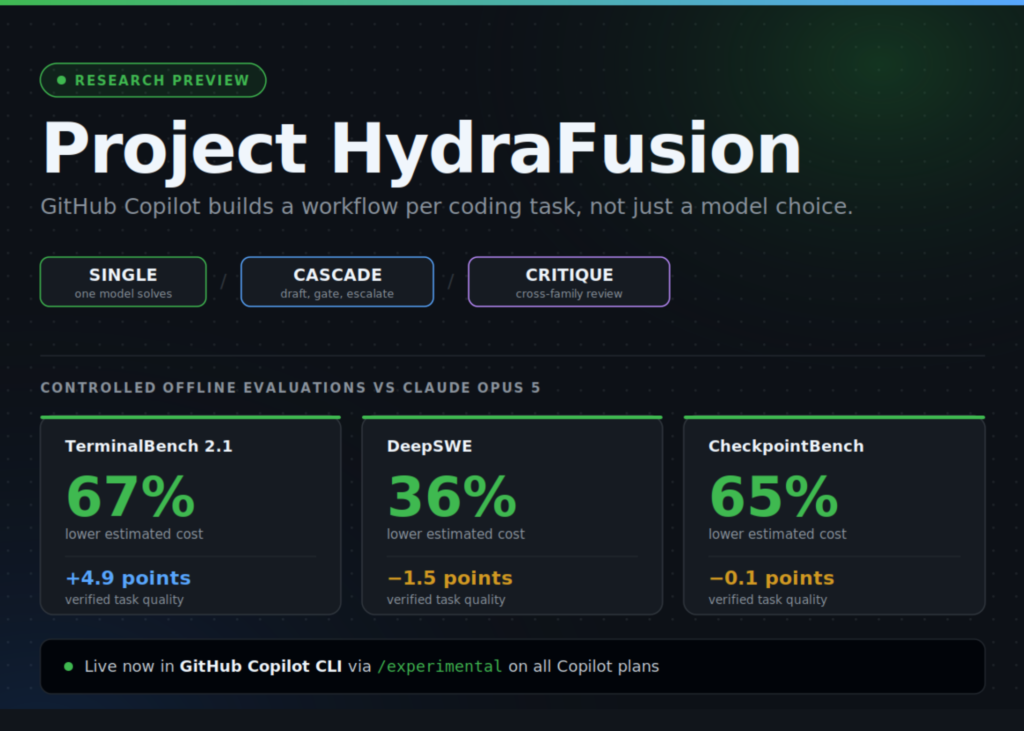
For each request, HydraFusion currently selects one of three patterns:
- Single: One selected model solves the task directly.
- Cascade: An efficient model drafts a solution. A quality gate then either accepts it or escalates to a stronger model.
- Critique: One model drafts, an independent read-only critic from a different model family reviews it, and the drafting model revises once. The review follows the same pattern as Rubber Duck.
Each pattern trades quality against cost differently. Single preserves speed. Cascade keeps a path to stronger inference open. Critique adds an outside perspective where review beats another unaided attempt.
Engineering guardrails
GitHub built the runtime around five operating principles that matter for repository-level work:
- Complete accounting across every leg, including drafting, critique, revision, escalation, retry, and fallback.
- Bounded execution with explicit timeout and cancellation per leg.
- Isolated review, where critics run in tool-less contexts and cannot modify the repository.
- Fail-safe application, applying no patch when a workflow is cancelled or fails validation.
- Validated routing, verifying model bindings, fallback behavior, and availability before execution starts.
Internally the runtime logs role, outcome, cost, latency, and diagnostics per leg. Externally the developer sees one coherent response and one permission-aware change set.
Benchmark results
The GitHub team evaluated fixed HydraFusion policies on three agentic coding benchmarks, using Claude Opus 5 and GPT-5.6 Sol as baselines. All models ran at medium reasoning level. The reported figures below are relative to Opus 5.
| Benchmark | Estimated cost vs Opus 5 | Verified task quality vs Opus 5 |
|---|---|---|
| TerminalBench 2.1 | 67% lower | +4.9 points |
| DeepSWE | 36% lower | −1.5 points |
| CheckpointBench | 65% lower | −0.1 points |
CheckpointBench is GitHub’s internal multi-turn set, curated from real Copilot sessions and anchored to immutable public commits so runs are replayable.
What it means
Developers gain a way to automate workflow complexity without manual configuration. The system handles the logic of whether a task needs a simple pass or a multi-stage review. For users on Copilot plans, this offers a potential reduction in token spend while maintaining quality, provided the task fits the tested benchmarks. The trade-off is that the feature remains locked to the CLI and billed at the underlying model rates.