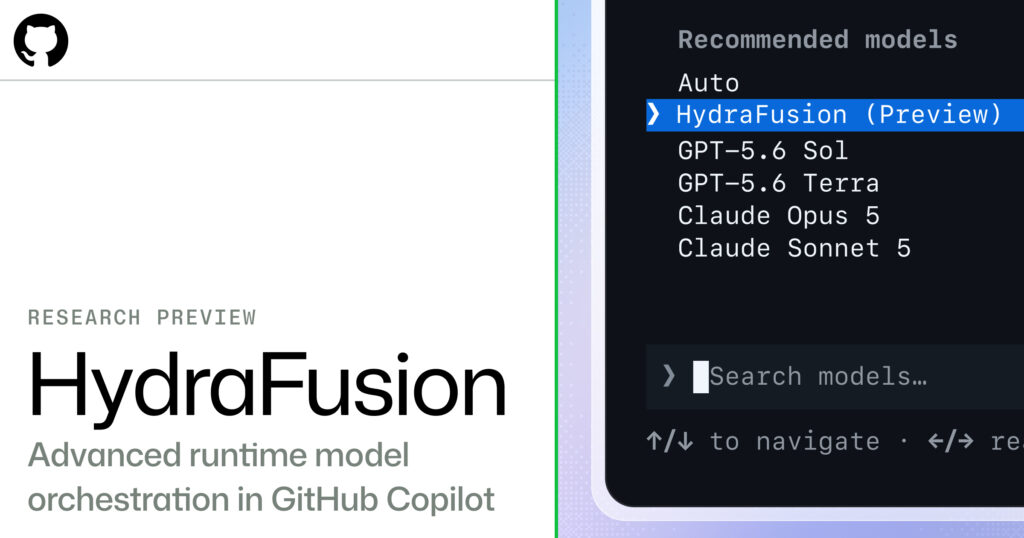
GitHub has launched Project HydraFusion, a research preview that automatically selects the most efficient combination of AI models to complete coding tasks. The system manages the workflow behind the scenes, choosing whether to use a single model, cascade to a stronger one, or employ a critique step to ensure accuracy.
Previously, GitHub introduced Auto model selection to match a single task with a suitable model. HydraFusion expands this by orchestrating multiple models across different providers to draft, review, and revise code. It balances performance, cost, and latency for every request without requiring developers to manage the complexity.
The tool treats workflow selection as an optimisation problem. It uses signals for reasoning, code generation, debugging, and tool use to pick the most efficient execution pattern. For each request, it chooses from three specific patterns:
- Single. One selected model solves the task directly.
- Cascade. An efficient model drafts a solution, and a quality gate decides whether to accept it or escalate to a stronger model.
- Critique. One model drafts a result, an independent critic from a different model family reviews it, and the drafting model revises once.
Each pattern addresses a different quality-to-cost trade-off. The Single method preserves speed when one model can solve the task. Cascade gives an efficient model the first attempt while retaining a path to stronger inference if the candidate fails the acceptance gate. Critique adds an independent perspective for tasks where review is more useful than another unaided attempt.
In offline evaluations across three agentic coding benchmarks, HydraFusion demonstrated frontier-level quality with substantial estimated cost savings. On TerminalBench 2.1, it improved verified task quality by 4.9 percentage points at 67% lower estimated cost compared with Claude Opus 5.
Adaptive multi-model orchestration
Developers already coordinate models manually: choosing one for a task, asking another to review the work, or escalating a difficult problem to a more capable model. HydraFusion brings that familiar process into the runtime. You choose HydraFusion once and stay focused on your task while it manages the models and workflow behind the scenes.
The key is selectivity. Some coding tasks can be solved directly, while others benefit from review, revision, or escalation. HydraFusion evaluates each request and chooses the least complex workflow expected to meet its needs, using additional model calls only when they are likely to improve the result. This adaptive approach balances quality, cost, and latency across models.
As the model frontier advances, so does HydraFusion. When new models become available in GitHub Copilot, the system can evaluate and incorporate them into its model pool, bringing their strengths to the tasks best suited to them.
Building HydraFusion
Turning adaptive multi-model orchestration into one dependable coding experience requires careful control of execution, review, cost, and repository state. HydraFusion is built around five operating principles:
- Complete accounting. Aggregate cost and usage across every workflow leg, including drafting, critique, revision, escalation, retry, and fallback.
- Bounded execution. Give each leg explicit timeout and cancellation behavior to keep execution and cost within defined limits.
- Isolated review. Run review steps in isolated, tool-less contexts, while solver steps use the shared workspace and normal permission-aware agent loop. This allows models to assess the work independently without modifying the repository.
- Fail-safe application. Apply no patch when the workflow is cancelled or fails validation, preventing incomplete changes from reaching the repository.
- Validated routing. Verify workflow definitions, model bindings, fallback behavior, and model availability before execution begins.
Together, these principles make multi-model orchestration practical for repository-level work. Internally, the runtime records the role, outcome, cost, latency, and diagnostics of each leg so the workflow can be understood after execution. Externally, the developer receives one coherent response and one permission-aware change set.
Benchmarking results
Fixed HydraFusion policies were evaluated across three agentic coding benchmarks — TerminalBench 2.1, DeepSWE, and CheckpointBench. The internal benchmark is based on real GitHub Copilot sessions. Comparisons used Claude Opus 5 and GPT-5.6 Sol as baselines. Each policy used the same task inputs, tools, execution limits, pricing assumptions, grading conditions, and treatment of missing results. The evaluation measured verified task quality, which is the share of tasks confirmed as correctly answered, and the complete estimated workflow cost. Cost accounting included every invoked leg, such as drafting, critique, revision, escalation, retry, and fallback. The results below show the best tuned HydraFusion configuration.
| Benchmarks | Cost vs. Opus 5 | Quality vs. Opus 5 |
|---|---|---|
| TerminalBench 2.1 | 67% lower | +4.9 points |
| DeepSWE | 36% lower | -1.5 points |
| CheckpointBench | 65% lower | -0.1 points |
These controlled offline results are specific to the evaluated benchmark revisions, workflow configurations, model pool, and pricing assumptions, with all models evaluated at the same medium reasoning level. Through this research preview, the team will validate how these results translate to real developer workloads and use the findings to further optimize HydraFusion for production quality, latency, reliability, caching efficiency, cost, and safety.
TerminalBench 2.1
TerminalBench 2.1 evaluates coding agents on complex, multi-step tasks in terminal environments. Figure 2 compares HydraFusion and Opus 5 across verified task quality and estimated workflow cost.
DeepSWE
DeepSWE evaluates challenging repository-level software engineering tasks that require navigating large codebases, understanding cross-file dependencies, and producing end-to-end fixes. On this benchmark, HydraFusion comes within 1.5 percentage points of Opus 5 while reducing cost by 36%, demonstrating a compelling quality-cost tradeoff for complex real-world engineering tasks.
CheckpointBench
CheckpointBench is an internal multi-turn benchmark curated from real GitHub Copilot agentic coding sessions. Each conversation is anchored to a specific public repository and immutable commit, ensuring every session is replayable. The benchmark is balanced across language, task type, difficulty, scrubbed for quality, resulting in a realistic evaluation set that closely mirrors production agentic sessions.