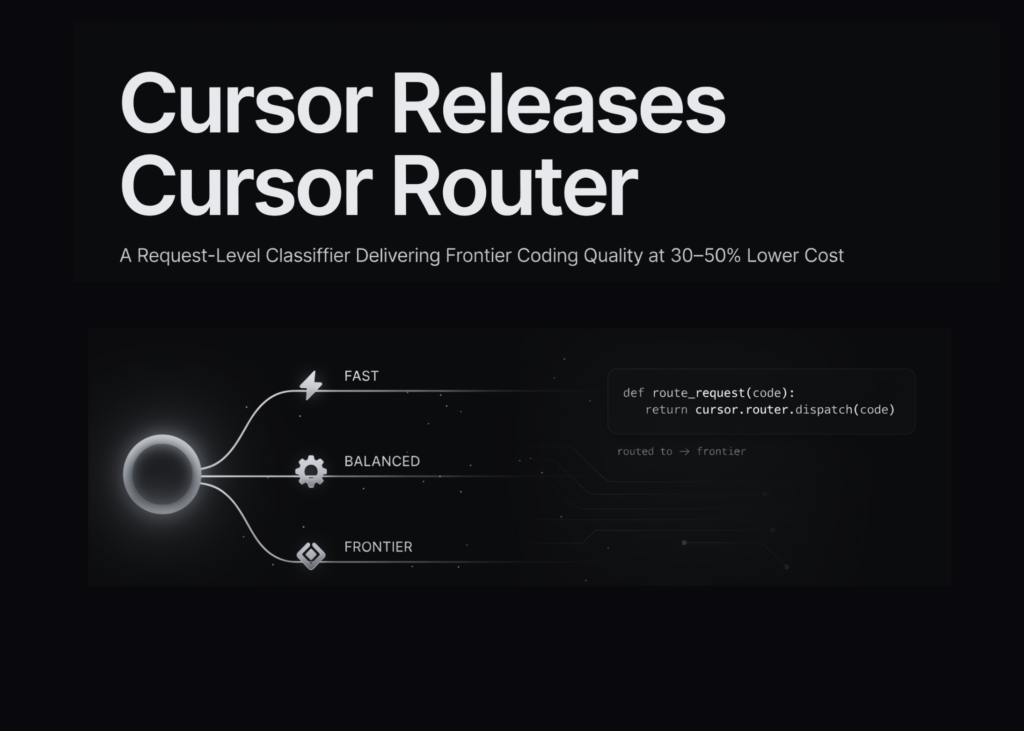
Cursor has launched Cursor Router for Teams and Enterprise plans, a system that inspects every coding request before it reaches a model to assign it to the best-suited option. Early-access enterprise accounts report 30–50% savings in AI spend, while online A/B tests show 60% savings compared to running all requests through a single high-end model.
The tool addresses a specific spending habit rather than a lack of capability. Roughly 60% of Cursor developers rely on one model as their daily driver. This means routine work consumes frontier-tier pricing, driving costs up without necessarily increasing output quality. Routing separates the two.
What the classifier actually reads
Cursor Router is not a fallback chain or a retry mechanism. It is a classifier trained on 600k+ live requests and evaluated in an online A/B test across millions of live requests. User satisfaction acts as the reward signal.
For each request, the system analyzes four inputs: query, context, task complexity, and domain. It combines these with learned knowledge of each model’s behavior. Cursor publishes three routing rules that follow from that classification:
- Simple work goes to the most price-efficient models.
- UI updates go to the model with the best taste.
- Complex, long-horizon problems go to frontier reasoning models.
The third rule carries the weight of the cost argument. The savings do not come from downgrading hard problems. They come from removing routine work from frontier pricing while the difficult tier stays intact.
One implementation detail deserves attention from anyone who has built a router. Cursor Router is cache-aware in both training and evaluation. It is trained on a dataset where routing produces cache misses, and the reported cost savings include the cost of those cache misses. Switching models mid-conversation invalidates prompt cache, and that cost is real. Routers that ignore it overstate their savings.
The classifier was also designed for model churn. Cursor states it can update the router as newer models ship, which matters in a market where the frontier moves monthly.
Why online A/B tests instead of offline evals
Cursor deliberately avoided offline evals as its primary measurement. Its stated reasoning is that offline evals suffer from small sample size, distance from real-world usage, and the difficulty of reducing success to a rubric. They also omit the cache-miss cost incurred when switching models.
Real routing happens across a conversation, not a single turn. Developers write code, ask follow-ups, hit errors, and continue, often across hundreds of requests in a week. The router must decide both which model to pick and when to switch.
Two quality metrics carry the evaluation:
- User satisfaction: agent success classified from user responses. Moving on to the next feature is a strong positive signal. Correcting the agent is a strong negative one.
- Keep rate: how much agent-generated code remains in the codebase over time.
Cursor team states it has used both metrics to evaluate every model launch and harness improvement for the past nine months. This is a meaningful credibility marker: the metrics predate the product they are now being used to justify.
Three modes, and the numbers behind them
Auto mode now exposes three optimization settings that move the user along the cost–intelligence Pareto frontier.
- Auto Intelligence lands near Fable on user satisfaction at about 60% lower cost for teams. Against Opus 4.8, it lifts satisfaction about 15% at nearly the same cost.
- Auto Balance lands above Opus 4.8 on user satisfaction at about 36% lower cost. Against GPT-5.6 Sol, it delivers comparable satisfaction at a lower spend rate.
- Cost mode is described as good quality reaching the highest available intelligence while optimizing token spend. Cursor published no A/B quality or cost figures for it.
Cost per request is only part of the picture, so Cursor also measured cost per commit:
| Model / mode | Cost per commit |
|---|---|
| Auto Balance | $4.63 |
| Auto Intelligence | $6.76 |
| Opus 4.8 | $7.34 |
| Fable 5 | $12.69 |
GPT-5.6 Sol matched the cost of Intelligence mode but produced lower user satisfaction. Cursor did not publish an exact per-commit figure for it.
Deployment reality and the one hard constraint
Cursor Router ships across desktop, web, iOS, CLI, and the Cursor SDK. It is on by default for Teams plans. Enterprise admins enable it from the dashboard.
The changelog specifies the admin surface: per-team and per-group enablement, restrictions on which optimization modes members can select, a configurable default mode, and model allow and block lists. Soft and hard enforcement options exist for standardizing on Auto. The routed model can be displayed or hidden, and it is hidden by default — teams that