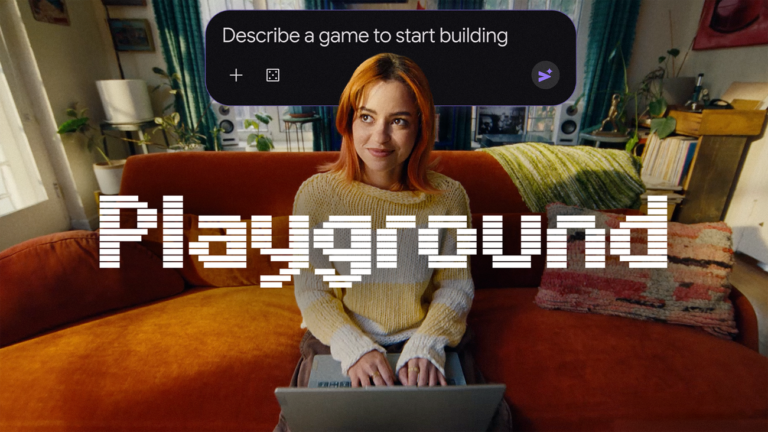
Neon Don is really pissed at his ex-wife’s lawyer. He’ll tell you any chance he gets while he shotguns lines of pixelated bad guys. He’s also not real—his likeness has only existed for a few minutes in a top-down cyberpunk-style shooter game, generated in the Google Labs service Playground.
“Keep shooting!” Neon Don says as he mows enemies down. “Brenda took everything else away!”
Playground, which Google launched this week, is part of Google Labs, the company’s landing page for its various AI experiments that haven’t made it into an app or official service quite yet. (Google has done this before with things like music production). It works similarly to Horizon Create, the game generation service Meta announced in September.
Playground is essentially vibe coding for video games, letting people describe in plain language what kind of game they want to make in a chatbot-like interface. Playground then builds a working in-browser version of a game. You can add further instructions to tweak the design from there. If you have assets you want to use as a reference, you can upload photos, videos, or models. Otherwise, the visuals and designs are all AI-generated.
The process of making a game is very straightforward, conversational, and responsive. That means it is perfect for dummies like me with little to no video game development chops or even decent coding skills. By simply throwing out some ideas, I built three playable, stable, and not even remotely good games in one day.
Pork Drop
My first work was Pork Drop, a result generated from the prompt “Tetris but with cute pigs instead of blocks.” I typed that in, hit Build. The AI chugged, then spit out a farm-themed version of Tetris with little pig faces drawn on every block.
I had to iterate a bit to realize my vision, telling the AI not just to stick pig faces on the blocks but to have the blocks shaped like distorted pigs. “Each block is a pig,” I wrote, “contorted into the shape of the Tetris blocks. Make ’em look a little squished but still cute!” This resulted in a clean, playable version of Tetris, though the occasional block looked like a T-posed pig with its legs spread-eagle. The AI suggested the title Piggy Stacker, but I thought mine was better. (I’m right.)
Dinner Darling
The next game idea came courtesy of my colleague Jay Dayrit, who, when asked what kind of game I should make, immediately requested, “Gay dinner party.” I typed that in.
With no follow-up requests, the result was a 2D flash-style game called Dinner Darling. The art looks like everyone is a Bitmoji. You’re placed in the shoes of a very stressed-out-looking host, Julian, who is tasked with hosting a fancy dinner party with fussy guests who can’t seem to sit in their chairs at the table. As timers count down, you have to prepare various artisanal bruschettas and espresso martinis for your increasingly angry guests.
After it generates, I give the game a shot and fail miserably, unable to figure out the controls in time to bring my guests a timely pastry or cocktail. (Sasha, one of the guests, required numerous espresso cocktails in a row.) “PARTY CATASTROPHE,” the game-over screen read.
There is no mention of anybody’s sexuality in the game at all, but when I lost, Dayrit called from across the office, “See? You’re bad at the game because you’re straight!” Well played, Playground.
My colleague Reece Rogers was less impressed when he looked at the game. “This is very unrealistic, because there’s not a vegan or dairy-free option,” he said.
Neon Don
The game that took the most work is the one that has since been played the most by random people on Playground. (Anyone can sign in with their Google account and play these user-generated games.) I’m up to seven unique players as of publication, which apparently means this game is my masterpiece.
I asked the AI to make a “cyberpunk-style rhythm game” where you play as a “very divorced” grizzled ex-cop who battles waves of rogue agents and corrupt politicians. It started as a Beat Saber–type title, but I asked the AI to make it more like the top-down shooter Hotline Miami. The result was Neon Don (title mine), a top-down, arcade-like shooter with pulsing synth wave background music.
Neon Don is also the game I tried to push the content bounds on, to see what Playground would let me get away with.
I described the enemies, and Playground AI added its own details on top, including “bulky, wide builds with prominent beer bellies straining against their tight tactical shirts and cargo pants” and “custom tough-guy swagger animations.” OK, Playground, go off.
The game had several small issues at first. I countered them and added features a little bit at a time. I dictated systems for level scaling, boss generation, and better enemy variety. I flagged mobility issues, like the player getting stuck, and it fixed them. (And occasionally introduced other problems.) I asked it to develop a text-based snark system that made the main character respond to combat with witty in-character quips like “Keep shooting! Brenda took everything else away!” or “I’ve taken worse hits from my ex-wife’s lawyer!”
I imagine that a real game developer would know what to actually say to sharpen features and make the game more fun or playable. Some of the top games people have created on the platform are much better than mine, since I tended to lean on more vibe-based iterative changes like, “Make Don taller” or “more divorced.”
Game Plan
After a certain point, Google throttles your usage of its Playground service. Every new game and iteration therein uses up more of your allowance. (Note for all my new loyal fans: Updates on my titles will be coming on October 14 when my usage allowance refreshes.)
That means my games still have many issues. I wanted to add a “Backflip” button to Neon Don, but the AI called it “Doge flip,” which I think sucks but cannot change until my usage credits recharge. I want to change the difficulty and add more weapon options. I want to do a lot of things, but I ain’t paying for more usage credits.
Playground does make me interested in the actual art of making video games. It’s fun and somewhat intuitive, and there are tangible results you can play with in real time. People are probably going to make some interesting stuff with it. But the limitations keep it from being truly useful.
Also, when you scroll through the Playground games, an unmistakable sameness permeates everything. Different game genres wind up with almost identical menus and music. You start to see the same types of combat options and style choices.
Playground is fun for a bit. But soon it becomes pretty clear it’s AI slop all the way down. Tell that to your ex-wife’s lawyer.