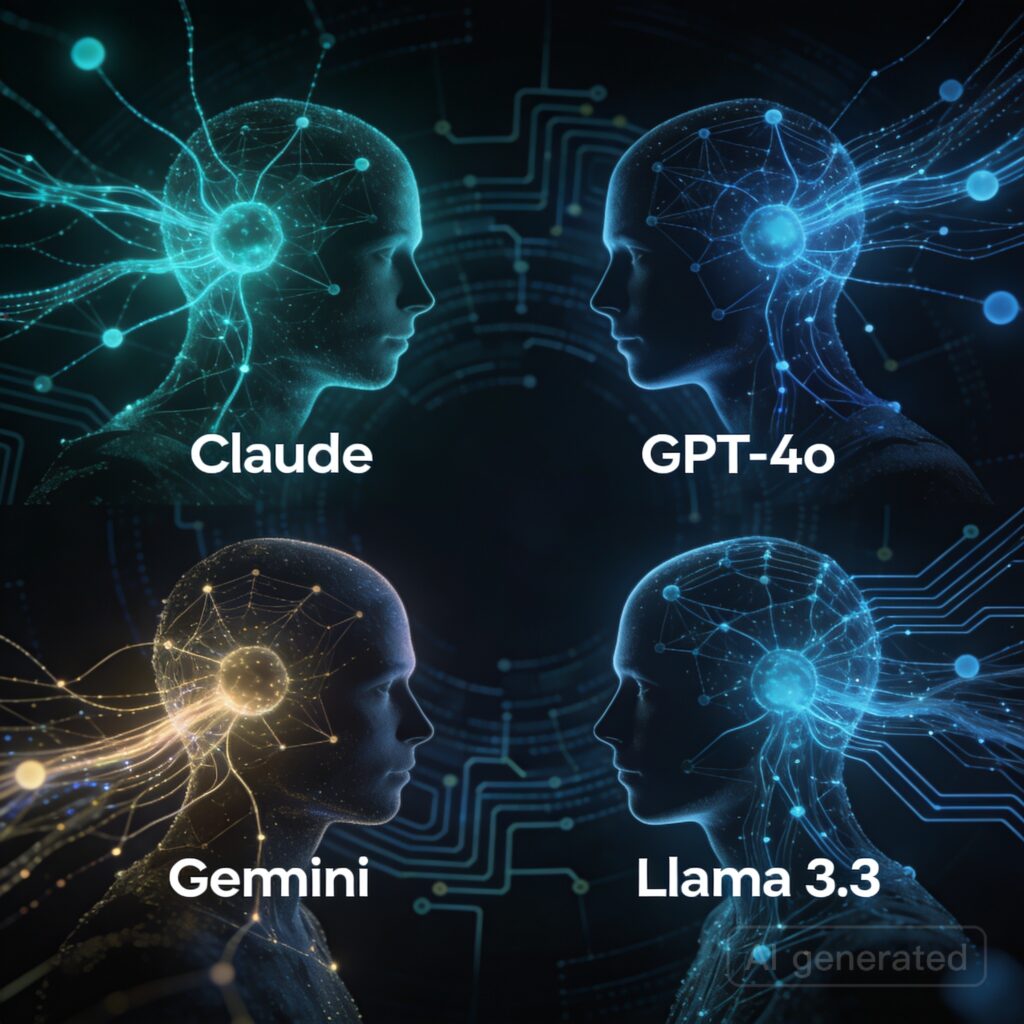
Choosing an LLM in 2026 is less about “which one is best” and more about “which one is best for your specific workload.” Frontier models have converged significantly, the gap between Claude, GPT-4o, and Gemini is measurably smaller than it was in 2023. The differences are now in pricing, context window, tool use, speed, and the particular tasks where each model excels. This guide gives you honest assessments of each major player.
The Contenders
We’re covering the models practitioners actually use in production in 2026:
- Claude Sonnet 4.5 (Anthropic), the workhorse, excellent reasoning and coding
- Claude Opus 4 (Anthropic), highest capability, highest cost
- GPT-4o (OpenAI), fast, multimodal, broad integration ecosystem
- Gemini 1.5 Pro (Google), 2M context window, strong at long-document tasks
- Gemini 2.0 Flash (Google), fast, cheap, surprisingly capable
- Llama 3.3 70B (Meta, open-weight), the best open model for most local deployments
- Mistral Large 2 (Mistral), European data residency, strong multilingual
- Qwen 2.5 72B (Alibaba, open-weight), exceptional for coding and Chinese
- DeepSeek R2 (DeepSeek, open-weight), strong reasoning, Chinese research lab
Claude (Anthropic)
Claude’s strengths are reasoning quality, instruction following, and writing. The models are trained with Constitutional AI, which makes them more consistent in following nuanced instructions and less prone to the kind of “I’ll do it but I’ll tell you it’s problematic” hedging that other models exhibit.
Claude Sonnet 4.5 is the best all-around model for most production workloads in mid-2026. It handles complex coding tasks, long documents, and nuanced writing equally well. The extended thinking mode is available when you need to step through hard reasoning problems.
Claude Haiku 3.5 is the fast/cheap option, at $0.25/$1.25 per million tokens, it’s the go-to for high-volume classification, summarisation, and routing tasks where you don’t need full reasoning power.
Best at: Technical writing, complex coding, long-form analysis, instruction following, agentic tasks that require careful tool use.
GPT-4o (OpenAI)
GPT-4o remains the most widely integrated model in 2026, it’s the default for most enterprise software that added AI capabilities. The model is genuinely good across the board, fast, and has native multimodal capability (vision, audio, real-time voice).
Where GPT-4o has a persistent edge: the OpenAI ecosystem. If you’re building on tools that were built around the OpenAI API, many are, GPT-4o slots in seamlessly. The function calling and structured output implementation is mature and well-documented.
Best at: Multimodal tasks, broad compatibility, code generation, tasks where you need the widest ecosystem of tooling support.
Gemini (Google)
Gemini’s headline feature is context. Gemini 1.5 Pro’s 2 million token context window is categorically different from anything else at scale, you can feed it an entire codebase, a full book, or months of conversation history in a single prompt. For long-document tasks, this is a genuine moat.
Gemini 2.0 Flash is the surprise of 2026, genuinely strong performance at a price point that undercuts most alternatives. For high-volume applications where GPT-4o pricing is a concern, Flash is worth serious consideration.
Best at: Very long context tasks, document analysis at scale, cost-sensitive applications (Flash), Google Workspace integration.
Llama 3.3 70B (Meta, open-weight)
Llama 3.3 70B is the benchmark open-weight model. It runs on a single A100 (80GB), two 4090s, or a Mac M4 Max with 128GB, and it performs at a level that would have been called frontier just 18 months ago.
The case for Llama 3.3 over proprietary APIs: zero marginal cost at scale, complete data privacy, the ability to fine-tune on your own data, and no rate limits. The case against: you need the hardware, inference is slower than cloud APIs at comparable quality, and you’re responsible for updates.
Best at: Privacy-sensitive workloads, high-volume use cases where you’ve made the hardware investment, base model for fine-tuning.
Qwen 2.5 (Alibaba, open-weight)
Qwen 2.5 is the open-weight model that repeatedly surprises Western practitioners. The 7B and 14B variants punch significantly above their weight class on coding benchmarks, and the 72B competes with Llama 3.3 70B on most tasks while having better Chinese-English bilingual capability.
The 7B model in particular has become a default choice for local deployment where VRAM is constrained, it runs on any GPU with 8GB VRAM and produces output that was “large model territory” in 2023.
Best at: Coding, Chinese-English tasks, constrained hardware (7B and 14B variants), cost-sensitive local deployments.
Head-to-Head: Which to Use When
| Task | Recommended | Why |
|---|---|---|
| Complex coding / debugging | Claude Sonnet 4.5 or GPT-4o | Stronger on multi-file reasoning and edge cases |
| Long document analysis | Gemini 1.5 Pro | 2M context, no chunking required |
| High-volume simple tasks | Claude Haiku or Gemini Flash | Best price-per-token at low complexity |
| Privacy-sensitive workloads | Llama 3.3 70B (local) | Zero data egress, fully self-hosted |
| Fine-tuning on domain data | Llama 3.3 or Qwen 2.5 | Open weights, commercial licences |
| Constrained local hardware | Qwen 2.5 7B or Mistral Nemo 12B | Best quality at 6-12GB VRAM |
| European compliance | Mistral Large 2 | EU-based infrastructure, GDPR-native |
| Multimodal (vision + text) | GPT-4o or Gemini 1.5 Pro | Native multimodal, mature API |
| Reasoning / maths problems | Claude Opus 4 or DeepSeek R2 | Extended thinking / chain-of-thought optimised |
The Benchmarks Problem
A note on benchmarks: MMLU, HumanEval, and similar standard evals are increasingly gamed. Models are trained on or near the benchmark datasets. The more reliable signal in 2026 is domain-specific evaluation, testing on YOUR actual tasks, with YOUR prompts, at YOUR output quality bar.
The models that consistently perform well on real-world tasks (not just published evals) in 2026 are Claude Sonnet 4.5, GPT-4o, and Llama 3.3 70B for general tasks. For coding specifically, Claude and Qwen 2.5 Coder consistently outperform.
Key Takeaways
- Claude Sonnet 4.5 is the best all-around choice for production applications requiring high reasoning quality.
- GPT-4o wins on ecosystem and multimodal capability. If you’re building on existing OpenAI tooling, it’s the path of least friction.
- Gemini 1.5 Pro is the only model to choose when context window genuinely matters at 100K+ tokens.
- Llama 3.3 70B and Qwen 2.5 72B are now capable enough for most production tasks, run them locally for zero marginal cost.
- Evaluate on your actual tasks. Published benchmarks no longer reliably predict real-world performance.