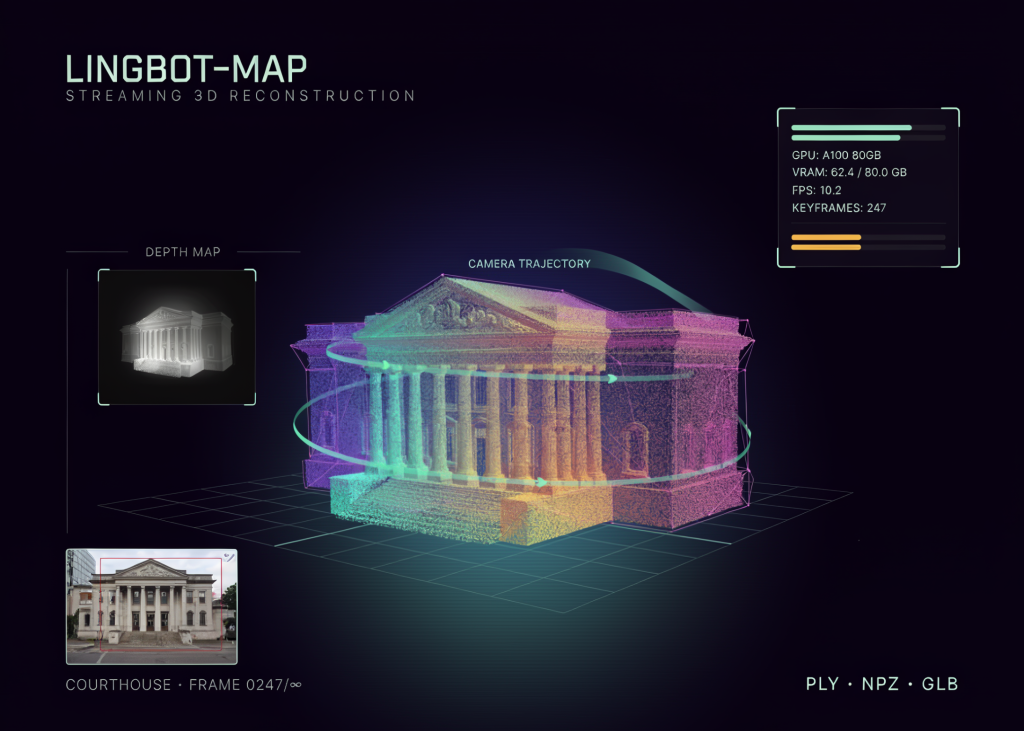
LingBot-Map runs on a CUDA GPU and automatically adjusts its settings based on how much VRAM is available. The tutorial walks through building a streaming 3D reconstruction pipeline that takes images or video, estimates camera movement, and outputs a point cloud.
Configuration and GPU tuning
The script starts by defining a dictionary of parameters. These control the input source, model behaviour, inference mode, point-cloud generation, and export settings. The code then checks the available GPU, system memory, and disk space before adjusting frame limits, scale frames, camera iterations, and KV-cache size according to the detected VRAM.
It also creates reusable shell and GPU-probing functions that prepare the Colab environment for the remaining reconstruction workflow.
CFG = {
   "scene":        "courthouse",
   "image_folder": None,
   "video_path":   None,
   "fps":          10,
   "max_frames":   None,
   "stride":       None,
   "checkpoint":   "lingbot-map.pt",
   "image_size":   518,
   "patch_size":   14,
   "use_sdpa":     True,
   "mode":                  "streaming",
   "num_scale_frames":      None,
   "keyframe_interval":     None,
   "kv_cache_sliding_window": 64,
   "camera_num_iterations": None,
   "offload_to_cpu":        True,
   "window_size":           128,
   "overlap_keyframes":     8,
   "conf_percentile":  55.0,
   "pixel_stride":     2,
   "max_plot_points":  60000,
   "export_ply":       True,
   "export_glb":       False,
   "launch_viser":     False,
   "run_ablation":     False,
   "seed":             0,
}
WORK = "/content"
REPO = f"{WORK}/lingbot-map"
OUT  = f"{WORK}/lingbot_out"
import os, sys, subprocess, glob, json, time, math, shutil, textwrap
os.environ.setdefault("PYTORCH_CUDA_ALLOC_CONF", "expandable_segments:True")
os.makedirs(OUT, exist_ok=True)
def sh(cmd, check=True):
   p = subprocess.run(cmd, shell=True, capture_output=True, text=True)
   if p.returncode != 0 and check:
       print(p.stdout[-3000:]); print(p.stderr[-3000:])
       raise RuntimeError(f"command failed: {cmd}")
   return p
def probe_gpu():
   try:
       q = sh("nvidia-smi --query-gpu=name,memory.total --format=csv,noheader", check=False)
       if q.returncode != 0 or not q.stdout.strip():
           return None, 0.0
       name, mem = [x.strip() for x in q.stdout.strip().split("\n")[0].split(",")]
       return name, float(mem.split()[0]) / 1024.0
   except Exception:
       return None, 0.0
GPU_NAME, VRAM_GB = probe_gpu()
print("=" * 78)
print(f"GPU        : {GPU_NAME or 'NONE — enable Runtime > Change runtime type > GPU'}")
print(f"VRAM       : {VRAM_GB:.1f} GB")
try:
   import psutil
   print(f"System RAM : {psutil.virtual_memory().total/2**30:.1f} GB")
except Exception:
   pass
print(f"Free disk  : {shutil.disk_usage(WORK).free/2**30:.1f} GB   (checkpoint is 4.6 GB)")
print("=" * 78)
if GPU_NAME is None:
   raise SystemExit("This model needs a CUDA GPU. Switch the Colab runtime to GPU.")
if VRAM_GB < 18:
   AUTO = dict(max_frames=48, num_scale_frames=4, camera_num_iterations=2, kvsw=48)
   tier = "small (<18 GB)"
elif VRAM_GB < 30:
   AUTO = dict(max_frames=96, num_scale_frames=8, camera_num_iterations=4, kvsw=64)
   tier = "medium (18-30 GB)"
else:
   AUTO = dict(max_frames=240, num_scale_frames=8, camera_num_iterations=4, kvsw=64)
   tier = "large (30+ GB)"
if CFG["max_frames"] is None: CFG["max_frames"] = AUTO["max_frames"]
if CFG["num_scale_frames"] is None: CFG["num_scale_frames"] = AUTO["num_scale_frames"]
if CFG["camera_num_iterations"] is None: CFG["camera_num_iterations"] = AUTO["camera_num_iterations"]
if VRAM_GB < 18: CFG["kv_cache_sliding_window"] = AUTO["kvsw"]
print(f"Auto-tuned for {tier}: max_frames={CFG['max_frames']}, "
     f"scale_frames={CFG['num_scale_frames']}, "
     f"cam_iters={CFG['camera_num_iterations']}, "
     f"kv_window={CFG['kv_cache_sliding_window']}")
print("Raise CFG['max_frames'] if you have headroom — reconstruction quality "
     "improves a lot with more views.\n")
Environment setup and model download
The script clones the LingBot-Map repository and installs the required dependencies without replacing Colab’s existing NumPy and OpenCV packages. It registers the repository in the Python environment and verifies the installed library versions to ensure that the runtime is ready for execution.
It then downloads the selected pretrained LingBot-Map checkpoint from Hugging Face and stores its local path for model initialization.
if not os.path.isdir(REPO):
   print("Cloning repo (shallow) ...")
   sh(f"git clone --depth 1 https://github.com/Robbyant/lingbot-map.git {REPO}")
print("Installing deps ...")
sh("pip install -q einops safetensors huggingface_hub")
sh(f"pip install -q -e {REPO} --no-deps", check=False)
if REPO not in sys.path:
   sys.path.insert(0, REPO)
import importlib
importlib.invalidate_caches()
import cv2, numpy as np
print(f"numpy {np.__version__} | opencv {cv2.__version__}")
from huggingface_hub import hf_hub_download
print(f"\nFetching {CFG['checkpoint']} from robbyant/lingbot-map ...")
t0 = time.time()
CKPT = hf_hub_download(repo_id="robbyant/lingbot-map",
                      filename=CFG["checkpoint"],
                      cache_dir=f"{WORK}/hf_cache")
print(f"  -> {CKPT}  ({os.path.getsize(CKPT)/2**30:.2f} GB, {time.time()-t0:.0f}s)")
Loading frames and preprocessing
The code imports PyTorch, LingBot-Map components, geometry utilities, and visualization libraries before selecting the appropriate inference precision for the available GPU. It loads frames from a bundled scene, custom image directory, or video file and uniformly samples them according to the configured frame limit and stride.
It preprocesses the selected images into model-ready tensors and previews representative frames after cropping and resizing.
import torch
import matplotlib.pyplot as plt
from lingbot_map.models.gct_stream import GCTStream
from lingbot_map.utils.load_fn import load_and_preprocess_images
from lingbot_map.utils.pose_enc import pose_encoding_to_extri_intri
from lingbot_map.utils.geometry import (
closed_form_inverse_se3,
closed_form_inverse_se3_general,
depth_to_world_coords_points,
)
torch.manual_seed(CFG["seed"]); np.random.seed(CFG["seed"])
DEVICE = torch.device("cuda")
CC = torch.cuda.get_device_capability()
DTYPE = torch.bfloat16 if CC[0] >= 8 else torch.float16
print(f"torch {torch.__version__} | sm_{CC[0]}{CC[1]} | inference dtype {DTYPE}")
def extract_video_frames(videoSource Read original →Related articles