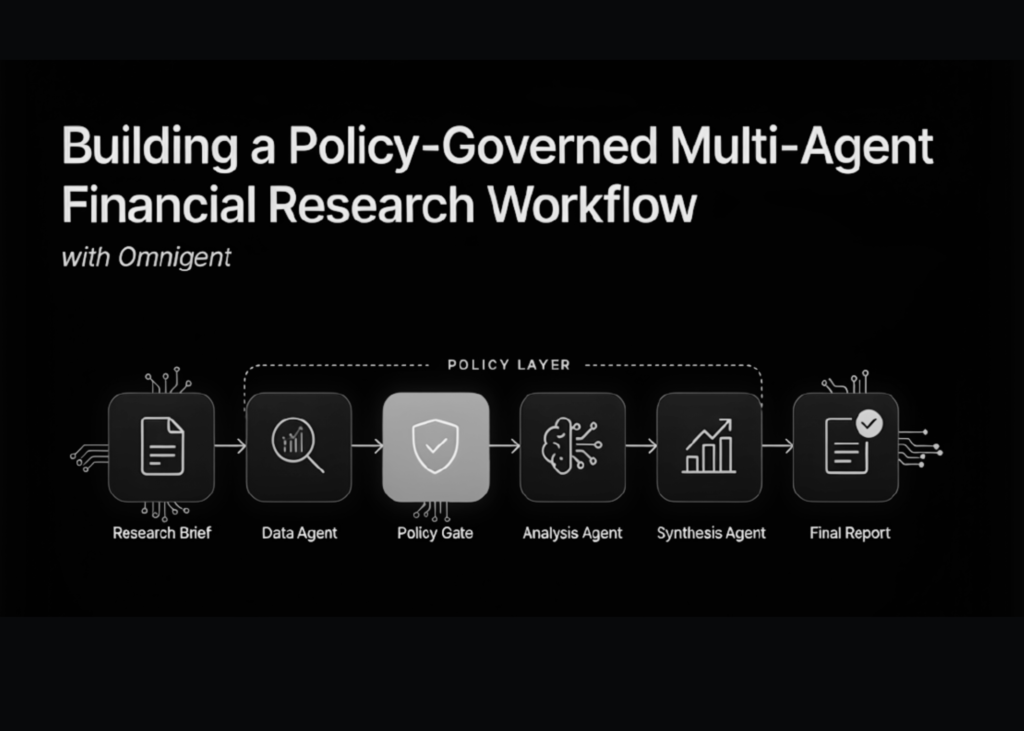
Omnigent now allows developers to run a policy-governed multi-agent financial research workflow directly from a Python environment managed by uv. The system pulls a live USD-to-EUR exchange rate from an external API, summarises the data for a client, and sends the draft to a sub-agent for clarity and length checks. Developers define reusable Python functions as callable tools, describe the agent structure in YAML, and use the Claude Agent SDK as the execution harness. The workflow manages the Anthropic API key securely through environment variables, applies non-interactive policies that limit tool calls and control session costs, and runs without requiring Node.js, tmux, or an interactive terminal.
Setup
The script imports necessary Python modules and defines a helper function to execute shell commands. This function prints the actual error message if a command fails rather than just a generic code. The code creates a dedicated working directory and uses uv to build an isolated Python 3.12 virtual environment. This step avoids the ensurepip limitation found in Colab notebooks. The installation installs Omnigent and Requests inside the environment. The script locates the Omnigent CLI executable and verifies the installation by printing its version.
The Anthropic API key is collected only when it is not already present in the notebook environment. The credential is stored in the current process environment so that Omnigent can detect it without writing sensitive information to a file. A separate environment configuration is created for the subprocess, and the automatic update check for Omnigent is disabled during execution.
A Python module is generated to contain local functions that Omnigent exposes as callable tools. The code defines a live exchange-rate tool that sends a request to the Frankfurter API. This tool returns the latest rate, currency codes, and the applicable date. A simple word-count tool is also implemented to allow the auditing sub-agent to measure the length of the financial summary.
Configuration
The multi-agent architecture is defined through a YAML configuration file. The financial research lead is configured to call the exchange-rate tool for any question about currency movements. The lead then hands its draft summary to the text-auditor sub-agent for a clarity and length check. The text-auditor is tasked with evaluating the draft using the word-count function, flagging unexplained jargon, and suggesting one concrete clarity improvement.
Hard governance policies are applied to restrict the number of tool calls and limit the maximum API cost for the session. The policy limits tool calls to a maximum of 20 per session and caps the total cost at 1.00 USD.
Execution
The tutorial directory is added to PYTHONPATH, and the currency-related question is defined. The Omnigent agent is executed through a non-interactive subprocess. The generated response is captured and displayed. Diagnostic output is printed if execution fails, and a debug command is provided for examining runner issues. The output finishes with useful next steps for exploring Omnigent’s CLI, bundled agents, YAML specification, and policy documentation.
What it means
Developers can now build agent systems that handle live data and enforce strict cost controls without needing complex infrastructure. The use of uv ensures the environment remains clean and isolated, while the YAML configuration keeps the agent logic readable. The ability to delegate tasks between a lead agent and a sub-agent allows for more robust workflows where one agent checks the work of another before final output.