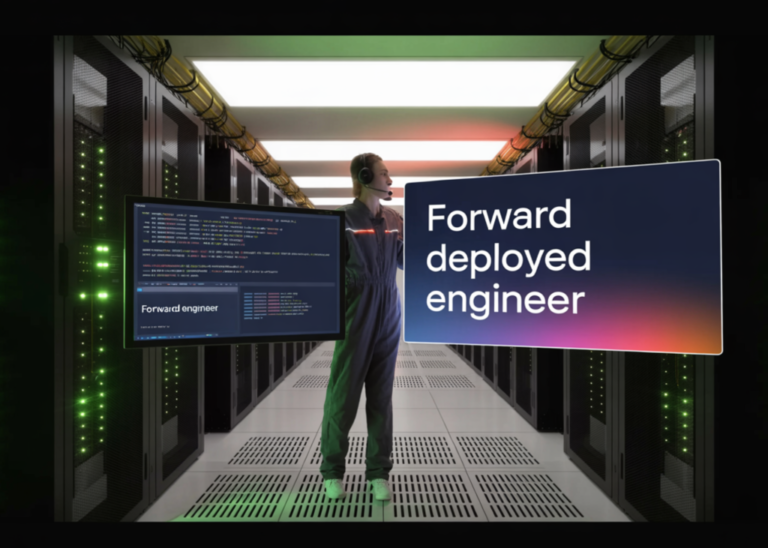
Christian & Timbers estimates there are only 2,000 engineers in the United States with the specific mix of industry knowledge, authority, and practical AI skills required to ensure companies get a return on their technology spending.
“Not 2,000 available,” reads the report. “2,000 total.”
As businesses move beyond simply accessing the best models to integrating them into workflows that actually improve their finances, the forward-deployed engineer (FDE) is becoming a top priority. These are the staff members who work inside client organisations to build and launch software or AI systems.
Demand for these specialists is already climbing quickly. The study projects a surge of 2,100% by the end of the year.
The research relies on interviews with more than 250 chief executive hiring managers across 180 firms, a survey of 80 Fortune 500 leaders, and talks with over 300 FDEs and applied AI engineers between January and June 2026.
At the start of the year, only 5% to 10% of companies planned to hire FDEs, mostly for small pilots. By the end of the second quarter, that figure jumped to 70%. The largest consulting and services firms reported needing to increase their FDE headcount by 10 times, building full teams of 20 to 100 employees.
“This is all happening at a speed I’ve never seen. Enterprises are hiring in the middle of summer,” Jeff Christian, founder of C&T, told TechCrunch.
If the study is accurate, that demand will outstrip supply. The report found roughly 17,000 U.S. FDEs on the market today. A significant number are already employed by Palantir, which invented the concept of the FDE years ago. Christian noted that some clients are buying Palantir technology just to access the firm’s engineers.
Only a fraction of the FDEs working in the field are elite enough to deliver true return on investment. Christian describes this as “multiple tens of millions of dollars of ROI impact.” It could mean revenue acceleration on the go-to-market side, such as lead generation, or replacing financial planning and analysis functions or 2,300 document processors in India.
Chris Taylor, CEO of Ode with Anthropic, a new firm focused on FDE services, noted the difference in capability. “Many FDEs are well equipped to help you roll Claude Code out to your workforce. Very few are capable of building your flagship AI product feature.”
As companies look harder at their balance sheets, accounting for AI spending is becoming more important. Token-maxxing has morphed into value-maxxing.
“This fall, [Wall Street] is about to say, ‘Hey, we’ve given you two years to figure this out…and you haven’t. There’s no ROI. So we’re going to start punishing those that have spent hundreds of millions, maybe even billions on this, and aren’t generating ROI, and rewarding those that have’,” Christian said.
AI companies face pressure too, having already spent tens of billions to train and deploy their models. For frontier AI firms, reaching profitability depends on injecting their technology into as many enterprises as possible. That task is now threatened by cheaper, increasingly capable open-weight models from China.
That is why firms like OpenAI and Anthropic have set up their own ventures — Ode with Anthropic and OpenAI’s Deployment Company — and staffed them with FDEs whose sole purpose is to spread their tech around the enterprise.
It is not only top AI firms and large consultancies clamoring for FDEs. Enterprises from insurance and fintech to healthcare and gaming are seeking out these specialists, Christian said.
Companies are hiring teams of FDEs instead of bringing them in from firms like Ode or Deployment Co, seeking to keep knowledge of proprietary processes in-house and protect them from the likes of OpenAI and Anthropic.
“Everybody’s concerned that if they give up their proprietary business processes, [the AI firms] can compete with them, which is true in many different areas,” Christian said. “So having this muscle internally is so important.”
Taylor said he is starting to hear the phrase “internal forward-deployed engineers” more often, but his clients are not yet asking Ode to put together internal FDE teams for them.
While many young engineers might think they have the industry expertise and AI skills to take advantage of what may turn out to be a talent war, Christian warns that the FDE may not always be in demand.
“Maybe in two years, everything’s automated, and agents are automating agents as opposed to humans automating agents,” Christian said. “That is something that could occur. Hopefully, it doesn’t, and we continue to need these people within companies.”
In the medium-term, he thinks the need for FDEs will shift from enterprise AI to physical AI as companies try to implement things like humanoid robots into their workflows. But within five or 10 years, he says it is entirely possible that the role of FDE will “go away.”
That may be true for all knowledge work if AI leaders and CEOs’ predictions come true. While C&T focuses on recruiting for fast-growing industries and has not seen a pullback yet, Christian says more general search firms have definitely experienced a slowdown in recruitment requests.
Everything to do with AI is growing and in demand, he says. For now.
“I think that there’s absolutely a time soon where we’re going to see an impact in our business,” Christian said.
What it means
The market is shifting from buying access to models to buying people who can make those models work for specific business problems. The scarcity of skilled engineers means companies must now choose between hiring expensive internal teams to protect their data or relying on external vendors who may eventually become competitors.