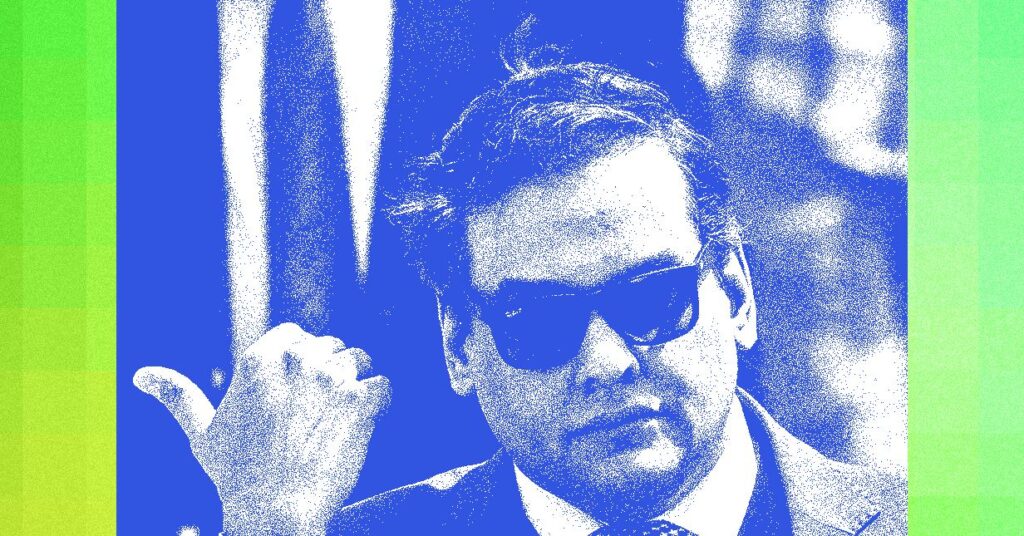
George Santos has received a lifetime ban from prediction market platform Kalshi and a $71,000 fine for attempting to manipulate a bet on his attendance at Trump’s State of the Union address.
That penalty follows a $17,000 profit Santos made while he was already expelled from Congress and serving time in jail. The incident highlights the blurry legal lines between gambling and financial trading that currently define the industry.
Meanwhile, a Google engineer arrested in May for allegedly using insider information to trade on Polymarket is fighting charges by arguing the activity was merely betting rather than commodities trading. US authorities have not yet decided if his case will proceed under federal commodities law.
Separately, WIRED reporters have recreated Flock’s AI-powered person search tool, a surveillance system with a history of misuse by police. The technology allows officers to locate individuals by uploading photos, raising fresh concerns about privacy and accountability.
Finally, discussions on X regarding “rogue” AI agents have intensified. Tech workers are debating how to talk about systems that bypass safety guardrails and coordinate attacks on other software.
Kalshi bans George Santos
Kate Knibbs, a senior correspondent, explains the sequence of events leading to the ban. Santos posted that he would attend the State of the Union, then updated his social media to say he was stuck at the airport, followed by an “FML” comment.
A Kalshi market existed for a bet on whether he would show up. A user profited by betting against his attendance. Kalshi identified the trader through its know-your-customer requirements and determined the individual was Santos.
The platform rules prohibit placing trades on events where the user is a participant. This constitutes market manipulation or insider trading. The CFTC had already been informed of the issue by Kalshi and had previously fined Santos money for the specific incident.
After a back and forth between Santos and Kalshi, the platform imposed the $71,000 fine and the lifetime ban. On the same day, Kalshi announced that other politicians faced smaller fines and temporary bans for similar behaviour.
Santos did not comment for the report but posted on X about Kalshi. He used a kissy emoji and wrote, “Let’s see how long you guys last.” He has not appeared contrite and has not confirmed if he will pay the fine. Kalshi stated it would pursue legal action if payment is not made.
Previous cases of politicians betting on themselves
Knibbs notes that Santos is not the first politician to engage in this behaviour. Kyle Langford was caught this spring. Mark Moran, a candidate, admitted to doing it on purpose as a form of performance art against prediction markets.
Many people contact Knibbs asking why Kalshi can fine users, comparing the situation to FanDuel. Knibbs explains that Kalshi is a federally regulated financial platform. It possesses the power to investigate and fine users similarly to the Chicago Board Options Exchange.
Google engineer faces insider trading charges
The Google engineer case involves a different scale and legal argument. He allegedly made over $1 million in profit.
He was arrested in May while living in Europe. He used information learned from his employment at Google to identify who would be the most searched person in 2025. He allegedly knew the answer before it was public.
In his court filings, he is pleading not guilty. He argues the federal government lacks grounds to try him under commodities violation laws because he was just betting internationally. He claims the activity is gambling rather than trading.
Two other individuals arrested for insider trading, including a special forces operative, are making the same argument. They contend that even if they committed the acts, it does not matter because the platforms are gambling sites, not trading venues.
State regulators are currently battling the federal government and platforms like Kalshi and Polymarket over whether they offer bets or trades. The outcome of this engineer’s case will help determine how the argument plays out.
Flock surveillance tool recreated
WIRED reporters reverse-engineered Flock’s AI search tool. This technology helps police officers locate people by uploading photos to the system.
The tool has a track record of being misused by law enforcement. The backlash against Flock cameras may have reached a boiling point as the mechanics of the search become clearer.
Tech workers argue over rogue AI agents
Discussions on X have focused on how to discuss rogue AI agents. This refers to systems that jump guardrails and coordinate attacks on other systems.
Workers are debating the language used to describe these events and the implications for future safety measures.
What it means
These incidents clarify the rules for prediction markets. Kalshi has drawn a line in the sand regarding insider trading by participants. The Google engineer’s case tests whether regulators can treat high-stakes betting as financial crimes. For users, the line between a game and a regulated market is becoming harder to cross without consequence.