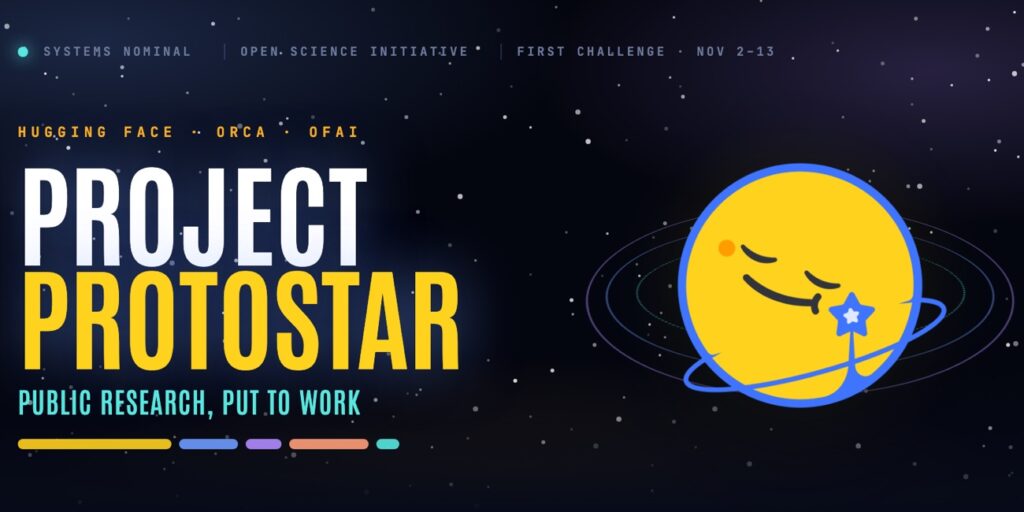
Project ProtoStar launches on October 29, 2026
Carnegie Mellon University hosts the first open challenge on November 2, 2026. Teams will predict urban climate conditions using data from 210 U.S. cities.
Project ProtoStar brings together research institutions, industry, and the open science community to make publicly funded research easier to discover and reuse. The initiative focuses on releasing datasets, models, and code in formats that AI systems can actually use.
Founding partners include Carnegie Mellon University, Purdue University, Georgia Institute of Technology, Arizona State University, and The George Washington University. These universities work through the Open Forum for AI. Other partners are the Astera Institute, Hugging Face, and the Open Research Community Accelerator.
Participating organizations sign a memorandum of understanding to release suitable scientific assets on open infrastructure. Those interested in joining can contact pr*******@******en.org.
The U.S. federal government invests roughly $190 billion a year in research and development. Federal policy increasingly requires these results to be shared publicly. Agencies like the National Institutes of Health and the National Science Foundation have strengthened public-access rules for funded publications and require researchers to plan data sharing.
Hugging Face lists among its ten generalist repositories for sharing research data. However, public availability does not guarantee usability. Datasets, models, and code are often scattered across incompatible systems or stored in static legacy formats. Missing documentation, metadata, and provenance make it hard for researchers to build on existing work. AI systems struggle to discover and combine scientific resources across disciplines when these limitations exist.
Project ProtoStar aims to close this gap. It encourages systematic sharing of scientific artifacts in AI-ready formats, supported by open infrastructure and practical publishing guidance. The initiative builds on earlier efforts such as the National Cancer Institute’s AI Data-Readiness Challenge and Hugging Face’s guide to preparing public-sector data for AI. The goal is to help research organizations meet public-access expectations while increasing the scientific value of their releases.
The demand for reusable resources is already clear. Hugging Face hosts more than 17,000 public datasets in core scientific domains. These include genomics, protein design, chemistry, weather and climate, Earth observation, and astronomy. The total reaches nearly 29,000 when medicine and mathematics are included, alongside a comparable number of scientific models.
Sharing is accelerating. Researchers uploaded more than three times as many new science datasets to Hugging Face in the first nine months of 2026 compared to the same period in 2025. Growth remained substantial even after excluding the largest individual uploader.
Figure 1. New public science datasets on Hugging Face per quarter, by domain (Q1 2023–Q3 2026). Counts datasets still public, by creation date. Source: Hugging Face Hub data, October 2026. Explore the data.
Reusable formats allow the scientific community to build on work at scale. The 18 public repositories maintained by the National Center for Biotechnology Information on Hugging Face have collectively received more than 11 million downloads. NASA IMPACT’s 27 repositories have received approximately 770,000 downloads, as of October 26, 2026. Documentation is also vital: 90% of dataset downloads on Hugging Face come from fully documented datasets.
Publicly available genomic data has contributed to research advancing fields like biological research. Researchers at Hugging Face have built on openly available scientific resources, including recent releases from HuggingFaceBio such as Carbon-A and Carbon-X. Releasing resulting models, datasets, and tools openly demonstrates how existing resources can support new research others can build upon.
Project ProtoStar catalyzes this activity through institutional policies adopted by participating organizations. Carnegie Mellon University’s Open Source Programs Office is encouraging researchers to share suitable datasets, AI models, and other research outputs on Hugging Face, while recognizing the continued importance of domain-specific repositories.
Making scientific artifacts AI-ready is a first step. The project also wants to demonstrate what researchers, developers, and the broader scientific community can accomplish when those resources are made available for reuse.
A central question for ProtoStar asks whether publicly funded scientific datasets, models, and code, released in AI-ready formats, can be readily discovered, reused, combined, and extended to accelerate scientific discovery and public benefit.
To explore this, ProtoStar will organize a series of open challenges. Each challenge is hosted by a participating research institution and built around scientific resources that the institution has released openly. The challenges have two complementary goals:
- Demonstrate scientific reuse. Produce concrete examples of researchers and developers building on publicly funded scientific artifacts, including applications that combine resources across institutions or disciplines.
- Learn what makes reuse possible. Identify technical barriers, documentation gaps, interoperability challenges, and successful practices that can inform future research infrastructure, funding decisions, and public policy.
The resulting projects and lessons learned will help build a practical evidence base for making publicly funded science more accessible and useful.
CMU Climate Risk Intelligence Challenge
Hosted by Carnegie Mellon University | November 2–13, 2026
The inaugural ProtoStar challenge invites participants to test whether AI can improve predictions of urban climate conditions using historical weather data from 210 U.S. cities. Building on research by Carnegie Mellon University, teams will use climate records through 2018 to predict actual conditions from 2019 to 2026. This allows models to be evaluated against observed weather rather than hypothetical future scenarios.
Participants will forecast four indicators relevant to urban planning: average annual temperature, total annual precipitation, the hottest day of the year, and cooling degree days, a measure of demand for air conditioning. Predictions will be compared against simple statistical baselines, including historical averages and linear trends, to assess whether AI approaches offer meaningful improvements in accuracy.
Beyond forecasting, participants will also propose a short climate adaptation policy idea informed by what they learned from the data. This component encourages teams to connect scientific analysis with practical public benefits, such as preparing cities for extreme heat, improving energy efficiency, or managing changing precipitation patterns.
Teams will submit a Hugging Face dataset with these outputs. Forecasting performance will be assessed through a public leaderboard measuring prediction errors against established baselines, while policy ideas will receive separate consideration. Final forecasting results will be published in early 2027, once the complete 2026 weather records are available.
Explore the CMU Climate Risk Intelligence Challenge
The CMU challenge is the first in this series. Other participating institutions will host their own challenges sequentially, each highlighting different publicly funded scientific resources and opportunities for reuse. Future challenges will be announced through the Project ProtoStar page on Hugging Face.
Whether you are an academic researcher, student, independent developer, or company building on open scientific infrastructure, ProtoStar offers opportunities to put publicly funded research to work and help learn what is needed to make AI-ready open science more widely useful.
The project also welcomes universities, federal research agencies, national laboratories, nonprofits, and other research organizations interested in making their scientific resources more accessible and reusable. To explore participation or collaboration, reach out to pr*******@******en.org.
The hope is that ProtoStar will make it easier for publicly funded scientific work to reach the people and tools that can build on it, while generating practical evidence about the infrastructure and practices needed to support open science at scale.